
The company has kicked off sale of infrastructure assets as well as sale of a part of the promoter holding in Zee to repay loans.

2019 appears a story of two halves for Indian equities - a more difficult first half might precede a stronger second half, said Abhiram Eleswarapu, bottom, left, Head of India Equity Research, BNP Paribas in an interview with Ashley Coutinho.

In HDFC Life, the company has to pare 1.43 per cent, and in HDFC Ergo, it has to pare only 0.58 per cent.

'I suggest a cut in the GST rates and an infusion of Rs 1.2 trillion into the economy in six months.'

Private equity players said their research had shown that the PE share after COVID-19 could go up to 8-10 per cent.

The current valuation is 38 per cent higher than the 10-year average of 22x and over 50 per cent higher than the 20-year average of around 20x.

A vast majority of borrowers are in the essential services' supply chain with tiny and micro businesses, and this has sprung back.
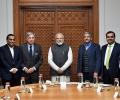
Further stimulus measures are expected in the upcoming Budget where the focus is likely to be on reforms, including some structural measures such as reducing red tape and boosting foreign direct investment. The meeting with industrialists is in the series of discussions that Modi has had during the last couple of weeks to seek suggestions to revive growth.

Financial inclusion has two parameters- access and use of banking services.
Financial inclusion has two aspects- access and use of banking services.

The broader NSE Nifty too dived by 131.70 points, or 1.24 per cent, to close at 10,453.05.

The current episode highlights the structural vulnerabilities in the liquidity management practices of Indian NBFIs

Listening -- really listening -- to advisers in the government and outside would help. India has plenty of wise economists who have worked within the bureaucracy during previous crises, points out Rahul Jacob.

DHFL has been generating funds through various means and has exited from its subsidiary units to tide over the current financial crunch.

Gandhi was the executive director at the Reserve Bank of India before being promoted to deputy governor post.

Credit to priority sectors as well as small and medium industries will be discussed to find ways to accelerate economic growth.
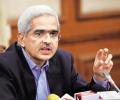
A staunch defender of demonetisation, it would be interesting to see how he handles the government's increasing demand for more cash from the RBI, and letting some weak banks get out of prompt corrective action.

Half a dozen stocks from the large-cap universe and over two dozen from the mid-cap universe have been replaced.
Is a short tenure (3 to 5 years) floating rate car loan a feasible option?
Moody's Investors Service on Friday slashed its estimate of India's GDP growth during the 2020 calendar year to 2.5 per cent from an earlier estimate of 5.3 per cent, on account of the rising economic cost of the coronavirus pandemic.

'Banks, fund managers, NBFCs, rating agencies, those buying into debt funds -- all of them will have to watch their step as India's financial system enters a new phase,' warns T N Ninan.

MUDRA bank will help microfinancing firms to lend more.

The panel suggests the government be authorised to raise the thresholds, which trigger applicability of Corporate Social Responsibility provisions.
Applicants have also in the past expressed fear about higher capital requirements, stringent priority sector lending norms and rules on promoter shareholding as key deterrents.
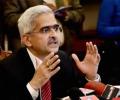
The overarching talking point will be the reluctance on the part of private banks to loosen their purse strings and increase lending substantially, even as the central bank believes there is adequate liquidity within the system.

For 2020 calendar year, it reduced the estimate by a similar measure to 6.7 per cent.

The demand environment is expected to improve over the next three quarters, aided by a recovery in demand from the construction sector, following release of payments to contractors after elections.

Due to tax associations with the fiscal-ending, April is a month of SIP renewal. So, the April numbers will be important and may perhaps, mark a change in retail attitude.
Equity investors should thank cash-rich biggies such as TCS, ITC, HUL, Nestl, and Bajaj Auto for this.

The broader NSE Nifty too fell over 150 points to crack below the 10,400-mark as financials, IT and energy stocks declined.

Most borrowers of loans against property pin hopes on future cash flows from their business, but in case of failure to repay the loan, the lender can repossess the property and sell it.
Now, non-banking finance companies can give a loan up to 75 per cent of the gold value; the previous limit was 60 per cent.

With auditing under the scanner and two of the Big Four firms stopping non-audit services for audit clients, auditors will now be subjected to a more stringent standard of reporting.

According to ICRA, even in a high-growth scenario, wherein the second half of FY20 sees the incremental bank credit rise to Rs 6.5-7 trn, there will still be a 40-45% year-on-year decline.

The government would be ironing out issues related to the controversial 'bail-in' clause in the earlier Bill, explore hiking the deposit insurance cover of customers, and decide whether the resolution framework should apply to public sector banks.

The move by the central bank follows concerns over tight liquidity conditions and banks' unwillingness to lend to NBFCs.

'In the short-term, the markets may be affected' by the review but 'it will help address what they are worried about which is why we need transparency,' says former chief economic advisor.

As a result of this moratorium, individuals' EMI payments of loans taken will not be deducted from their bank accounts, providing much needed liquidity to borrowers whose income has been disrupted due to the lockdown till May 31.

At a pre-Budget meeting, the FM was asked to ensure that NBFCs come out of the liquidity crisis they are facing with the help of RBI. They also spoke about the futility of trying to achieve a 3 per cent fiscal deficit target over the medium term.

Moody's on Monday slashed India's growth forecast for 2020 to 5.4 per cent from 6.6 per cent projected earlier, on slower than expected economic recovery. In its update on Global Macro Outlook, Moody's Investors Service said India's economy has decelerated rapidly over the last 2 years and economic recovery is likely to be 'shallow'.
