
'The prohibition regime has been accompanied by concerns regarding the expansion of the illicit liquor trade, increased enforcement challenges and corruption, and the growing use of alternative intoxicants, including illicit drugs.'
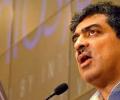
Infosys co-founder Nandan Nilekani predicts that large corporations in India will lose jobs due to automation and AI, while millions of small businesses will drive future employment growth. He advocates for deregulation, simplified business interfaces, and digital platforms to support small entrepreneurs and a gig economy workforce.

Computer-based testing can make the examination more secure and transparent. Ensuring equal opportunities to prepare will make it fair as well. India needs both, suggests Dibyasree Ganguly.

A research paper by the National Council of Applied Economic Research (NCAER) recommends that Bihar revoke its alcohol ban, citing its failure to reduce violence against women and a rise in illicit drug and alcohol consumption. The report suggests that reinstating the liquor excise tax would significantly increase state revenues and decrease enforcement costs.

The food delivery platform sector in India employed 1.37 million workers in the financial year 2023-24 (FY24) and is growing at a compound annual growth rate (CAGR) of 12.3 per cent, estimates a new report released by the Delhi-based think tank National Council of Applied Economic Research (NCAER).

'We can integrate AI and tech into education, but that is just a means and not an end.' 'Ultimately, we need to control what happens in a classroom and we need to let teachers innovate their teaching style to suit the needs of Gen Z and beyond.'

The Ministry of Statistics and Programme Implementation (MoSPI) has upgraded its official data portal to be directly readable by AI models, aiming to prevent reliance on non-credible sources. This initiative includes standardising 288 priority datasets and addressing semantic interoperability challenges to improve public service delivery.

'The West Asia or the Gulf crisis has shown that what we develop as national infrastructure when things are not as bad as they could be, we forget to plan for adversities.'

At nearly 82 per cent of GDP, India's public debt is very high, but the country doesn't face debt sustainability issue on account of high growth rate and higher share of local currency debt, NCAER Director General Poonam Gupta has said. Participating in an event organised by NCAER, Gupta said India's high debt levels are sustainable for now because of higher real or nominal GDP and as most of the debt is held in rupee.

This is the lowest that the BCI has ever fallen in the history of 113 rounds of the NCAER Business Expectations Survey.
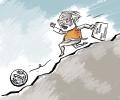
The Business Confidence Index (BCI) prepared by the Delhi-based think tank NCAER declined by 27.5 per cent in the first quarter of the current financial year over the previous quarter mainly on account of the second wave of the COVID-19 pandemic. The BCI on a quarter-on-quarter basis decreased by 35.3 per cent for the services sector, 32.9 per cent for the consumer durables sector, 32.3 per cent for the capital goods sector, 17 per cent for the intermediate goods sector and 14.3 per cent for the consumer non-durables sector, NCAER said in a release.

Nilekani is the president of NCAER's governing body, while Rohini Nilekani is the Founder-Chairperson of Arghyam, a foundation that supports initiatives around the country for safe and sustainable water and sanitation.

The Centre should privatise all public sector banks (PSBs), except the State Bank of India (SBI). This is because private banks have emerged as a credible alternative to PSBs with substantial market share. Also, government ownership hinders the ability of the Reserve Bank of India (RBI) to regulate the sector, according to a report by the National Council of Applied Economic Research (NCAER).

Simplifying GST rates, removing exemptions, easing disputes, and speeding up refunds can boost investment in India and offer the best reply to Trump's tariffs, observes V S Krishnan, former member, Central Board of Indirect Taxes and Customs.

For India, the challenge is to strike a balance between tactical necessity and economic priorities, point out Pravin Krishna and Monil Sharma.
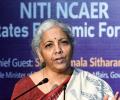
'Each state is unique, but when it comes to finance, the fundamentals cannot be different.'
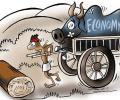
NCAER said the monetary policy measures are unlikely to revive growth at this juncture and suggested providing fiscal stimulus, which too can be challenging unless it can be financed through better revenue generation.

The economic think-tank in its earlier projection had suggested that the Indian economy was likely to grow at 5.7 per cent in 2014-15.

The Indian economy is expected to grow around 10 per cent during the current financial year on the likelihood of fewer COVID-19-linked supply disruptions and buoyancy in the global economy, said Poonam Gupta, director general of economic think-tank NCAER. The real challenge, however, would be to sustain a growth rate of 7-8 per cent in years to come, she said. "We could see annual growth in the ballpark range of about 10 per cent. "The reasons for this perceived optimism are: fewer supply disruptions; increased pent-up demand in the traditional and contact-intensive services; and a buoyant global economy.
The National Council of Applied Economic Research (NCAER) on Thursday lowered the GDP projection for the current fiscal to 4.7-4.9 per cent due to exchange rate depreciation.
Leading economic think-tank NCAER has advocated slew of policy reforms, including a felxible labour regime, to boost exports from the country.
The Business Confidence Index formulated by NCAER stood at a seven-year low of 91.4 points in January 2009, plummeting 41 per cent compared to a year ago period. On a quarterly basis, the index lost 24 per cent compared to October 2008. 'This (BCI) is the lowest since January 2002,' the NCAER said in its quarterly review of the business expectations survey. It said the slowdown in the markets appears to be a leading factor in influencing the fall in business expectations.
NCAER has pegged the growth rate between 4.9 and 5.2 per cent, led by healthy projections in the industrial output and services sector.
Economic think tank NCAER fears that the Planning Commission's ambitious nine per cent growth target for the 11th plan may not be achievable.
With all-round upturn in economic cycle except in agriculture, Economic think tank NCAER has forecast India's GDP growth rate at 6.5 to 6.7 per cent for this fiscal.

FY14 economic growth rate pegged at 4.8-5.3%, WPI inflation set to rise
India's Current Account Deficit rose to a record 6.7 per cent in the quarter ended December of 2012-13.
Projecting a much better forecast than those made by the government and Reserve Bank of India, economic think tank NCAER on Tuesday said the Indian economy could grow by up to 8.9 per cent during 2008-09, despite a global slowdown.
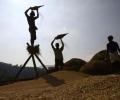
The agriculture sector has witnessed feeble growth on account of drought for two successive years
Surging oil prices, deficient monsoon and the Tsunami disaster last year notwithstanding, business confidence has inched its way up to its highest level since December 1995, economic think tank NCAER said on Monday.
Leading think-tank National Council for Applied Economic Research has underlined the need for encouraging manufacturing sector to generate more jobs especially for the unskilled workforce.
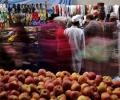
Recent estimates show that foodgrain production in 2016-17 has touched a new record of 273.4 million tonnes or 8.7 per cent higher as compared to last year.
The NCEAR has indicated some improvement in the fourth quarter of the current financial year.
Economic think-tank NCAER on Thursday projected a comfortable 6.6-6.7 per cent economic growth this fiscal but said revenue deficit seems a "bit out of control" and concern on inflation remains.

The survey took the poverty line at Rs 356 per person per month in rural areas and at Rs 538 in urban areas for 2004-05.
Economic think-tank National Council for Applied Economic Research on Tuesday revised upwards the GDP growth forecast to 7.98 per cent in 2003-04 from its earlier projection of 7 per cent.

Think tank NCAER on Friday said the country's growth rate is likely to be 5.9 per cent, a tad lower than its previous forecast due to slowdown in key manufacturing and services sectors.
The National Council of Applied Economic Research has revised its forecast for the country's gross domestic product growth for 2006-07 to 8.44 per cent
Economic think-tank NCAER has revised its projections for economic growth to 7.9 per cent for 2006-07, compared to 7.7 per cent made in April due to likely higher growth in industry and services sectors.
NCAER on Wednesday forecast a higher 8.13 per cent growth for 2003-04, but warned that fiscal deficit would shoot up to 6.1 per cent of GDP due to increased government expenditure and surging inflation.
