
New business premium of life insurance companies grew 18 per cent year-on-year (Y-o-Y) to Rs 35,417 crore in February, driven by robust growth at the state-owned Life Insurance Corporation of India (LIC) due to a favourable base.
The life insurance industry recorded nearly 40 per cent year-on-year (Y-o-Y) growth in new business premiums (NBP), aided by the rationalisation of goods and services tax (GST) on individual life insurance premiums, which has made policies more affordable for consumers.

Both the life and non-life insurance segment posted over 20 per cent premium growth in November for the first time in this financial year (FY26), supported by the reduction in goods and services tax (GST) on premiums from 18 per cent to zero and a favourable base effect.

Recent years have been turbulent for the insurance industry due to direct and indirect tax reforms, regulatory overhaul and other external pressures. The events cumulatively slowed growth rate to single digits from the high teens seen earlier.
Life Insurance Corporation of India (LIC) reported encouraging results for the April-June quarter (Q1) of FY26. The net premium income of India's largest life insurer was Rs 1.2 trillion, up 5 per cent year-on-year (Y-o-Y), in Q1. Renewal premium grew 6 per cent Y-o-Y to Rs 59,900 crore, while first-year and single premium grew 1 per cent and 4 per cent Y-o-Y respectively to Rs 7,500 crore and Rs 51,900 crore.
Life Insurance Corporation of India's (LIC) annualised premium equivalent (APE) growth remained weak in the fourth quarter of the financial year 2024-25 (Q4FY25) and flat in FY25, but management expects growth to rebound in FY26. The focus remains on improving product mix by increasing share of non-participating or non-par products in the individual APE.
The new business premium (NBP) of life insurance companies dropped 21.7 per cent year-on-year (Y-o-Y) to Rs 30,218.71 crore in December 2024 on the back of a steep fall in business. According to data published by the Life Insurance Council, LIC's premium dropped 41.15 per cent Y-o-Y to Rs 13,523.87 crore while private insurers reported 7 per cent growth in NBP to Rs 16,694.85 crore as the industry absorbs the impact of the revised surrender value norms.

Life insurance companies reported a 13.16 per cent year-on-year (Y-o-Y) growth in new business premium (NBP), totting up Rs 30,347 crore in October, even as the number of policies sold saw a sharp decline. The growth was largely driven by strong performance from private sector life insurers.

'Our new business premium is around Rs 700 crore, which we want to take to Rs 2,000 crore.'
The data for individual weighted received premium (WRP) showed divergent trends for life insurers in December 2024. Overall, the industry's individual WRP grew 4.8 per cent year-on-year (Y-o-Y); LIC's individual WRP declined 13 per cent while private players saw 11.4 per cent growth.

Gold buying by central banks surged to 60 tonnes in October, mainly led by the Reserve Bank of India (RBI) which added 27 tonnes of the precious metal to its reserves, the World Gold Council (WGC) said on Thursday. India added 27 tonnes of gold in October, bringing its total gold purchases to 77 tonnes from January to October, according WGC data based on reported monthly data from the International Monetary Fund (IMF).
Insurance companies reported nearly 23 per cent growth in first year premium in the first quarter of financial year 2024-25, when compared to the same period last year, with market leader LIC leading the charge with 28 per cent growth. According to the data released by the Life Insurance Council, the new business premium (NBP) increased by 22.91 per cent year-on-year (Y-o-Y) to ~89,726.7 crore in Q1FY25 from ~73,004.87 crore in Q1 FY24, reflecting a robust demand for insurance policies in the country.
Contrary to expectations, the new business premium (NBP) of life insurance companies dropped 12.62 per cent year-on-year (YoY) in March 2023 due to an over 30 per cent drop in Life Insurance Corporation (LIC) of India's premiums, albeit on a high base. Data released by the Life Insurance Council shows the industry racked up NBP of Rs 52,081 crore in March 2023, compared with Rs 59,608.83 crore in the year-ago period. NBP is the premium acquired from new policies in a year. It is the sum of the first-year premium and single premium, reflecting the total premium received from new businesses.
The share of Life Insurance Corporation of India (LIC) in monthly new business premium (NBP) in the life insurance sector declined to 58.50 per cent in September 2023 from 68.25 per cent in September 2022 -- a drop of 975 basis points -- owing to shortcomings in the product and distribution side of business. However, the market share saw a marginal uptick from the 57.37 per cent recorded in August this year. According to the monthly business data released for September 2023 by the Life Insurance Council, the NBP of LIC up to September 2023 stood at Rs 92,462.62 crore as compared to about Rs 1.25 trillion in the same period a year ago.
New business premium (NBP) growth of life insurers in March is expected to be weak owing to the high base effect in the year-ago period due to revision in taxation norms for high-value policies, insurers said. In the Budget, Finance Minister Nirmala Sitharaman proposed that insurance policies (excluding unit-linked insurance plans or Ulips) with an aggregate premium exceeding Rs 5 lakh would be taxed. This rule came into effect on April 1, 2023. In March 2023, the NBP of life insurance companies witnessed a strong growth after the tax announcement. Premiums rose by 14.45 per cent year-on-year (Y-o-Y) to Rs 59,608.83 crore in March 2023 from Rs 52,081.12 crore.
SBI Life Insurance reported a weak performance in Q2FY25. The annual premium equivalent or APE grew 3 per cent year-on-year (Y-o-Y) to Rs 5,390 crore. For the first half of financial year 2025 (H1FY25), it grew 9 per cent Y-o-Y to Rs 9,030 crore.
Life insurers' new business premium (NBP) reported stellar performance in November after a poor showing in October, on the back of strong growth in group single premiums for both private insurers and Life Insurance Corporation (LIC) of India. In November, 24 life insurers, including LIC, reported NBP to the tune of Rs 27,177 crore, up 42 per cent year-on-year (YoY) from the year-ago period. Private insurers' NBP rose 58.63 per cent YoY to Rs 11,209.75 crore as group single premiums more than doubled during this period.
Life insurance companies reported a 17 per cent year-on-year (YoY) drop in new business premium (NBP) in February as state-owned Life Insurance Corporation of India's premiums contracted 32 per cent during this period on account of a drop in its group single premium segment. According to data released by the Life Insurance Council, the industry earned an NBP of Rs 22,847.65 crore in February - a drop of 17 per cent from the same period a year ago.
The ICICI Prudential Life Insurance Company's net premium income in the third quarter (October - December) of the current financial year (Q3FY24) swelled by 4.9 per cent year-on-year (Y-o-Y) to touch Rs 9,929 crore. Income from investment rose 111.3 per cent Y-o-Y to touch Rs 16,315 crore. The Annual premium equivalent (APE), and new business premium (NBP) increased by 4.8 per cent Y-o-Y. Both declined 7.5 per cent and 5.6 per cent respectively, quarter-on-quarter (Q-o-Q).
With the lockdown being eased gradually, providing more and more digital solutions, for service delivery and procurement of new policies, is what the corporation is focussing on.
'At the policy's maturity, the total premium is refunded.'

Prices of natural gas, which is used to generate electricity, make fertiliser and is converted into CNG to run automobiles, were on Friday hiked by a steep 40 per cent to record levels, in step with global firming up of energy rates. The rate paid for gas produced from old fields, which make up for about two-thirds of all gas produced in the country, was hiked to $8.57 per million British thermal units from the current $6.1, according to an order from the oil ministry's Petroleum Planning and Analysis Cell (PPAC). Simultaneously, the price of gas from difficult and newer fields like the ones in Reliance Industries Ltd and its partner bp plc operated deepsea D6 block in KG basin, was hiked to $12.6 per mmBtu from $9.92, the order said.

Prices of natural gas, which is used to generate electricity, make fertiliser and is converted into CNG to run automobiles, is likely to rise to record levels at the rate review scheduled this week, sources said. The government-dictated price for natural gas produced in the country is to be revised on October 1. After factoring in the spike in energy prices witnessed in recent months, the rate paid for gas produced from old fields such as of state-owned Oil and Natural Gas Corporation (ONGC) is likely to rise to $9 per million British thermal units from current $6.1.

The government on Thursday more than doubled the price of natural gas that is used to produce electricity, make fertilisers, turned into CNG and piped to household kitchens for cooking, on the back of a spike in global energy prices. The price of gas produced from old regulated fields, such as the nation's largest gas field of Bassein of ONGC, will rise to a record high of $6.10 per million British thermal unit (mmBtu) from the current $2.90 per mmBtu, according to the oil ministry's Petroleum Planning and Analysis Cell (PPAC). The new price, which is likely to result in a hike in CNG and piped cooking gas rates, will be for six months beginning April 1.

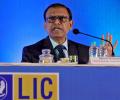
Thomas Mathew T, managing director, tells Manojit Saha and M Saraswathy about the LIC's strategy and growth plans.

A company official said work stopped temporarily only at two rigs and the remaining 34 in the offshore were operational. He added there was no impact on the company's production.

Investment in market leaders with a safety-first approach could yield reasonable returns across sectors.
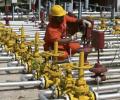
The government recently announced a new formula for determining the price of natural gas, lowering it from $8.4 suggested by the C Rangarajan committee.
