
Maruti Suzuki India is strategically investing in the premium hatchback segment, launching a refreshed Baleno with advanced driver assistance systems (ADAS) to capture a significant share of the evolving Indian passenger vehicle market, even as SUVs continue their dominance.

The updated Maruti Suzuki Baleno redefines the premium hatchback segment in India with its aggressive new look, advanced Level 2 ADAS features, and a more fuel-efficient Z series petrol engine, catering to the evolving demands of tech-savvy car buyers.

Maruti Suzuki India announced a price hike of up to Rs 20,000 on select models, effective from September 2026, marking its third increase since May, citing continuous increases in input costs and inflationary pressures.

A cyberattack on an automaker can spread through its wider supply chain and create significant financial losses.

Maruti Suzuki India has significantly increased its capital expenditure (capex) outlay to Rs 77,500 crore for the five-year period ending FY31, aiming to boost capacity, develop new models, and enhance R&D, as announced by MD and CEO Hisashi Takeuchi.
The refreshed Brezza will target first-time, replacement and additional-car buyers as Maruti responds to changing preferences and intensifying competition in compact SUVs.

India's sedan market is experiencing a notable divergence: affordable entry-level sedans are gaining market share, while midsize sedans are seeing a significant decline as buyers increasingly opt for SUVs in higher price brackets.

New players like Maruti Suzuki, VinFast, and Tesla are significantly expanding India's electric passenger vehicle (e-PV) market, capturing an 8.1 per cent share and contributing 18 per cent of incremental registrations in the first half of 2026, according to Fada Research data.

The 200-DMA is a closely watched indicator of a stock's long-term trend and can serve as an early warning of trouble.

While the new Brezza keeps its tried and tested 1.5 litre NA engine, there is now an additional 1.0l turbo petrol unit with a 6-speed manual gearbox to tempt younger buyers, points out Somnath Chatterjee.

Domestic passenger vehicle dispatches in India are estimated to have grown by approximately 21 per cent to 4.60 lakh units in September, with major carmakers like Maruti Suzuki, Tata Motors, M&M, and Hyundai all reporting double-digit growth, driven by increased supplies for the upcoming peak festival season and healthy demand.

More than 40 per cent of Cars24's sales are now linked to rural registration and transport office (RTO) locations, although procurement remains concentrated in urban markets.

Indian benchmark indices, Sensex and Nifty, recovered early losses on Wednesday, driven by strong buying in IT stocks and HDFC Bank, sustaining the previous session's recovery despite FII outflows. Track Sensex, Nifty on October 14.

Indian benchmark indices Sensex and Nifty saw an early rebound, driven by strong performances from blue-chip HDFC Bank and major IT firms like HCL Tech, which reported a significant rise in net profit. Track Sensex, Nifty on October 13.

Pune Police have arrested three men from Haryana in connection with nine theft cases, recovering valuables worth Rs 23 lakh. The accused allegedly targeted crowded places during Ganeshotsav. The investigation involved police travelling 4,600 km across multiple states.
Maruti Suzuki India will increase the prices of its vehicles by up to Rs 30,000 across all models from August 2026, citing a sustained increase in input costs.

September marked India's highest-ever monthly EV retail volume. More than one in nine two-wheelers retailed in September was electric.

'I am now driving an electric vehicle. I have lost faith in petrol-run cars.'

Indian benchmark indices, Sensex and Nifty, recorded their fourth consecutive day of losses, driven by relentless foreign institutional investor (FII) outflows, rising bond yields, and a significant surge in crude oil prices, impacting overall investor sentiment.

As India's festive season approaches, passenger vehicle dealers are seeing a notable increase in inventories, yet discounts remain surprisingly moderate compared to previous years, signalling a tighter demand-supply balance in the automotive market.
Indian stock markets witnessed a significant rebound, with the Sensex rallying 1,109 points and the Nifty closing above 22,720, driven by strong performances in IT and financial sectors, a recovering rupee, and Finance Minister Nirmala Sitharaman's comments on long-term capital gains (LTCG) tax.

Indian benchmark indices Sensex and Nifty experienced declines in early trade, ending a two-day rally, driven by a spike in Brent crude oil prices above USD 101 per barrel and investor caution ahead of the Reserve Bank of India's monetary policy decision. Track Sensex, Nifty on October 7.
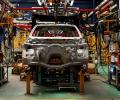
Passenger vehicle dispatches in the domestic Indian market are estimated to have surged by 33 per cent to approximately 4.7 lakh units in July, with market leaders Maruti Suzuki and Hyundai reporting record sales, alongside significant growth from Tata Motors and Mahindra & Mahindra.
Maruti Suzuki India (MSIL) reported a 9.1 per cent year-on-year decline in net profit for the April-June quarter of 2026-27, marking its second consecutive quarterly fall. This dip occurred despite a significant 29.3 per cent jump in sales volume, primarily due to escalating commodity prices, increased energy costs, and logistics disruptions stemming from the West Asia conflict.
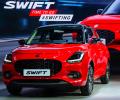
Maruti Suzuki India (MSIL) reported a mixed Q1 FY27, with record quarterly sales driving strong revenue growth, but operating performance was below expectations due to higher commodity and other costs impacting margins. Brokerages anticipate sustained sales growth for the company in the current fiscal year, supported by new launches, robust demand, and significant capacity expansion.
Maruti Suzuki India's CFO, Arnab Roy, has urged the central government to introduce an amnesty scheme or an 'as-is' settlement option to resolve past indirect tax disputes, aiming to clear legacy litigation and foster growth in the automotive industry. Roy emphasised the need for a 'smarter way to address the past' to provide long-term certainty for businesses.

Korean auto major Hyundai plans to invest an additional Rs 4,000 crore in Maharashtra by 2030, aiming to nearly double capacity at its new Pune manufacturing plant to 320,000 units per annum in a phased manner, a top company executive said.

Nitesh Siwach has secured India's first silver medal in Greco-Roman wrestling at the Asian Games since 1962, despite missing out on gold in the men's 97kg final against Japan's Yuri Nakazato.

Maruti Suzuki, India's leading passenger vehicle manufacturer, is experiencing robust growth in the June quarter, driven by a recovery in the entry-level segment, easing supply constraints, and significant market share gains. Despite potential headwinds from El Nio, analysts remain optimistic about the company's future performance.

India's Ministry of Power has notified the third phase of Corporate Average Fuel Economy (CAFE-III) norms for passenger vehicles, effective from April 1, 2027, which set relatively softer efficiency targets for lighter cars and demand greater improvements from heavier vehicles, a move expected to benefit manufacturers like Maruti Suzuki India.
Indian benchmark indices, Sensex and Nifty, experienced a decline in early trade due to relentless foreign institutional investor (FII) outflows, although a drop in crude oil prices below USD 100 per barrel provided some cushioning. Track Sensex, Nifty on October 1.

The Indian stock market experienced a significant downturn, with the Sensex crashing over 1,000 points and the Nifty hitting a fresh 52-week low, driven by sustained selling from foreign institutional investors, the RBI's monetary policy tightening, and elevated Brent crude prices.

The Tata Aeris iCNG, evolving from the Tigor, offers a modernized exterior and a feature-rich interior. It boasts innovative twin-cylinder CNG technology for maximum boot space, premium comfort features like ventilated seats and a 360-degree camera, and a smooth driving performance. Priced competitively, it aims to challenge rivals in the segment while offering enhanced practicality.

Suzuki Motor Corporation is set to revolutionise its operations by halving vehicle development times and significantly boosting efficiency by 2030, while committing to a diverse multi-powertrain strategy that includes BEVs, hybrids, and carbon-neutral fuels.

India-EU FTA opens a bigger European market for Indian carmakers while giving European brands greater access to India.

A year after GST rates were rationalised, retail growth in automobiles has sustained beyond the initial festival surge, led by two-wheelers and passenger vehicles (PVs), with the Fada data showing rural markets emerging as a key driver of the post-GST demand recovery.

The scheme, called 'Suhana Safar', targeted customers who aspire to own a car but were hesitant because of concerns around arranging the down payment or managing future EMI obligations.

India's passenger vehicle sales are estimated to have surged by approximately 35 per cent to about 4.5 lakh units in August, driven by strong performances from major automakers like Maruti Suzuki India, Tata Motors Passenger Vehicles, and Mahindra & Mahindra, with the industry entering the festive season with optimism.
Nitesh Siwach secured India's first Greco-Roman wrestling silver medal at the Asian Games since 1962, though he missed out on gold after being defeated by Japan's Yuri Nakazato in the 97kg final. Meanwhile, Mansi Ahlawat lost her bronze medal play-off in the women's 62kg event, and other Indian wrestlers were eliminated in the quarterfinals.

Shimla Police have seized assets worth Rs 4.13 crore from 19 drug traffickers and their associates, believed to be acquired through illegal drug trade. The action followed an arrest in August 2026, leading to a detailed financial investigation under the NDPS Act. This seizure is part of a larger effort in 2026, where assets worth Rs 12.52 crore have been confiscated in 15 NDPS cases.
