
'We never waste a crisis. There will be learning and the supervisory tools will get better with each episode.'

Shaktikanta Das will demit the office on Tuesday after completing six years as the 25th Governor of the Reserve Bank of India. Revenue Secretary Sanjay Malhotra will replace him as the 26th Governor. He was appointed as the Governor on December 12, 2018, after the abrupt exit of Urjit Patel.

High frequency indicators, like vehicles sales, air traffic, steel consumption and GST E-way bills, point towards a sequential pickup in momentum of economic activity during the second half of the fiscal 2024-25 and sustain moving forward, RBI Bulletin said on Wednesday. However, a strong dollar, driven by US economic resilience and trade policy pivots, could exacerbate capital outflows from emerging economies, push risk premiums higher, and intensify external vulnerabilities, said an article on 'State of the Economy' published in RBI's February bulletin.

The Reserve Bank should focus on making liquidity easier rather than cutting rates if the intent is to drive growth, Axis Bank's chief economist Neelkanth Mishra said on Tuesday. Mishra, who is also a part-time member of the Economic Advisory Council to the PM, said the rate cut announced earlier this month or even the subsequent ones if they were to come will not end up increasing borrowings as the scarce liquidity will hamper transmission.

Markets regulator Sebi has notified a stricter regulatory framework for small and medium enterprise (SME) IPOs by introducing a profitability requirement and capping a 20 per cent limit on offer-for-sale (OFS). The reforms aim to provide SMEs with a sound track record an opportunity to raise funds from the public while protecting investor interests. This move follows a rise in SME issues, which has driven significant investor participation.
As the MPC is mandated to target CPI inflation rate at 4 plus minus 2 per cent, any measurement error in CPI is likely to have grave consequences for monetary policy.

The US Fed rate cut of 50 basis points is unlikely to have any significant impact on foreign inflows into India, Economic Affairs Secretary Ajay Seth said on Thursday. He said the US Federal Reserve has done what it assesses is good for the largest economy in the world, but the RBI will take a decision on interest rate cut keeping the Indian economy in mind. "It is a positive for the global economy, including the Indian economy. "It is a 50 basis points cut from a high level.

Sanjay Malhotra takes charge as the 26th RBI governor at a time when headline retail inflation has shot up to 6.2%.

RBI's interest rate decision, quarterly earnings and global cues would be the major driving factors for equity markets this week, analysts said adding that the impact of the Union Budget could linger on this week. Trading activity of foreign investors will also be a key driver for the markets, experts noted. "US and India's manufacturing PMI for January to be released on Monday, will be the key macro data to watch out for.

The Reserve Bank of India's (RBI's) job to bring down inflation is not over, and any premature move on the policy front could undermine the success achieved so far on the price situation, according to RBI Governor Shaktikanta Das. RBI's rate setting panel, Monetary Policy Committee (MPC), had met for three days from February 6-8. The panel decided to leave the key policy rate unchanged at 6.5 per cent for the sixth time in row.

Continuing the downward trend, retail inflation fell to a five-month low of 4.31 per cent in January, mainly due to a decline in the prices of vegetables, eggs, and pulses. The Consumer Price Index-based retail inflation was 5.22 per cent in December and 5.1 per cent in January 2024. The previous low inflation was in August 2024 at 3.65 per cent.

State Bank of India, Adani Ports, Tata Consultancy Services, ICICI Bank, Reliance Industries and PowerGrid were also among the laggards.
With concern on food inflation ebbing with the monsoon progressing well, the Reserve Bank of India (RBI) is warming up to the idea of a change in stance to "neutral" from "withdrawal of accommodation", according to economists. In his speech on Thursday during the annual event of the Federation of Indian Chambers of Commerce and Industry-Indian Banks' Association, RBI Governor Shaktikanta Das said: "The balance between inflation and growth is well-poised."
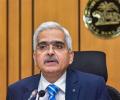
The Reserve Bank of India on Thursday decided to keep policy rate unchanged for the sixth time in a row as it maintains a tight vigil on inflation. The rate increase cycle was paused in April last year after six consecutive rate hikes aggregating to 250 basis points since May 2022.

The Reserve Bank of India on Friday decided to keep the policy rate unchanged at 6.5 per cent for the fifth time in a row as it maintains a tight vigil on inflation. The rate increase cycle was paused in April after six consecutive rate hikes, aggregating to 250 basis points since May 2022. Announcing the bi-monthly monetary policy, RBI Governor Shaktikanta Das said the Monetary Policy Committee (MPC) unanimously decided to keep the repo rate unchanged at 6.5 per cent.

From the 30 Sensex firms, Bajaj Finance, Reliance Industries, Tata Steel, JSW Steel, Tech Mahindra, Tata Motors, Kotak Mahindra Bank and Maruti were the biggest laggards. Reliance Industries Ltd, India's most valuable company, on Monday reported a 5 per cent fall in the July-September quarter net profit as weak oil refining and petrochemical business hurt operational performance. ICICI Bank, Bharti Airtel, Asian Paints, Adani Ports, UltraTech Cement and HCL Technologies were among the gainers.

The Monetary Policy Committee (MPC) is expected to maintain the status quo on policy rates for the fourth consecutive time in its October 4-6 review meeting. The incremental information available since its last meeting in August suggests that growth and inflation prints for the second quarter (Q2) of financial year 2023-24 (FY24) will exceed the committee's projections. However, the Consumer Price Index (CPI)-based inflation is expected to moderate in the second half (H2) of FY24.

In a bid to ease compliance towards companies planning public offers (IPOs), the Securities and Exchange Board of India (Sebi) has notified norms that open more avenues to meet the minimum promoters' contribution (MPC). The market regulator has permitted promoter group entities and non-individual shareholders to contribute to the mandated promoters' contribution in the case of a shortfall without being identified as a promoter.

The Reserve Bank of India on Friday decided to keep the policy rate unchanged for fourth time in a row as it maintains a tight vigil on inflation. The rate increase cycle was paused in April after six consecutive rate hikes aggregating to 250 basis points since May 2022. Announcing the bi-monthly monetary policy on Friday, RBI Governor Shaktikanta Das said the Monetary Policy Committee (MPC) unanimously decided to keep the repo rate unchanged at 6.5 per cent.

In the Union Budget for Financial Year 2023-24 (FY24), Finance Minister Nirmala Sitharaman had held forth on the need for better governance and investor protection in the banking sector. She had proposed certain amendments to the Reserve Bank of India Act (RBI Act), 1934; the Banking Regulation Act (BR Act), 1949; and the Banking Companies (Acquisition and Transfer of Undertakings) Act, 1970.
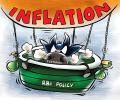
The Reserve Bank on Wednesday retained the retail inflation projection at 4.5 per cent for fiscal 2024-25, with Governor Shaktikanta Das stressing that the central bank will have to closely monitor the price situation and keep the "inflation horse" under tight leash lest it may bolt again. Unveiling the October bi-monthly monetary policy, the Governor also said the flexible inflation targeting (FIT) framework has completed 8 years since its introduction in 2016 and is a major structural reform of the 21st century in India.

The Reserve Bank of India's (RBI's) state of the economy report observed that any durable alignment of headline retail inflation with the target of 4 per cent could recommence in the second half of FY25 and sustain until numbers closer to the target are seen during the course of FY26, dashing hopes of any reduction in the policy repo rate in the current financial year. The report, authored by RBI staffers, including Deputy Governor in charge of monetary policy Michael Patra, said though headline numbers may fall in July and August due to base effect, it is likely to reverse in September.

India's manufacturing sector growth eased slightly in July, on softer increases in new orders and output, while cost pressures and demand strength led to the steepest increase in selling prices since October 2013, a monthly survey said on Thursday. The seasonally adjusted HSBC India Manufacturing Purchasing Managers' Index (PMI) moderated slightly from 58.3 in June to 58.1 in July.

The RBI under former governor Shaktikanta Das resisted pressures to cut interest rates through 2024 as it kept its 'Arjuna's eye' trained on inflation, but the central bank under a new detail-oriented head will soon have to take a call if it can continue sacrificing growth. Das, a career bureaucrat who in 2016 oversaw Prime Minister Narendra Modi's highly disruptive demonetisation move, left a lasting legacy as he demitted office towards the end of 2024 after expertly navigating monetary policy for six years, the highlight of which was steering India's recovery through the pandemic.

'Investors can consider staying invested in long duration products as there is a possibility of rate cuts in the near term.' Positive macros - lower inflation, high forex reserves and favourable demand-supply dynamics for government bonds - make a strong case for rate cuts from December, says Devang Shah, head of fixed income, Axis Mutual Fund. In an interview with Abhishek Kumar in Mumbai, Shah says this view may not hold true if commodity prices go up sharply.
The Reserve Bank of India's interest rate decision, macroeconomic data and global trends will drive investors' sentiment this week, with markets hoping to continue the positive momentum after ending FY24 on a buoyant note, analysts said. In addition, the trading activity of foreign investors, the rupee-dollar trend and the movement of global oil benchmark Brent crude would also influence trading in equity markets. The 30-share BSE Sensex climbed 14,659.83 points or 24.85 per cent in the 2023-24.
The Reserve Bank is likely to maintain status-quo on the key interest rates for the third time in a row in its upcoming bi-monthly policy review despite the US Federal Reserve and the European Central Bank hiking benchmark rates, as domestic inflation is within the RBI's comfort zone, say experts. The borrowing cost which started rising in May last year has stabilised with RBI keeping the repo rate unchanged at 6.5 per cent since February when it was raised from 6.25 per cent. In the previous two bi-monthly policy reviews in April and June the benchmark rate was retained.

The Reserve Bank on Friday retained inflation projection at 4.5 per cent for the current financial year, lower than 5.4 per cent in the last fiscal. Assuming a normal monsoon this year, CPI (consumer price index-based) inflation for the current year is projected at 4.5 per cent, with Q1 at 4.9 per cent, Q2 at 3.8 per cent, Q3 at 4.6 per cent, and Q4 at 4.5 per cent.

Among the Sensex firms, ITC, Kotak Mahindra Bank, ICICI Bank, Nestle, Axis Bank, IndusInd Bank, UltraTech Cement, Bajaj Finance, Maruti and HDFC Bank were the major laggards.
The RBI's Monetary Policy Committee brainstormed the impact of any future shocks on the inflation trajectory and stressed monitoring the cumulative effect of monetary policy actions over the past one year, which is still unfolding, revealed minutes of the rate-setting panel released on Thursday. The minutes of the meeting of the Monetary Policy Committee (MPC), headed by Reserve Bank Governor Shaktikanta Das, also indicated it would be premature to declare an end to the monetary tightening cycle, which started in May 2022 to check high inflation following the outbreak of the Russia-Ukraine war. The central bank, which effected six back-to-back hikes in the key short-term lending rate (repo) since May 2022 to check high inflation, decided to take a pause early this month.

The retail inflation eased to a four-month low of 4.87 per cent in October, mainly due to cooling prices of food items, government data showed on Monday. The Consumer Price Index (CPI) based retail inflation fell to a three-month low of 5.02 per cent in September. The previous low inflation was recorded at 4.87 per cent in June.
The Reserve Bank of India on Friday retained its projection for retail inflation at 4.5 per cent for the current fiscal assuming a normal monsoon, while emphasising that uncertainties related to food price outlook warrant a close monitoring. Consumer Price Index (CPI)-based retail inflation has been projected at 4.5 per cent with quarter-wise projections at 4.9 per cent in Q1 (April-June), 3.8 per cent in Q2, 4.6 per cent in Q3, and 4.5 per cent in Q4.
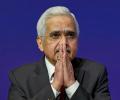
The highlights of RBI's bi-monthly monetary policy announced by Governor Shaktikanta Das:

'The real repo rate is very high in terms of core inflation.'

After raising interest rate by a cumulative 250 basis points in 11 months, the Reserve Bank of India (RBI) on Thursday unexpectedly kept benchmark rate unchanged as global banking woes added uncertainty to the economic outlook. Five out of six members of MPC voted to remain focused on the withdrawal of accommodation to ensure inflation aligns with target while focusing on growth, RBI Governor Shaktikanta Das said on Thursday. The Monetary Policy Committee of the central bank decided to take a pause after a rate hike seen in previous six consecutive policies.
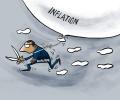
'If all goes well, we may well hit or even surpass the forecast growth rate.'

From the Sensex pack, Power Grid, Mahindra & Mahindra, JSW Steel, HCL Technologies, Sun Pharma, Nestle, IndusInd Bank, Reliance Industries, Bharti Airtel and ITC were the major laggards. Tech Mahindra, Wipro, Bajaj Finance, State Bank of India, Bajaj Finserv, Axis Bank, Titan and ICICI Bank were among the major gainers.

The services sector growth in India fell to a one-year low in November on softer expansions in new work intakes and output, despite receding price pressures, a monthly survey said on Tuesday. The seasonally adjusted S&P Global India Services Business Activity Index fell from 58.4 in October to a one-year low of 56.9 in November. Despite witnessing a month-on-month decline, the rate of expansion was stronger than its long-run average.

RBI's interest rate decision, macroeconomic data and global trends would dictate terms in the equity market in a holiday-shortened week, analysts said. Besides, the focus will also be on foreign portfolio investors' trading activity, they added. Equity markets will remain closed on Tuesday for 'Mahavir Jayanti' and on Friday on account of 'Good Friday'.

The Reserve Bank of India (RBI) will maintain the policy repo rate at 6.5 per cent during its upcoming June 8 announcement, considering the easing of retail inflation in April and the potential for further decline, indicating the effectiveness of previous policy rate actions, anticipate experts. Headed by Reserve Bank Governor Shaktikanta Das, a meeting of the six-member Monetary Policy Committee (MPC) is scheduled for June 6-8. The decision of the 43rd meeting of the MPC would be announced on Thursday, June 8.
