
India and Japan have signed a Memorandum of Arrangement on maritime security cooperation, committing to deepen defence ties and oppose unilateral actions that impede freedom of navigation in the Indo-Pacific, a move seen as directed at China's increasing military presence.

Japan is deepening its defence relationship with India while simultaneously expanding its economic, infrastructure and security engagement with countries around India -- particularly Bangladesh. The result is an emerging Japanese conception of South Asia in which India remains the strategic anchor, but the geography surrounding India is becoming increasingly important, points out Varun Arya.

Earlier in July, Ishiba had faced a major setback after a significant electoral defeat in the upper house of Japan's parliament as his coalition failed to attain a majority. This came after his party also failed to attain a majority in the lower house of the parliament last year.
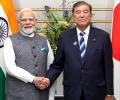
Prime Minister Shigeru Ishiba's sudden resignation after only a year in office has thrown Japan into political turmoil, raising doubts about how the country will handle economic and regional challenges, observes Dr Rajaram Panda.

DPS, R K Puram was the first engagement on Koizumi's two-day visit to India and he was pleasantly surprised by the strong Japanese influence on the school.
The issues of nuclear proliferation and resumption of development assistance to Islamabad will figure during talks between Japanese Prime Minister Junichiro Koizumi and Pakistan President Pervez Musharraf.
Koizumi, who arrived in Islamabad from New Delhi on a two-day visit, held two-hour-long one-to-one meeting with Musharraf during which a host of issues, including Pakistan's commitment to the India-Pak peace process, figured.
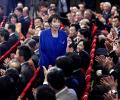
As a protege of Shinzo Abe, Takaichi is expected to scale bilateral ties much higher. Trade and investment shall grow. People-to-people contacts shall be scaled up, points out Dr Rajaram Panda.

Shigeru Ishiba is expected to prioritise strengthening Japan's military capabilities and fostering deeper international partnerships, particularly with India, with whom Japan shares significant strategic interests, explains Dr Rajaram Panda.

There is nothing to be worried about as bilateral ties are robust with solid foundations. Both are on the same page on the economic and defence/security ties bilaterally and globally and that shall continue irrespective of change in political dispensation in either country, points out Dr Rajaram Panda.

Prime Minister Narendra Damodardas Modi and other dignitaries from around the world attended the State funeral for Japan's former prime minister Abe Shinzo at the Budokan in Tokyo on Tuesday, September 27, 2022.
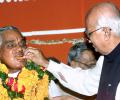
Chef par excellence Satish Arora recalls his days working as a chef to prime ministers to Chandrima Pal.

Koizumi will hold talks with Prime Minister Dr Manmohan Singh before going on to Pakistan.
India, which has kept its distance from the militaristic dimension given to the SCO by the recent Sino-Russian exercises, should equally avoid closer involvement in a quadrilateral combine which will harm its relations with China
The public apology is an attempt to stem the blazing row with China over a textbook which Beijing says glosses over Japan's wartime atrocities.
The issue of veto came up for discussion during the talks between Prime Minister Manmohan Singh and his Japanese counterpart Junichiro Koizumi, who is on a two-day visit to India, in New Delhi.
More than two decades after manufacturing its first vehicle in India, Maruti Udyog Ltd on Wednesday rolled out the five-millionth car from its assembly line in Gurgaon, a red 'WagonR'.
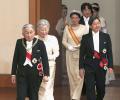
The emperor has no political power, yet he enjoys a unique place in Japanese society, notes Dr Rajaram Panda.

Japan has the capital and needs to pull out of China, which has been its major destination. India, on the other hand, desperately needs capital especially for infrastructure, argues Rajeev Srinivasan.
