
These were Zia's first comments on politics since the interim administration in emergency-ruled Bangladesh last week denied widely-speculated government plans to exile her and restrict her movement.
22 images that captures glimpses of a most unusual Indian who led the nation for 10 years.

Bangladesh's interim government on Wednesday said it is 'consulting all stakeholders' to decide the fate of President Mohammed Shahabuddin, as authorities beefed up security around his residence in the wake of protests demanding his removal over comments that raised questions on prime minister Sheikh Hasina's resignation.

A lawyer was killed on Tuesday during clashes between the security personnel and followers of a Hindu community leader, who was denied bail and sent to jail by a court in the port city of Chattogram in Bangladesh, police said.
Former Bangladeshi prime minister Khaleda Zia was booked for sedition over her alleged "slanderous comments" concerning martyrs of the 1971 liberation war against Pakistan.

A Bangladeshi court on Tuesday denied bail to prominent Hindu leader Chinmoy Krishna Das Brahmachari, arrested on alleged 'sedition' charges, and sent him to prison, amid protests by community members in the capital Dhaka and the port city of Chattogram.
In the same case, her son Tarique Rahman and four others have been sentenced to 10 years in jail.

Talking to reporters after placing a wreath at the grave of former president and BNP founder Zia-ur Rahman in the city, Fakhrul said India is seemingly not keeping its commitment towards democracy by providing shelter to her.

At least 30 suspects have been detained in Bangladesh's Chattogram city for their alleged involvement in the killing of a lawyer and attacking security personnel following the arrest of a prominent Hindu community leader. The violence erupted after Chinmoy Krishna Das Brahmachari, spokesperson for Bangladesh Sammilita Sanatani Jagran Jote, was denied bail and sent to jail in a sedition case. The lawyer, Assistant public prosecutor Saiful Islam, was killed during clashes between security personnel and Das' followers. The interim government has condemned the violence, urging people to remain calm and has ordered an investigation into the killing and appropriate legal measures.

'Bangladesh has become unstable and this instability will impact India.'
A murder case has been filed against Bangladesh's ousted prime minister Sheikh Hasina and six others over the death of a grocery shop owner during last month's violent clashes that led to the fall of her government, media reports said on Tuesday.

'My father died in the liberation struggle. Bangladesh is our Motherland. This is home,' says Monindra Kumar Nath, a Hindu who has lived his 74 years in Dhaka.
"I'm taking all responsibility (of the country). Please cooperate," he said in a televised address amid reports that Hasina has left the country.

'In the interim, India will be confronted with anti-India feeling because Sheikh Hasina had India's support.' 'We will have to deal with it, but it will not be a permanent phenomenon.' 'There is substantial goodwill towards India which will stand us in good stead.'
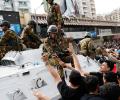
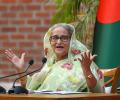
Bangladesh descended into chaos on Monday as Prime Minister Sheikh Hasina surreptitiously resigned and fled the country in a military aircraft while the Army stepped in to fill the power vacuum.

Videos on social media showed protesters climbing a statue of Hasina's father Sheikh Mujibur Rahman, a 1971 Liberation War hero, in Dhaka and smashing it with hammers.

The application accuses Hasina and others of orchestrating a violent crackdown on student protestors, resulting in widespread casualties and human rights violations.

New Delhi -- which has had a disastrous neighbourhood policy that has alienated almost all the States with which it has a land or sea border -- seemed to be unwilling over the past years to even consider that its unquestioning support of Sheikh Hasina was painting it into a corner, points out Mihir S Sharma.

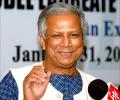
Nobel laureate Prof Mohammad Yunus, the designated head of Bangladesh's interim government, on Wednesday fervently appealed everybody 'to stay calm' and 'refrain from all kinds of violence' as the country witnessed a major reshuffle in the security establishment after the ouster of the Sheikh Hasina government.
The other members of the interim government will be finalised after consultations with various political parties, the press secretary added.

Alamgir said that even after the fall of the Hasina government following a people's uprising, the 'Indian establishment is yet to reach out to BNP, even though China, the US, the UK, and Pakistan have already done so.'
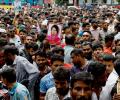
As news of Hasina's departure spread, hundreds broke into Hasina's residence, vandalising and looting the interiors, providing dramatic expression to the anti-government protests that have killed more than 100 people in the last two days. At the centre of people anger is the Hasina government's controversial quota system reserving 30 per cent jobs for families of veterans who fought the 1971 liberation war. With volatile crowds taking to the streets -- some clambering on Hasina's father and Bangladesh founder Sheikh Mujibur Rahman's statue and smashing it with hammers in a lasting image underscoring the fickleness of history -- Army chief General Waqar-uz-Zaman announced that the 76-year-old prime minister has resigned.
'We should be mindful that the religious minority community in one country is the majority in another (and) so treatment of the minority community in our respective countries will be an important variable in our relationship'

'The dominance of her party also meant that the institutions became lopsided -- whether it was the bureaucracy or the courts or the military.' 'She centralised power to the extent that you would see her representatives or her party office bearers having overly represented in these institutions.' 'That perhaps would have been the biggest blunder that she committed.'

The clashes broke out this morning when protesters attending a non-cooperation programme to demand the government's resignation faced opposition from the supporters of the Awami League, Chhatra League, and Jubo League activists.

'Religion and extremism is going to be a big force, a very important force, in Bangladesh's politics.'
'At this moment you cannot give her asylum because if you do, then you are directing public anger against India.'

Sheikh Hasina was on Thursday sworn in as the prime minister of Bangladesh for the fifth term, days after her Awami League won an overwhelming majority in the general elections boycotted by the main opposition Bangladesh Nationalist Party (BNP) and its allies.
'Are we supposed to look the other way as Islamists go on a rampage against Hindus and the Hasina government pay lip service to secularism?' A revealing excerpt from Avishek Biswas and Deep Halder's book, Being Hindu In Bangladesh: The Untold Story.

Bangladeshis on Sunday began voting in the general elections expected to be won by Prime Minister Sheikh Hasina in the absence of the main Opposition Bangladesh Nationalist Party (BNP) which is boycotting it.

Bangladesh Prime Minister Sheikh Hasina on Sunday secured a record fourth straight term as her Awami League party won two-thirds of the seats in the general elections marred by sporadic violence and a boycott by the main opposition BNP and its allies.

The main Opposition BNP of former premier Khaleda Zia, 78, who is under house arrest, is boycotting the elections amidst violence.
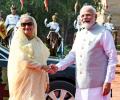
This is possibly the first time Hasina's daughter will be by her mother's side during an official visit to close neighbour and ally India, and analysts believe this to be significant in many ways.
One man follows Guru Nanak's visits to multi-faith sites across nine countries.
A senior Bangladesh lawmaker has pointed a finger at former premier Begum Khaleda Zia, claiming that she played a role in a failed coup to overthrow Sheikh Hasina's government with the help of retired and serving army officials.
A court in Dhaka on Wednesday ordered the arrest of former Bangladesh prime minister Khaleda Zia, scrapping her existing bail in connection with two graft cases after she did not appear for the hearing citing "security reasons".
Bangladesh Prime Minister Sheikh Hasina has alleged that there were attempts on her life by mixing poison with her food when she was under detention in a sub-jail during the state of emergency.
Bangladesh Prime Minister Khaleda Zia on Friday said she was ready to hand over power to a caretaker government to oversee the general elections due in January.
Foreign Heads of State and governments on Friday congratulated Bharatiya Janata Party's prime ministerial candidate Narendra Modi on his party's victory in the Lok Sabha polls and said they were looking forward to working with him.
Zia was spearheading a violent nationwide campaign to topple Prime Minister Sheikh Hasina's ruling Awami League government.
