
Since the historic judgment of the apex court that paved the way for the construction of a Ram temple by a trust at the disputed site in Ayodhya, and ruled that an alternative five-acre plot must be found for a mosque in the Hindu holy town, a large number of devotees have been flocking to Ayodhya, several among them making their maiden visit to the city.

As the evening progressed, Ram bhajans echoed at virtually each and every street of the temple town and earthen lamps lined the streets from Naya Ghat and Ram ki Paidhi to Hanumangarhi, giving children a perfect selfie background.

Hundreds of sadhus, who were marking the 16th anniversary of the demolition of the Babri Masjid at the Karsewakpuram in Ayodhya, ended up burning Pakistani flags to protest the 'Pakistani sponsored terror attack on Mumbai'.Leading the group of hundreds of saffron-clad sadhus, former Bhartiya Janata Party member of parliament Mahant Ram Vilas Vedanti gave a call for 'military attack on Pakistan'.
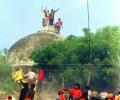
"I believe that I should have also been listed as an accused by the CBI," says Hazaari Lal, one of the thousand karsewaks, who pulled down the mosque on December 6 1992, a day that shook India.
The 'Ram Baraat' will leave for Janakpur from Ayodhya on Dec 8, and the marriage ceremony of Lord Ram and Sita will be held in Nepal on Dec 16.
It was called to discuss the future course of action of the temple movement.
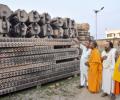
The carving work by artisans had been carried out uninterrupted since 1990 when Mulayam Singh Yadav of the Samajwadi Party was Uttar Pradesh chief minister.
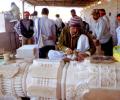
'The signals were clear. December 6 would not witness another show of "Hindu" strength staged periodically in Ayodhya. Something grave was afoot.' Radhika Ramaseshan's personal recollection of the events of December 6, 1992.

'The outrage that followed the destruction of the Babri Masjid was an inability to see the event for what it was: The rectification of a grave historical wrong, the restitution of a hurt of a people and the countering of moral injustice,' argues Vivek Gumaste.
 © 2026 Rediff.com - Advertise with us - Disclaimer - Privacy Policy - Sitemap - Feedback - About us - Terms of use - Grievances