
Now candidates can appear for NEET any number of times.
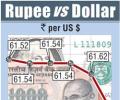
The rupee was largely rangebound for most of the trading day in the absence of any major cues ahead of the Reserve Bank of India's rate-setting meeting next week.

The rupee on Tuesday weakened by 15 paise to close at 63.30 against the US currency

The rupee has dropped by 21 paise or 0.32 per cent in the last two sessions.

Forex dealers said dollar's weakness against other currencies overseas supported the rupee.

The rupee extended gains for the second straight session against the US currency by firming up 21 paise to close at 64.82 a dollar.

According to the global financial services major, the Consumer Price Index based inflation is peaking off and is expected to be around 7.5-8 per cent in September.

The country's merchandise deficit narrowed to $9.2 billion in November, but exports growth eased to 5.9 percent from 13.5 percent in October, government data showed.
Fag-end selling of dollars by banks and exporters

Fresh selling of dollars by banks and exporters on the back of good foreign capital inflows helped the rupee

Data showing foreign institutional investors have slowed their purchases in domestic shares further added to the weak sentiment.

The rupee had firmed up 16 paise to close at 67.52 on Thursday.

The domestic currency has gained 9 paise or 0.13 per cent in two days.

The dollar's weakness against some currencies overseas limited the rupee's fall.
The domestic currency has already dropped 44 paise, or 0.67 per cent, in the previous two sessions.

The rupee slipped from its initial gains by 5 paise against the US currency to 67.89 in late morning deals on bouts of dollar demand from importers.

The rupee had dropped by 60 paise or 0.89 per cent in previous three trading days.

The rupee resumed lower at 61.15 per dollar as against the last weekend's level of 61.07 at the Interbank Foreign Exchange market and hovered in the range of 61.15 and 61.28 before quoting at 61.24 per dollar at 1030 hours.

Snapping its two-day gains, the rupee on Monday declined by 48 paise to settle at nearly four-week low of 62.17 against the US currency.

The domestic currency had last touched 65-level and ended at 65.24 on September 6, 2013. It moved in a range of 64.63 and 65.23 during the day.

The rupee came under pressure on demand from importers as the dollar strengthened overseas.

The Indian rupee on Tuesday ended marginally higher against the American currency at 61.41 amid volatile trading on the back of a higher dollar overseas.

However, the budget arithmetic is slightly optimistic.

Extending losses for the second straight day, the rupee declined by 11 paise to close at more than 3-week low of 66.93 against the US dollar.

Financial services firm AnandRathi analysed the key points of the policy soon after it was announced.
.jpg)
In the global market, the US dollar rose against the basket currencies in early trade as US President Barack Obama called for diplomacy in dealing with alleged chemical weapons attack in Syria but kept open the possibility of military action against the Assad regime.
.jpg)
Steps announced by new RBI Governor Raghuram Rajan could attract $10 billion of forex inflows in the next three months and this could be a material near-term positive for the rupee, which has lost 20 per cent since January, the London-based banking and financial services company said.

A strengthening dollar overseas also kept the rupee under pressure amid demand from importers. Goldman Sachs followed JP Morgan, HSBC and Nomura in cutting India's economic growth forecast and also said it expects the rupee to touch 72 against the dollar in the next six months.

According to the report by the global financial services major, the FY2013-14 CAD is expected to be within $36 billion or 2 per cent of GDP, and this fiscal year CAD is likely to be slightly higher but contained at 2.3 per cent of GDP.
The rupee hit a near 10-month high as an alliance led by pro-reform and business friendly Hindu nationalist Narendra was on course for an absolute majority.

The rupee had gained 10 paise to close at 60.11 against the dollar in Tuesday's trade on fag-end selling of the US currency by banks and exporters.

The local currency opened higher at 61.20 a dollar from the previous close of 61.30 at the Interbank Foreign Exchange Market.

Rupee down 13 paise to 66.72 against dollar
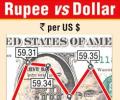
A weak dollar overseas failed to restrict the rupee's decline, a forex dealer said.

Forex dealers said strengthening of dollar against other currencies in the global market also put pressure on the rupee but a higher opening of the domestic equity market limited the fall.

The dollar's weakness against rivals overseas supported the rupee.

Recovery in the equity market also boosted the rupee value against the dollar, a forex dealer said

The dollar's weakness against other currencies overseas and a higher opening in the domestic equity market supported the rupee, forex dealers said.

The rupee fell to more than one-month low of 65.75 against the US dollar on Thursday.

In forward market, premium for dollar continued to fall due to persistent receivings from exporters.
