
The International Monetary Fund (IMF) warned on Tuesday that India's general government debt (comprising both central and state government debt) could exceed 100 per cent of gross domestic product (GDP) in the medium term. It also cautioned that long-term debt sustainability risks are high due to the significant investment required to meet India's climate change mitigation targets. The Indian government, however, disagreed, arguing that risks from sovereign debt are extremely limited as it is predominantly denominated in domestic currency.

The best way for India to prepare is by preserving and strengthening the RBI's hard-won credibility, point out Rajeswari Sengupta and Vaishali Garga.

India's forex reserves dropped $4.39 billion to $690.72 billion for the week ended August 22, the Reserve Bank of India (RBI) said on Friday. The overall reserves had jumped $1.49 billion to $695.11 billion in the previous reporting week.

India's forex reserves rose by $1.49 billion to $695.106 billion during the week ended August 15, according to RBI data released on Friday. In the previous reporting week, the overall reserves had increased by $4.75 billion to $693.62 billion.

NITI Aayog member Arvind Virmani on Monday said India is set to become the fourth largest economy in the world by the end of 2025, an assertion which came days after NITI CEO BVR Subrahmanyam claimed India has already overtaken Japan to reach that spot. The International Monetary Fund (IMF), in its World Economic Outlook (WEO) report released in April had said that India is expected to be the fourth largest economy in the world with a GDP of $4.19 trillion in 2025, ahead of Japan.
India remains the largest growing economy in the world, a senior official from the International Monetary Fund said, observing that the country's macroeconomic fundamentals are good. "India is said to remain the largest growing economy in the world. We project growth at seven per cent in FY24-25, supported by recovery in rural consumption, as there have been favourable harvests.

'The danger is that when the music stops, the fall will be sudden, faster, and deeper than anyone expects,' warns Debashis Basu.
India's forex reserves dropped by $9.32 billion to $688.87 billion for the week ended August 1 in one of the highest declines in the recent past, the RBI data showed on Friday. The overall reserves rose by $2.7 billion to $698.19 billion in the previous reporting week.

With general government debt now approaching three-quarters of GDP, and only incremental reform efforts visible, Pakistan risks prolonging its economic stagnation unless fundamental governance, regulatory, and industrial overhauls are undertaken.

India's forex reserves rose by $2.7 billion to $698.19 billion during the week ended July 25, the RBI said on Friday. In the previous reporting week, the overall reserves had dropped $1.183 billion to $695.489 billion.

What appeared to be a generous act of friendship was, in truth, a manoeuvre within a much larger strategic game. The United States used the 1962 war not just to aid India but to test how far it could be pulled into the Western fold, points out Dr Kumar.
The Reserve Bank has told the International Monetary Fund (IMF) that the objective of frequent interventions in the forex market is to curb excessive volatility, dismissing the Fund's rationale for reclassifying India's exchange rate regime. The IMF, following the Article IV consultation with the Indian authorities, reclassified the status of the exchange rate regime to "stabilised arrangement" from "floating" for period between December 2022 to October 2023. India's Executive Director at IMF K V Subramanian and Senior Advisors Sanjay Kumar Hansda and Anand Singh questioned the selection period adopted by the Fund for analysis and also reclassification of the country's exchange rate regime.

India's economy could reach $20.7 trillion in terms of purchasing power parity (PPP) by 2030 and may emerge as the second-largest economy by 2038 with $34.2 trillion GDP, an EY report said on Wednesday. The report also said that with appropriate countermeasures, India can limit the adverse impact of higher US tariffs on selected Indian imports to about 10 basis points of real GDP growth.

In 2024, Pakistan shelled out $10.2 billion in defence spends.

India's forex kitty declined by $1.18 billion to $695.49 billion during the week ended July 18, the RBI said on Friday. In the previous reporting week, the overall kitty had dropped by $3.06 billion to $696.67 billion.

India will argue for Pakistan's return to the Financial Action Task Force (FATF) grey list due to its alleged failure to combat money laundering and terror financing. The move comes after recent tensions between the two countries following a terror attack in Pahalgam, India. India believes Pakistan has not adequately addressed the issue of terrorism emanating from its territory and has diverted funds from multilateral agencies towards arms purchases.

India's forex reserves dropped by $3.05 billion to $699.74 billion in the week ended July 4, the RBI said on Friday. In the previous reporting week, the overall reserves had jumped by $4.85 billion to $702.78 billion.
India's forex reserves were up by $4.84 billion to $702.78 billion for the week ended June 27, the Reserve Bank of India said on Friday. In the previous reporting week, the foreign exchange reserves had dropped by $1.01 billion to $697.93 billion.

India should refrain from playing cricket with Pakistan in view of the ongoing tension with the neighbouring country, Arvind Sawant (SS-UBT) said on Monday in the Lok Sabha.

Fitch Ratings on Wednesday raised India's GDP growth forecast to 6.9 per cent for current fiscal year, from 6.5 per cent earlier, citing strong June quarter growth and domestic consumption-led demand.

The IMF on Tuesday projected a growth rate of 6.1 per cent for India in 2023, which is a 0.2 percentage point upward revision compared with the April projection. This is reflective of the "momentum" from stronger-than-expected growth in the fourth quarter of 2022 as a result of stronger domestic investment, the International Monetary Fund (IMF) said. "Growth in India is projected at 6.1 per cent in 2023, a 0.2 percentage point upward revision compared with the April projection," it said in its latest update of the World Economic Outlook.
India's forex reserves dropped by $1.01 billion to $697.93 billion for the week ended June 20, the Reserve Bank of India said on Friday. In the previous reporting week, the reserves had jumped by $2.29 billion to $698.95 billion.

Gold and silver prices are expected to maintain their upward trajectory this week, but may see late profit-booking amid the release of a series of crucial global economic indicators, analysts said. On the economic front, traders will closely monitor the manufacturing/ services PMI data from across regions and the US non-farm payrolls/ employment data along with consumer confidence for the month of September and speeches from several Federal Reserve officials, they added.

Re-entry into the list could have far-reaching consequences for Pakistan, including diminished foreign investment, increased borrowing costs, and tighter scrutiny from global financial institutions.

"We are contributing about 18 per cent, which is more than the US where the contribution is expected to be much less -- about 11 per cent or something. We are doing very well and we will continue to improve further," RBI governor Sanjay Malhotra said, replying to a question on Trump's recent comments.

India's forex reserves rose $2.29 billion to $698.95 billion for the week ended June 13, the RBI said on Friday. The overall reserves had increased by $5.17 billion to $696.65 billion for the previous reporting week ended June 6.

Growing at a robust rate due to economic reforms in key sectors like digitisation and infrastructure, India has emerged as a star performer and is projected to contribute more than 16 per cent of the global growth, the International Monetary Fund said on Monday. "What we have been observing for quite some time now is that India has been growing at a very robust rate. "It's one of the star performers when it comes to real growth when you look at peer countries.

The International Monetary Fund (IMF) on Tuesday slashed India's growth forecast for 2022-23 (FY23) by 80 basis points to 7.4 per cent, citing less favourable external conditions and rapid policy tightening by the central bank. In its update to the April World Economic Outlook, the IMF said that though a global recession in 2022 was ruled out with a growth estimate of 3.2 per cent, the balance of risks was squarely to the downside, driven by a wide range of factors that could adversely affect the global economic performance. "The risk of recession is particularly prominent in 2023, when in several economies growth is expected to bottom out, household savings accumulated during the pandemic will have declined, and even small shocks could cause economies to stall.

India's forex reserves increased by $5.17 billion to $696.65 billion for the week ended June 6, the RBI said on Friday. The overall reserves had dropped by $1.24 billion to $691.49 billion for the week ended May 30.
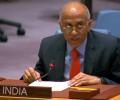
India's Permanent Representative to the UN Ambassador Parvathaneni Harish said that the Indian sub-continent offers a "stark contrast" in terms of progress, prosperity and development models.

Defence Minister Rajnath Singh on Thursday questioned the safety of nuclear weapons in the hands of Pakistan, and said they should be taken under monitoring of the International Atomic Energy Agency.

'America holds about 16% of IMF voting rights, giving it crucial influence over Pakistan's desperately needed bailout loans.'

India's forex reserves jumped by $6.99 billion to $692.72 billion during the week ended May 23, the RBI said on Friday.

India's forex reserves dropped by $1.24 billion to $691.49 billion for the week ended May 30, the RBI said on Friday. The overall reserves had jumped by $6.99 billion to $692.72 billion in the previous reporting week.
India has become the world's fourth largest economy, overtaking Japan, according to NITI Aayog CEO B V R Subrahmanyam. He cited IMF data, stating that India's economy is now larger than Japan's, with a USD 4 trillion GDP. Subrahmanyam also highlighted the favorable geopolitical and economic environment for India, predicting that within 2.5-3 years, India will become the third largest economy.

India's forex reserves dropped $4.89 billion to $685.73 billion for the week ended May 16, the Reserve Bank of India said on Friday. The overall reserves jumped by $4.553 billion to $690.617 billion in the previous reporting week.
India's forex reserves jumped by $4.55 billion to $690.62 billion for the week ended May 9 on the back of a steep increase in gold assets, the RBI said on Friday.

The 25 per cent US tariffs, plus a penalty for Russian imports, could dent India's GDP growth by 30 basis points in the current fiscal, but the higher duty is unlikely to significantly affect India's domestic demand-driven economy, Barclays said on Thursday. If the 25 per cent tariff, announced by US President Donald Trump on Wednesday, is implemented from August 1, the effective average US import tariff on Indian goods will rise to 20.6 per cent in trade-weighted terms, as per Barclays estimates.

Crypto assets should not be granted official currency or legal tender status, the much-awaited synthesis paper by the International Monetary Fund (IMF) and Financial Stability Board (FSB) has said ahead of the G20 leadership summit under India's presidency. However, the report has argued against a blanket ban on activities linked to crypto assets, explaining that such a move can be costly as well as technically demanding to enforce. Central banks should avoid holding crypto assets in their official reserve as they pose a risk to monetary and global financial stability, according to the synthesis paper.
India's forex reserves dropped Rs 2.065 billion to Rs 686.064 billion for the week ended May 2, the RBI said on Friday.
