
It is pegged at 6.8-8% by various economists, as compared to 6.7%.

'The disease is we have models that are still based on debt and not equity. And banks are singularly not equipped to lend for longer duration projects, which often take 20 years.'

The industrial production index, which contracted by 0.4 per cent in October for the first time in 15 years, will continue to show a slowing trend till the end of 2009 with some chance of recovery later, feel economists.

The NSE Nifty settled at 5,117, down 17 points. The market breadth was fairly negative, out of 2,912 shares traaded, 1,754 declined and 1,084 advanced so far on the BSE.
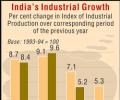
The Indian industry logged 8.5 per cent growth in October 2005, compared to 10.6 per cent in the same month last fiscal.
After contracting for the first time in 15 years in October, industrial production again crashed by two per cent in December against a growth rate of a whopping 8 per cent a year ago despite a stimulus package announced by the government to boost sagging demand.
Industrial growth recovered to 7.1 per cent in July from the dismal performance in previous two months of the current fiscal, even though it moderated compared with 8.3 per cent recorded a year ago.
India's industrial production slowed down to 8.6 per cent in February 2008, compared to 11 per cent a year-ago, but belied apprehensions of a major slowdown after dismal figures for the previous month, giving RBI some headroom to tighten money supply for combating the surging inflation.

The elections held in April-May 2019 will be an important determinant of future growth and investment.

Rate sensitive sectors were among the top gainers with Tata Motors and ICICI Bank leading the gains on the Sensex.

Sandwiched between demonetisation, GST and other smaller policy changes, Gross Value Added or GVA may be a more reliable measure of economic activity over the next few quarters.

The combination of sanctions, and low fuel prices is really hurting the Putin regime.

Ajit Mishra will answer Your Questions on the stock markets on a weekly basis. Please mail your questions to getahead@rediff.co.in with the subject line 'Stock Market Query' along with your name and Ajit will offer his unbiased views.
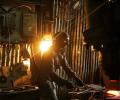
Manufacturing sector, which constitutes over 77 per cent of the index, showed a decline of 0.4 per cent in June as compared to a growth of 7.5 per cent in the same month last year.
The high growth rate over the last few years has been more cyclical, than structural, in nature. And continued supply side bottlenecks will necessarily mean that periods of high growth will trigger inflationary pressures.

Although the current long-term bullish trend is intact, markets are awaiting clarity on the taper and the Assembly election results.
The NSE Nifty ended at 3,681, up 127 points. The market breadth is fairly positive -- out of 2,586 stocks traded, 1,410 have advanced while 1,101 have declined.
Just when the markets were recovering came another jolt. Poor IIP numbers for the month of May, triggered a fresh round of selling, especially the capital goods stocks began to slide... Unabted selling, thereafter, saw the index tumble to a low of 13,351 - down 715 points from the day's high. The NSE Nifty dropped 113 points to settle at 4,049.

Chidambaram promises to maintain fiscal discipline; admits inflation is an issue.
If there is indeed a slowdown, it is unlikely to be confined to the export sectors.
The Index of Industrial Production (IIP) for July 2007, released on September 12, showed the manufacturing sector decelerated to a growth rate of 7.2 per cent over July 2006, after many months of double-digit growth.

The rupee on Tuesday tumbled by 32 paise to close at 64.17 on fresh dollar demand from importers.

Export growth picked up mainly owing to rising global crude prices, which pushed up processed petroleum exports by nearly 40 per cent, apart from a broad-based improvement in exports of major foreign exchange earners such as engineering goods and gems and jewellery.

Prices of two-wheelers, passenger and commercial vehicles are set to rise 15-25%
In a pointer to a slowdown in consumer demand, India's industrial production growth dipped to an 11-month low of 6.4 per cent this September, nearly half the September 2006 figure.
.jpg)
India's share of 2015 emerging market allocations will be driven by FII perceptions on likely growth and reform.
Credit growth has slowed down from around 32 per cent (year-on-year) in July 2006 to around 23 per cent in August. Anecdotal evidence suggests that much of the deceleration in growth has come on the back of softer retail credit off-take.

BSE Auto was the top sectoral loser with a 4.6% fall followed by realty sector down 3.7% and consumer durables 3.6% post disappointing IIP numbers

"We believe in the coming months of September and October, the manufacturing growth is likely to remain flat and IIP growth may even continue to remain in the negative territory," SBI Research said in its Ecowrap Report.

The rupee fell to a two-year low of 64.84 against the US dollar.

The trend was visible in the early trade on Thursday as investors indulged in trimming their bets after the minutes of the US Federal Reserve's September meeting indicated a possible rate hike this year.

The eight core industries -- fertilisers, cement, steel, electricity, crude oil, coal, petroleum refinery products and natural gas -- have a combined weight of about 38 per cent in the Index of Industrial Production.
The Index of Industrial Production (IIP) grew by 10.9 per cent in January this year as against 8.5 per cent in the corresponding month last year.
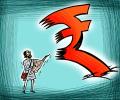
Historically, there has been no correlation between growth in bank credit to industry and lower benchmark interest rate
Huge gold imports have put pressure on the country's CAD, which in turn is affecting the value of rupee.

Subramanian's paper comes at a time when concerns have been raised in various quarters about the official economic growth numbers. The Economic Advisory Council-PM said the Base Year of India's income calculations were shifted to 2011-12 on the basis of recommendations of several committees with experts in national income accounting.

'Political parties bring out money they have stashed away and start spending it. How large that spending will be depends on how much money has been stashed. So, you are going to have a strong upside coming from the election effect,' says Pronab Sen.
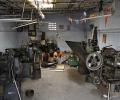
Small and medium enterprises have been struggling to raise bank credit even as they have been powering India's manufacturing growth in recent years.
On a cumulative basis, the Index of Industrial Production (IIP) for the first quarter this fiscal grew by 10.3 per cent as compared to 7.7 per cent in the year-ago period, according to the official figures released on Friday.

The 50-share NSE Nifty ended flat, up 5.80 points, or 0.06 per cent, at 10,308.95.
