
The broader NSE Nifty after shuttling between 10,451.90 and 10,595.75 finally ended 100.30 points, or 0.96 per cent, higher at 10,582.50.

The Sensex ended down 251 points at 27,351 and the Nifty shed 65 points to close at 8,228.

A team of scientists at the Indian Institute of Petroleum in Dehra Dun has developed a new technology to convert environmentally-hazardous plastic into petroleum products.
The BSE benchmark Sensex on Tuesday recovered by over 50 points in early trade, snapping its eight-session losing streak, on fresh buying by funds and retailers ahead of industrial output data, amid a firming trend in other Asian bourses.

Forex dealers said dollar selling by exporters and a higher opening in the equity market also supported the rupee.

The NSE Nifty settled the day 96.80 points, or 0.94 per cent lower, at 10,224.95

Growth in factory output, as measured by the Index of Industrial Production, was higher at 6.7 per cent in February 2011.

The expansion in September is highest since April, when the core sectors' growth stood at 2.6 per cent.

Except for crude oil, natural gas and fertilisers, all other segments registered healthy growth.
India has the capacity and the resilience to overcome economic crisis, Finance Minister Pranab Mukherjee said on Tuesday in the Rajya Sabha.

The Economic Survey said that a number of indicators -- GDP, IIP, credit, investment and capacity utilisation, point to a deceleration in real activity since first quarter of 2016-17 and a further deceleration since the third quarter.

Sentiment was largely positive after April IIP grew at 4.9 per cent, spurred by higher growth in manufacturing and mining sectors.

The 30-share BSE Sensex opened positive, but shed some ground to settle the session higher by 250.47 points, or 0.78 per cent, at 32,432.69, its biggest closing since August 2.

"The Index of Industrial Production (IIP) is expected to remain subdued and register below 5 per cent growth during the remaining months of FY'12 as production activity continues to be impacted by the slowdown in investment demand and the weak business and consumer sentiment," D&B said in the latest issue of its 'Economic Observer' report.

Power generation grew by 14.6 per cent in November.

The NSE Nifty too breached the 11,500-level with a jump of 145.30 points.
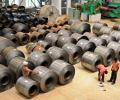
The mining sector grew by 4.3 per cent in June as against a dip of 4.6 per a year ago.

'We expect a pick-up in the second half of the current fiscal. But before that, data is likely to show a further slowdown. The second quarter print is likely to be worse than the first quarter,' said a senior official.
India may end the financial year with a seven per cent GDP growth rate, as the economic deceleration is expected to continue in the third quarter, said Montek Singh Ahluwalia, deputy chairman of the Planning Commission.
India's industrial growth has been crawling below five per cent for months now and overall economic growth has moderated to a two-year low of 6.9 per cent in the second quarter of this financial year, say the statistics.
IIP growth has been revised upwards to 2.5 per cent in December, from the provisional estimates of 1.8 per cent.

In the metal pack, Tata Steel was up 3.7% while Vedanta was up 1.8% .

Cement production contracted by 2.7 per cent as against an expansion of 6.2 per cent in October 2016.
Continuing its dismal performance, industrial growth fell further to 1.9 per cent in September, mainly due to poor output from the manufacturing sector.

The industrial growth number for the month of December has been revised upward to 2.53 per cent from the provisional number of 1.6 per cent released earlier.
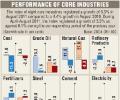
Eight infrastructure industries grew by 3.5 per cent in August this year, down from 4.4 per cent expansion witnessed in the same month last year.

Pronab Sen, principal advisor in the Planning Commission, says that it is difficult to pinpoint the exact GDP number for the current fiscal, as IIP data is questionable and contradicts with exports growth story.

Currently, the government evaluates performance of six key sectors -- crude oil, petroleum refinery, cement, electricity, finished steel and coal -- on a monthly basis.

Encouraged by the industrial production growth rate of 10.8 per cent in October, Finance Minister Pranab Mukherjee on Friday sounded confident that the trend would continue and the fiscal would end with double-digit growth rate.

The Nifty closed at 5,099, up 125 points.

The Reserve Bank of India, which mainly factors in retail inflation to decide its monetary policy, has been tasked by the government to ensure the rate of price rise remains around 4 per cent.
Industrial production in May slowed to 2.7 per cent from 5.6 per cent a year ago, dragged down by manufacturing, strengthening the case for an RBI rate cut.
IIP-based cumulative industrial output growth during April-December 2010 was 8.6 per cent, on a par with the growth rate of the corresponding months of the previous year, says the Economic Survey 2010-11 which was presented by the Union Finance Minister Pranab Mukherjee in the Parliament on Friday.

During the April-July period of this fiscal, IIP growth stood at 5.8 per cent, as against 9.7 per cent in the corresponding four-month period last year.

RBI moves will further add to corporate woes. Harsh Mariwala, the president of industry body Ficci, said, "I am afraid that with such a hawkish monetary stand, the investment environment would become even more difficult. Growth and employment targets will certainly not be achieved."

Industrial growth during the April-June quarter stood at 6.8 per cent.

After contracting for two quarters in a row, the Indian economy entered the positive territory with a growth of 0.4 per cent in the October-December quarter, mainly due to good performance by farm, services and construction sectors, official data showed on Friday. Trade and hotel industry registered a contraction of 7.7 per cent during the third quarter this fiscal, as the sectors continued to suffer on account of coronavirus pandemic. According to the data released by the National Statistical Office (NSO), the farm sector recorded a growth of 3.9 per cent, and the manufacturing sector output grew by 1.6 per cent in the quarter under review.
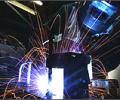
The manufacturing sector, which accounts for over 75 per cent of the total weight of the index, grew by just 5.6 per cent in May.
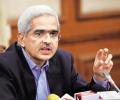
Softening inflation, Das said would make available more policy space to the central bank to address risks to the growth going forward.

Election results on Friday will determine the strength of the ruling coalition party Congress which will also determine market direction.
