
India's banking system is grappling with a persistent liquidity surplus exceeding Rs 5 trillion, driven by significant government spending and bond redemptions, leading market participants to anticipate the Reserve Bank of India will step up Variable Rate Reserve Repo operations to manage the excess funds.

'At the first sign of real trouble, that money will move. There will be a run.'

Despite geopolitical tensions and FII outflows, Indian small and midcap stocks have not only recovered losses but are also outperforming largecap indices, driven by attractive valuations, domestic institutional support, and a rebound in earnings.

The Indian rupee weakened against the US dollar due to geopolitical tensions surrounding the Strait of Hormuz and ahead of the Reserve Bank of India's monetary policy review.

The Indian rupee rebounded against the US dollar after the Reserve Bank of India (RBI) restricted banks' net open positions in dollars. This move prompted banks to sell dollars, providing temporary support for the rupee amidst ongoing geopolitical tensions and rising oil prices.

The rupee appreciated 13 paise to close at 90.34 against the US dollar on Thursday, on trade deal optimism and overnight decline in commodity prices, even as the upside remained capped as investors look for more clarity on the India-US trade deal.

The Indian rupee weakened against the US dollar due to rising crude oil prices, geopolitical tensions in the Middle East, and foreign fund outflows.

Stock market is gearing up for an eventful week ahead where key triggers such as quarterly earnings from corporates, the US Fed interest rate decision and the upcoming Union Budget for 2026-27 would grab the limelight, analysts said.

The Indian rupee, swaying through multiple headwinds, tiding over global trade disruptions and massive foreign fund outlfows, is unlikely to arrest its descent until tariff impact overhangs, notwithstanding robust domestic macroeconomic tailwinds. The Reserve Bank of India (RBI), which sees the rupee's depreciation as a silver bullet to offset the tariff shock, expects the currency to find its stable course once India reaches a trade deal with its largest trading partner, the US.

Importers are rushing to hedge their dollar positions amid the sharp depreciation of the rupee against the American currency and expectations of further volatility even as exporters are holding off after suffering mark-to-market (MTM) losses on earlier hedges.

'Calibrated depreciation will help rebalance external fundamentals, offset some of the tariff differentials with competitors, improve the competitiveness of domestic substitutes vis-a-vis Chinese imports, and contribute to the easing of financial conditions at a time when the inflation rate is unusually low,' explains Sajjid Z Chinoy, head of Asia Economics at JP Morgan.
The rupee breached 90-levels against the greenback for the first time on Wednesday, falling 6 paise to 90.02 in early trade, as banks kept buying US dollars at higher levels and FII outflows continued.

After a record-breaking year, India's automobile industry is entering 2026 on a relatively strong footing, with sales growth expected in the 6-8 per cent range. The outlook is underpinned by policy support, including GST rationalisation, easing monetary conditions, and income tax relief, which together are likely to improve affordability and sustain consumer demand across vehicle segments.

Using credit or debit cards abroad can prove costly.

The recent depreciation of the rupee along with sharp fall in the country's foreign exchange (FX) reserves has sparked a debate whether stability of the exchange rate is necessary and desirable. The rupee was one of the least volatile currencies among peers for almost two years before the current downward pressure started in September after the US Federal Reserve lowered interest rate.

In response to the panic triggered by Trump's trade policies, the RBI net sold approximately $43 billion in the second half of FY25 to curb volatility, as the rupee plunged to a low of 87.95 per dollar in February this year.

The Reserve Bank of India's (RBI's) $10 billion US dollar-rupee buy-sell swap auction for three years received bids worth $16.23 billion on Friday, reflecting robust demand amid persistent liquidity deficit in the banking system. This was the second swap auction by the central bank after it infused $5 billion via six month-swap on January 31.

'Investors can consider staying invested in long duration products as there is a possibility of rate cuts in the near term.' Positive macros - lower inflation, high forex reserves and favourable demand-supply dynamics for government bonds - make a strong case for rate cuts from December, says Devang Shah, head of fixed income, Axis Mutual Fund. In an interview with Abhishek Kumar in Mumbai, Shah says this view may not hold true if commodity prices go up sharply.
The Reserve Bank of India (RBI) has extended the trading hours for the interbank call money market from July 1, and that of repo and tri-party repo markets from August 1. Market participants said the decision is intended to help reduce the large Standing Deposit Facility (SDF) balances held by banks with the RBI, thereby addressing liquidity mismatches.

The RBI under former governor Shaktikanta Das resisted pressures to cut interest rates through 2024 as it kept its 'Arjuna's eye' trained on inflation, but the central bank under a new detail-oriented head will soon have to take a call if it can continue sacrificing growth. Das, a career bureaucrat who in 2016 oversaw Prime Minister Narendra Modi's highly disruptive demonetisation move, left a lasting legacy as he demitted office towards the end of 2024 after expertly navigating monetary policy for six years, the highlight of which was steering India's recovery through the pandemic.

'Many global investors have been overweight on dollar assets, so some diversification or hedging is naturally expected.'

The RBI added roughly 3 tonnes in 2025, taking its gold reserves to 879 tonnes as of January 31, 2025.

After a robust 2023, foreign investors significantly scaled back their investments in Indian equities in 2024, with net inflows amounting to over Rs 5,000 crore, as elevated domestic valuations, coupled with geopolitical uncertainties prompted investors to adopt a more cautious stance. Looking ahead to 2025, FPI flows into Indian equities could see a recovery, supported by a cyclical upswing in corporate earnings, particularly in domestic-oriented sectors like capital goods, manufacturing, and infrastructure, Vinit Bolinjkar, head of research, Ventura Securities, said.
The rupee has remained largely stable against the US greenback in the current calendar year (CY 2024), depreciating by just 0.59 per cent so far. However, it has considerably weakened against the euro and pound. The local currency has depreciated by 1.6 per cent against the euro and 5.6 per cent against the pound, as both currencies strengthened against the dollar during this period.
R N Subramanian, manager-foreign exchange, Canara Bank, will be the new chairman of the Forex Association of India for the current financial year 2004-05

The Reserve Bank's rate-setting panel will start its 3-day deliberations on Wednesday amid expectations of yet another rate hike of 50 basis points to check high inflation, in line with similar actions taken by other major central banks, including the US Fed. Based on the recommendations of the Monetary Policy Committee (MPC), the RBI had effected 50 basis points increase in repo rate each in June and August after raising the short-term lending rate by 40 basis points in an off-cycle decision in May. The MPC, headed by RBI Governor Shaktikanta Das, is scheduled to meet during September 28-30.

Higher interest rates in the US do not necessarily coincide with capital outflows.
Deutsche Bank on Monday completed the first forex option transaction in India. The transaction, which was a 6-month dollar/rupee risk reversal, was inked by Deutsche Bank for Reliance in Mumbai, an official release said.

What the reserves offer for now is improved import coverage of about 13 months, almost double the 2013 level of less than seven months. And, ammunition to arrest a rapid rupee slide, says Anup Roy.

The steep decline in commodity prices has reversed.

The Reserve Bank of India on Friday decided to leave benchmark interest rate unchanged at 4 per cent but maintained an accommodative stance as the economy faces heat of the second Covid wave.
The Indian rupee, which has depreciated 1.1 per cent so far in August, is expected to decline further on the back of a strengthening US dollar and a weakening Chinese yuan, according to a Business Standard poll of analysts. The Indian rupee hit an all-time low recently, closing at 83.15 per dollar. Five of the 10 respondents said the Indian currency might touch 83.5 per dollar in August itself, while others said the worst could be over.

India needs foreign exchange buffer reserves to insulate itself from exchange rate volatility as we have "no friends" for swap lines and Japan was the only country that helped during the taper tantrum in 2013, former RBI Governor Raghuram Rajan said on Tuesday. Participating in a virtual event organised by economic think tank NCAER, Rajan said during the taper tantrum in 2013, India asked for swap lines, and only country who helped was Japan. "We need this (foreign exchange) reserve buffer to insulate ourselves because we have no friends.

Email alarm made government close arbitrage window

The rupee depreciated 44 paise and slipped below the 81-mark against the US dollar for the first time in early trade on Friday, weighed down by the strong american currency and risk-off sentiment among investors. Forex traders said escalation of geopolitical risk in Ukraine and rate hikes by the US Fed and Bank of England in a bid to contain inflation sapped risk appetite. Further, the strength of the American currency in the overseas market, a negative trend in domestic equities, and risk-off moods amid escalation of geopolitical risk in Ukraine weighed on the local unit.

Global rating agency S&P on Tuesday said even though the US and the Euro zone are headed to recession, India is unlikely to face the impact given the "not so coupled" nature of its economy with the global economy. "Indian economy is a lot decoupled from the global economy than we normally think of, given its large domestic demand, even though you (India) are a net importer of energy. "But you have enough forex reserves on one hand and your companies have managed to maintain healthy balance sheets," Paul F Gruenwald, S&P global chief economist and managing director, told reporters in Mumbai.

Travel companies and agencies are offering early bird discounts going up to 40 per cent. Priyadarshini Maji reports
India's rupee is likely to remain under pressure due to high prices of crude oil and other commodities, and may stabilise at around 79-80 against the US dollar in the near term, say experts amid limited headroom available with the Reserve Bank to check the weakening of the domestic currency. The currency has slumped over 5 per cent this year after Russia's invasion of Ukraine sent international crude oil prices soaring to a decade high. On Monday, rupee ended at a fresh all-time low of 78.34 (provisional) against the US dollar.
The rupee depreciated 31 paise to an all-time low of 80.15 against the US dollar in early trade on Monday tracking the strength of the American currency and firm crude oil prices. At the interbank foreign exchange, the rupee opened at 80.10 against the dollar, then lost ground to quote at 80.15, registering a fall of 31 paise from the last close. On Friday, the rupee closed at 79.84 against the dollar.
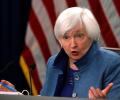
Hawkish guidance by the US Fed raises concerns it could tie the hands of RBI from trimming rates.
 © 2026 Rediff.com - Advertise with us - Disclaimer - Privacy Policy - Sitemap - Feedback - About us - Terms of use - Grievances