
rediffGURU Ulhas Joshi answers your mutual fund queries.

rediffGURU Dev Ashish answers your personal finance and mutual fund queries.

Despite the uncertainties created by rising bond yields and oil prices, fund managers have been proactively deploying fresh flows into the equity market. The cash available with equity fund managers, which has remained lower at around 5 per cent in the past few months, hit a 16-month low of 4.8 per cent in September, shows a Motilal Oswal Financial Services report. Cash holdings in equity schemes had topped 6 per cent in February amid subdued equity market sentiment.
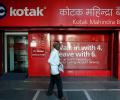
Cracking down on repeated non-compliance of IT norms, the RBI on Wednesday barred Kotak Mahindra Bank from onboarding new customers through its online and mobile banking channels and issuing fresh credit cards with immediate effect after the regulator found "serious deficiencies" in the lender's IT risk management. These actions, the RBI said, are necessitated based on significant concerns arising out of Reserve Bank's IT examination of the bank for the years 2022 and 2023 and the continued failure on part of the bank to address these concerns in a comprehensive and timely manner.

Bankers said the outlook of M&As in India in 2024, especially in the second half after the Lok Sabha election, seems relatively better.

The card offers special features like multiple reward points, weekend bonanza points, petrol surcharge waiver and 500 special gift reward points to be credited annually on the Teachers day, HDFC Bank said in a statement.

Cumulative FII holdings in the company rose to 77.85 per cent in the July-September quarter this year from 73.09 per cent in three months ended September last year, according to data from stock exchanges.

Wipro was the biggest loser among Sensex firms, sliding 2.32 per cent, followed by HDFC Bank, Power Grid, UltraTech Cement, ITC, ICICI Bank and Tata Motors. IndusInd Bank, Maruti, State Bank of India, Mahindra & Mahindra, Asian Paints and Bajaj Finserv were among the gainers.

rediffGURU and financial planning expert Colonel Sanjeev Govila (retd) answers your personal finance-related questions.

Brokerage says earnings inflated, but mortgage lender rubbishes charges.

'This segment has performed very well for us and this is reflected in our bounce rate which is about three to four per cent.'

rediffGURU Ramalingam Kalirajan answers your personal finance queries.

Among the Sensex firms, Larsen & Toubro, Tata Consultancy Services, Infosys, HCL Technologies, Hindustan Unilever, Axis Bank, ICICI Bank and Wipro were the major gainers. Nestle India, Asian Paints, JSW Steel, Kotak Mahindra Bank and HDFC Bank were among the losers.

Operating margins have been the primary driver of corporate earnings in India in recent quarters, despite revenue growth suffering from weak consumer demand. Companies across sectors have reported a sharp improvement in earnings before interest, tax, depreciation, and amortisation (Ebitda) margins over the past two years, benefiting from lower commodity and energy prices. Higher margins more than compensated for slower revenue growth, resulting in double-digit growth in net profit for five consecutive quarters.

Benchmark Sensex and Nifty closed at new lifetime high levels on Monday on foreign fund inflows and buying in index majors HDFC Bank and Reliance Industries. The 30-share BSE Sensex jumped 529.03 points or 0.80 per cent to settle at its new all-time closing high of 66,589.93. During the day, it climbed 595.31 points or 0.90 per cent to hit its lifetime intra-day peak of 66,656.20. The NSE Nifty went up by 146.95 points or 0.75 per cent to end at a new record high of 19,711.45.

The FIPB on Friday cleared the long-pending proposal of HDFC Bank to hike foreign holding in the bank to 74 per cent.

The number of dematerialised (demat) accounts - required to hold shares and other securities in electronics format - crossed the 150-million mark for the first time in March. In March, 3.12 million new demat accounts were added despite a spike in market volatility, taking the total count to 151.4 million. The milestone has come 19 months after the total number of demat accounts hit the 100-million mark, a sign that more domestic households are taking to direct equity investing.


It has been decided to reduce home loan rate by 20 basis points.

The value of FPIs (Foreign Portfolio Investors) holding in Indian equities reached $738 billion in the three months ended December 2023, marking a surge of 13 per cent from the preceding quarter, driven by the strong performance of the domestic stock market, according to a report by Morningstar. The value of FPIs investment was at $651 billion in the September quarter of the current fiscal. On a year-on-year basis, the value of such investments rose 26 per cent from $584 billion in December 2022.

Among the Sensex firms, HCL Tech, Wipro, Tata Consultancy Services, Tech Mahindra, Nestle, Tata Motors, Infosys, Bharti Airtel, UltraTech Cement and Tata Steel were among the laggards. On the other hand, Axis Bank, HDFC Bank, ICICI Bank, JSW Steel, Mahindra & Mahindra and Kotak Mahindra Bank were the major gainers.
In the Sensex pack, HCLTech rose the maximum by 3.12 per cent, followed by ITC which gained 2.73 per cent and M&M went up 2.61 per cent. TCS climbed 2.44 per cent. Tech Mahindra, Wipro, L&T and Maruti were among the other major gainers.

Reliance Industries was the biggest gainer in the Sensex pack, rising 2.69 per cent, followed by HCL Tech, ICICI Bank, Tata Motors, Wipro, IndusInd Bank, JSW Steel, Wipro, Tata Consultancy Services and Titan. In contrast, NTPC, Power Grid, UltraTech Cement, Axis Bank, Infosys and Nestle were the major laggards.

Among the Sensex firms, Bajaj Finance, Infosys, Tech Mahindra, ICICI Bank, Nestle, Tata Consultancy Services, HDFC Bank and Reliance Industries were the major laggards. Mahindra & Mahindra, JSW Steel, NTPC, Power Grid and IndusInd Bank were among the gainers.

Among the Sensex firms, Larsen & Toubro, Bharti Airtel, HCL Tech, Tata Motors, Sun Pharma and Tata Steel were the major gainers. On the other hand, Nestle, Asian Paints, Bajaj Finserv, HDFC Bank and Axis Bank were among the laggards.

Brokerages have lowered the price targets of asset management companies (AMCs) since they failed to beat revenue growth expectations in the January-March quarter (fourth quarter, or Q4) of 2022-23 (FY23). The regulator's plans to lower the fee charged by AMCs also added to concerns. While HDFC AMC and Nippon Life India AMC reported modest growth in revenue from operations in Q4FY23, UTI AMC and Aditya Birla Sun Life AMC delivered yet another weak quarter.
HDFC has reduced interest rates for individual deposits by 0.25 per cent across the board with effect from December 10.

rediffGURU Sunil Lala answers your personal finance-related queries.
The country's largest home loan player HDFC on Wednesday said that it may have to raise lending rates further if the Reserve Bank of India (RBI) increases key policy rates in the forthcoming monetary policy review on July 29. HDFC has been arguing that the effective borrowing cost is a little over 5 per cent if the tax benefits are included.
Among the Sensex firms, Wipro jumped over 6 per cent, the most among the frontline companies. HCL Technologies, Tata Motors, Maruti, Tata Steel, Infosys, Tech Mahindra, Larsen & Toubro and JSW Steel were the other major winners. State Bank of India, Bajaj Finance, ICICI Bank, HDFC Bank, Axis Bank and IndusInd Bank were among the laggards.

Among the Sensex firms, Bajaj Finance, JSW Steel, Reliance Industries, Mahindra & Mahindra, ITC, Tata Consultancy Services, Wipro, HDFC Bank, Larsen & Toubro and Bharti Airtel were the major laggards. Sun Pharma, NTPC, State Bank of India, IndusInd Bank and Axis Bank were the major gainers.

The country's largest private lender HDFC Bank's bad-loan write-offs doubled to Rs 3,100 crore in the April-June quarter (first quarter, or Q1) of 2021-22 (FY22), from the level of Rs 1,500 crore in the same quarter of 2020-21 (Q1FY21). It also offloaded its non-performing assets (NPAs) amounting to Rs 1,800 crore in Q1FY22 to maintain a robust asset quality profile. It had jettisoned NPAs worth Rs 1,000 crore in the last quarter. Lenders knock off stress assets from books after making full provisions. Their right to recover dues from delinquent borrowers remains intact after the write-downs.

The brokerage earnings estimate for the January-March 2024 quarter (Q4FY24) for Nifty 50 companies hints at a slowdown in corporate profit growth while revenue increase is likely to be in low single digits as in the previous two quarters. According to various brokerage estimates, the companies' combined net profits are expected to grow 3.1 per cent year-on-year (Y-o-Y) in Q4FY24, the slowest in the last five quarters. For comparison, the index companies' combined net profits were up 8.2 per cent Y-o-Y in Q3FY24 and 3.4 per cent Y-o-Y in Q4FY23.

For the financial year 2011, profit after tax of Reliance MF stood at Rs 261 crore (Rs 2.61 billion), while that of HDFC MF was Rs 242 crore (Rs 2.42 billion).
Public sector banks have lowered both deposit and lending rates, while almost all private and foreign banks have stayed away from rate cuts despite the Reserve Bank of India reducing key rates. HDFC Bank has become the first private sector lender to reduce deposit rates, while other private sector banks said they would also jump on the bandwagon over the next few weeks.
HDFC Bank on Friday announced a marketing alliance with American Express enabling the former to offer American Express Travellers cheques to consumers at over 160 of its branches across 70 cities.

Re-rating of Axis Bank's stock may continue in the near-future, believe analysts, as the risk-reward on the stock remains favourable amid healthy financials. The bullish stance comes after the Mumbai-based lender delivered a strong outperformance in the March quarter of fiscal year 2023-24 (Q4FY24) on core pre-provision profit and net profit, with improving asset quality. Axis Bank's net interest margin (NIM) expanded, against expectations, even in a tough market.

'We are working with a few housing finance companies to drive affordable lending because that's where we believe our sweet spot is.'

At end of week, Infosys had a market valuation of Rs 2,69,489 cr, or Rs 432.68 cr more than HDFC Bank's Rs 2,69,056 cr

In its 59-page order, the capital markets regulator Sebi said that the 10-year restraint period for them would be calculated after taking into account the restraint already undergone by him vide an interim order dated June 17, 2010.
 © 2026 Rediff.com - Advertise with us - Disclaimer - Privacy Policy - Sitemap - Feedback - About us - Terms of use - Grievances