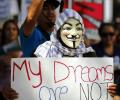
A group of influential lawmakers have introduced a bipartisan legislation in the US Senate to comprehensively overhaul the H-1B and L-1 visa programmes and usher in more transparency in the recruitment of foreign workers. The H-1B visa is a non-immigrant visa that allows US companies to employ foreign workers in speciality occupations that require theoretical or technical expertise. Technology companies depend on it to hire tens of thousands of employees each year from countries like India and China.

It has been the preferred visa for Indian IT companies and has helped them keep costs down and gain a margin advantage over multinational players by sending engineers to the US.
The Indian IT companies, which account for a large number of H-1B applications, are likely to face the additional financial burden because of this proposed increase in H-1B filing fees.

Ayan Pramanik and Shivani Shinde Nadhe report on the uncertainties that have dragged down shares of TCS, Tech Mahindra and HCL Technologies.

The Congressional-mandated cap of 65,000 H-1B visas and another 20,000 in the advanced degree categories were reached within the first five days after USCIS started accepted H-1B applications in April.

The US has received enough petitions needed to reach the congressionally mandated 65,000 H-1B visa cap for the fiscal year 2022, a federal agency has announced. The H-1B visa is a non-immigrant visa that allows US companies to employ foreign workers in speciality occupations that require theoretical or technical expertise. Technology companies depend on it to hire tens of thousands of employees each year from countries like India and China.

An influential immigration advocacy group representing Indian-Americans on Thursday urged the Biden administration not to issue the most sought-after H-1B work visa to any individual born in India, till the time the discriminatory country-cap on green cards or permanent legal residency is removed. The current per-country cap on issuing of green cards in the US has resulted in Indian professionals, mostly from the IT sector, having to wait for decades for their legal permanent residency. Issuing new H-1B visas to more Indians would add to this agonising painful wait for green cards, Immigration Voice said in a statement.

India's $280-billion IT industry heads into 2026, balancing visa-related headwinds and global trade uncertainty against its biggest-ever push into artificial intelligence and the rapid expansion of global capability centres (GCCs). Heightened scrutiny of the US H-1B visa programme - including a proposed $100,000 fee for new visas and concerns over a potential 25 per cent outsourcing tax - has complicated cross-border delivery for Indian firms, even as companies accelerate efforts to reduce reliance on onsite staffing.

A deep dive into Trump's new policy and what it means for Indian professionals and companies.
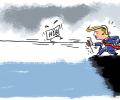
'USCIS has been making arbitrary rules for over eight years, it's our top priority to set things right.'

This non-refundable fee will support the new electronic registration system to make the H-1B cap selection process more efficient for both petitioners and the federal agency, USCIS said.
Under these reforms, the H-1B programme will prioritise those workers who are offered the highest wage, ensuring that the highest-skilled applicants are admitted, the White House said.

In a move that will benefit a significantly large number of Indian technology professionals, the US is set to begin a pilot programme for domestic renewal of certain categories of H-1B visas in December. The H-1B visa is a non-immigrant visa that allows US companies to employ foreign workers in speciality occupations that require theoretical or technical expertise. Technology companies depend on it to hire tens of thousands of employees each year from countries like India and China.

Amid headwinds across global markets, US issues fresh restrictions on H-1B visas. Ayan Pramanik & Raghu Krishnan list out the many ways in which this impacts the Indian IT industry.

In the past five years, the US has seen nearly two dozen Bills on employment visas introduced without success. But this time it is different, industry sources tell Ayan Pramanik.

The US Citizenship Act 2023 introduced by Congresswoman Linda S nchez creates an earned roadmap to citizenship for all 11 million undocumented immigrants, providing Dreamers, TPS holders, and some farmworkers with an immediate path to citizenship.

Several individuals and organisations, including the US Chambers of Commerce and the National Association of Manufacturers, have filed a lawsuit against the Trump administration's recent rules related to the H-1B visa, terming them "arbitrary" and "haphazard" regulations that will undermine high skilled immigration into America. Early this month, the Trump administration announced new restrictions on H-1B non-immigrant visa programme which it said is aimed at protecting American workers, restoring integrity and to better guarantee that H-1B petitions are approved only for qualified beneficiaries and petitioners, a move which is likely to affect thousands of Indian IT professionals.
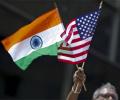
In a big relief for thousands of stranded Indian professionals in America due to the coronavirus pandemic, the US government has decided to allow applications by H-1B visa holders for an extended stay in the country. The US department of homeland security in a new notification has said it recognises that there are immigration-related challenges as a direct result of the coronavirus pandemic.
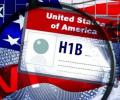
In what can be good news for hundreds of Indian IT professionals seeking the H-1B work visa, the US' immigration agency has decided to conduct a rare second lottery for the most sought-after visas to decide on the successful applicants who could not make it in the first random selection. The US Citizenship and Immigration Services (USCIS) said on Thursday that a decision was taken after determining that the computerised draw of lots for H-1B visas conducted early this year did not give them enough numbers of the Congressional mandated H-1B visas. The H-1B visa, the most sought-after among Indian IT professionals, is a non-immigrant visa that allows US companies to employ foreign workers in speciality occupations that require theoretical or technical expertise.


The Biden administration has proposed a massive hike in immigration fees, including the much sought-after H-1B visas for high-skilled foreign workers, which is very popular among Indian tech professionals. Under the proposed rule, published by the US Citizenship and Immigration Services (USCIS) on Wednesday, the application for the H-1B visa increases from $460 to $780, and L-1 from $460 to $1,385. The application fee for O-1 visas has been proposed to increase from $460 to $1,055.

Indian-American executive Srini Gopalan has been appointed chief executive officer of telecom operator T-Mobile, amid ongoing debates over H-1B visa policies. Gopalan's appointment, effective from November 1, 2025, comes as US President Donald Trump signed a proclamation imposing a staggering $100,000 fee on new H-1B visas, triggering widespread panic, concern and fear among Indian professionals on work visa.

TCS is hiring from over a hundred engineering campuses, MBA graduates from top B-schools in the US

From May 26 onwards, the US Citizenship and Immigration Services will begin accepting applications for work visas from H-IB spouses, reports Aziz Haniffa/Rediff.com.

The Biden administration has indicated that it is still undecided on ending the Trump-era ban on issuing new H-1B visas, with the Homeland Security Secretary Alejandro Mayorkas asserting that the US government's top priority is the acute needs of individuals fleeing persecution. The H-1B visa, the most sought after among Indian IT professionals, is a non-immigrant visa that allows US companies to employ foreign workers in speciality occupations that require theoretical or technical expertise. Technology companies depend on it to hire tens of thousands of employees each year from countries like India and China.
The lawsuit seeks an order declaring the presidential proclamation restriction on issuing new H-1B or H4 visas or admitting new H-1B or H-4 visa holders as unlawful.

If the Indian government is indeed serious about reversing brain drain, it needs to put much more emphasis on research and innovation, especially in areas that will determine the future, asserts Prosenjit Datta.
We look at the requirments and qualifications necessary for H-1B applicants: What work and educational experience do you need? What are the mandatory documents?
According to Republican Senator Charles Grassley and Democratic Senator Richard Durbin, more companies are now using H-1B visas to displace qualified American workers.

'We are only talking about 65,000 H1B visas a year, it is not going to go down drastically.' 'If the number reduces and when you spread that reduction across all the top IT services companies, the impact will be marginal.'
Trump told reporters that his administration will not tolerate firing of hardworking Americans in pursuit of cheap foreign labour.
Thousands of Indian H-1B workers are stranded in India after sudden visa appointment cancellations at US consulates.

The current Federal rules require an H-1B visa holder to leave the US along with family members within 60 days of losing his job. The H-1B visa holders have started a petition campaign on the White House website to extend the timeline for their stay in the US to 180 days after they are being laid off.

'The kids are already used to this place. We go back and that's a different environment.' 'So, mentally, emotionally we are stressed.'
While the denial rate has dropped slightly to 21 per cent in 2019 from 24 per cent in 2018, the National Foundation for American Policy has said it is much higher for Indian IT companies like Tata Consultancy Services (TCS) and Wipro and very low for American companies like Amazon and Google. For instance, the denial rate for TCS and Infosys in 2019 was 31 per cent and 35 per cent respectively, whereas for Wipro it was 47 per cent and 37 per cent for Tech Mahindra. On the other hand, the denial rate for the new H-1B petitions in 2019 was just four per cent each for Amazon and Google. The denial rate for Microsoft during the same period was six per cent, and Facebook along with Walmart was just three per cent each.
Even as the strong anti-outsourcing lobby in the US is forcing US lawmakers to take a relook at their H1-B visa strategy amid huge job losses, Infosys Technologies which holds the largest number of H1-B visas among all the Indian IT services companies has started reducing the number as a part of the company's policy to reduce its 'overseas bench' strength.

The US President said that companies have to bring people to "get those plants opened, we want you to do that, and we want those people to teach our people how to make computer chips and how to make other things."
The United States on Saturday announced that from April 3 it will temporarily suspend the 'premium processing' of H-1B visas that allowed some companies to jump the queue as part of its efforts to clear the backlog.

H1-B holders in the US can rest assured that changes are soon coming which will bring both simplicity and certainty to your stay, including a potential path to citizenship: Trump.
The much sought after H-1B visa programme, particularly among Indian technology graduates, discriminates against women.
