
The nearly month-long agitation by members of the Gujjar community demanding Scheduled Tribe status -- was called off by their leader Kirori Singh Bainsla on Thursday. The decision comes in the wake of the agreement finalised between the Rajasthan government and leaders of the Gujjar community on Wednesday.The 27-day Gujjar agitation, which witnessed large-scale violence, claimed 43 lives in police firing in Rajasthan and Haryana.
The Rajasthan government on Thursday invited Gujjar community leader Kirori Singh Bainsla for talks, who said he would send his representatives after consulting prominent Gujjar leaders.
The Gujjars have agreed to resume dialogue with the Rajasthan government hours after a local court granted bail to 25 arrested women. A 21-member Gujjar team will leave for Jaipur, a top official said.
Four columns of the army were deployed in violence-hit Bayana town and nearby villages on Saturday after 15 people were killed in clashes between members of Gujjar community and police. Gurjar Arakashan Sangarsh Samiti convener Kirori Singh Bhainsla said Gujjars will not settle for nothing less than the state's letter of recommendation to the Centre for the ST status.
The mahapanchayat comes less than a month after a violent agitation by the Gujjars, demanding ST status, rocked Rajasthan.
The faction led by Govind Gujjar has called a mahapanchayat at Pushkar in Ajmer district on June 24. The move was apparently not discussed by the other faction.
'Rajasthan Gujjars have not been able to benefit from the OBC quota. How do we interpret this extraordinary spectacle of backwardness?'

People along the Line of Control and International Border in the Jammu region continue to live under the shadow of death, with unexploded mortar shells fired by Pakistani troops still embedded in farmlands and residential areas even though hostilities have stopped for nearly a week. IMAGE: Kindly note that this image has been posted for representational purposes only. Photograph: / Rediff.com Despite the May 10 understanding between India and Pakistan, locals describe the border areas as a 'death trap'. Sixty-two-year-old Balvinder Singh, who returned to his home in Pargwal sector on May 14, recounted a narrow escape. "Two shells exploded in our compound, damaging our house. Three more landed on our farmland. We were terrified and told our family to stay away from the fields until the Army could help," Singh told PTI. Army engineers later came to the village and safely defused the unexploded shells, bringing a temporary sense of relief. "Fear is writ large on the faces of people to these death traps in border hamlets", he said. Scenes of destruction are evident rooftops torn apart, broken houses, windows punctured by shrapnel, and carcasses of cattle lying in pools of blood. The acrid smell of gunpowder still lingers in the air. Sardar Gurmeet Singh faced a similar ordeal. His family could not re-enter their home as a live mortar shell had sunk into the compound in a village close to the International Border. "The army's bomb disposal squad removed it after four days, allowing us to finally enter, back home," he said. Indian Army engineers have launched a sweeping clearance operation across border districts, defusing over 80 unexploded shells in the past five days -- including 6 in Pargwal, 19 in Rajouri, 42 in Poonch, and 12 along the IB. "These shells, mostly 120 mm calibre, have a range of 15 to 30 km and pose a serious threat to both civilian and military targets," an Army officer said. "Many of them were fired by Pakistan during recent hostilities." On May 7, the Indian Army launched Operation Sindoor, conducting precision strikes on nine terror hubs in Pakistan and Pakistan-occupied Jammu and Kashmir (PoJK) in response to the April 22 terror attack in Pahalgam that killed 26 people, most of them tourists. The subsequent retaliation by Pakistan pushed the region to the brink of war. From 7 to 10 of May, 27 civilians were killed and over 70 injured in Pakistani shelling in the Jammu region. Farid Din Gujjar, a resident near the border, expressed fear about returning to his fields. "Several shells created deep craters in our paddy land. We cannot resume work until all unexploded ordnance is cleared. It's a death trap," he said. Army units, in coordination with Jammu and Kashmir Police, have evacuated high-risk zones and issued stern warnings to residents not to touch any suspicious objects or unexploded shells. In one major operation, 42 live shells were safely destroyed in the Poonch villages of Jhullas, Salotri, Dharati and Salani. "All safety protocols were followed. The shells posed a serious danger to local lives," an Army spokesperson said, calling the effort a 'continued commitment to protect civilians and restore normalcy'. Poonch saw the vast majority of deaths due to shelling. Security officials said that Pakistan used a mix of mortar shells, armed drones, and missiles during the shelling spree, specifically targeting civilian habitations and border towns in Jammu, Samba, Kathua, Rajouri, and Poonch. As clearance operations continue, the border residents are slowly returning to their homes, but with caution, fear, and lingering uncertainty about shelling that may yet happen in the future.
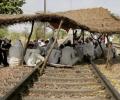
Gujjar protesters blocked the Delhi-Mumbai rail route and a key national highway for the fifth day on Monday after negotiations with the government over their demand of five per cent quota were stalled due to disagreement over the meeting venue.

An Indian delegation led by the BJP's Ravi Shankar Prasad will tour key European capitals to expose Pakistan's role in cross-border terrorism and State-sponsored extremism.
Fresh round of talks between the agitating Gujjars and Rajasthan government began in Jaipur on Sunday night at the state secretariat to resolve the 14-day-old stir by the community demanding 5 per cent reservation in government jobs.
Gujjars, demanding five per cent quota in jobs in Rajasthan, called off their 17-day agitation after the state government assured them that it will complete within six months the quantifiable data collection for the purpose.
Gujjar agitators continued the blockade of many rail and road routes in Rajasthan and jammed the Jaipur-Ajmer highway on Monday as their agitation over the issue of reservations in jobs entered the eighth day. "Nearly 200 agitators have blocked the highway near Nasirabad road at Mangaliawas (in Ajmer district). Traffic has been affected but is being diverted to other routes," police sources said. "Talks with local Gujjar leaders are going on to resolve the situation," he said

The protesters are demanding five per cent reservation to Gujjars, Raika-Rebari, Gadia Luhar, Banjara and Gadaria communities in government jobs and educational institutions.
Northern Railways on Friday cancelled 27 trains passing through Rajasthan and diverted several others in the wake of the ongoing agitation by the Gujjar community in the state, causing acute hardship to commuters.
A large number of Gujjar protestors including women disrupted train movement by squatting on the tracks at a bridge over Banganga river in Bandiqui area in Dausa district, where 14 people were killed in police firing and clashes on May 24, officials in the adjoining district of Bharatpur said. Rail commuters were stranded in Jaipur, Dausa, Kota, Jhalawar and other stations with trains either been cancelled or diverted in the wake of the Gujjar stir for ST status.
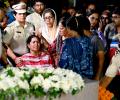
The dastardly dimensions of the attack are gradually sinking in even as the Government of India announced its immediate diplomatic and other retaliatory measures. It is generally expected to be followed up with punitive military action across the LoC, sooner than later, observes Mohammad Sayeed Malik, the distinguished commentator on Kashmir affairs.
The third round of talks between Gujjar leaders and the Rajasthan government began in Jaipur on Saturday in an effort to end the 22-day-old imbroglio. The talks remained inconclusive on Friday, but both sides had agreed to continue parleys.

Talks resumed in Jaipur on Wednesday between Rajasthan government and agitating Gujjars who have been blocking rail tracks and roads in three districts for a week now to press for five per cent quota in government jobs.
The 26-day-old agitation by Gujjars demanding Scheduled Tribe status is set to be called off on Wednesday as the community on Tuesday night reached an agreement with Rajasthan government in the final rounds of talks in Jaipur. The agreement will be signed on Wednesday by Chief Minister Vasundhara Raje and Gujjar leader Kirori Singh Bainsla, spearheading the stir, in Jaipur on Wednesday.
This is their first meeting since the conflict began.
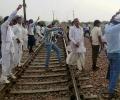
Reviving their demand for five per cent reservation in jobs, Gujjars in Rajasthan on Thursday launched an agitation, blocking railway tracks, even as the state government expressed readiness to have talks with them.
Two rounds of talks lasting nearly two hours between a Gujjar delegation and Rajasthan government emissaries -- Energy Minister Jitendra Singh and Home Minister Shanti Dhariwal -- failed to break the impasse and Gujjar leaders staged a walkout.

The SP said the protesters also pelted stones, injuring four jawans, adding that police had to lob tear gas shells to disperse the crowd.
Amid tight security, hundreds of Gujjars led by Kirorisingh Bainsla began their march from Gudla village, 400 km from Jaipur, to step up pressure on Rajasthan government to fulfil their demand for five per cent quota in state jobs.

Pressing for 5 per cent reservation, Gujjars on Sunday intensified their agitation by blocking highways in parts of Rajasthan and threatening to expand it across the state as they alleged that the state government had failed to offer any concrete proposal to meet their demand.

The BJP won a resounding victory in the Delhi Assembly elections, securing 48 seats out of 70. The party made significant inroads in constituencies dominated by various regional and socio-economic groups, including Purvanchalis, Sikhs, Jats, and slum dwellers. The BJP's strong performance can be attributed to its focus on these communities and its effective campaign strategies.
Bainsla told media persons at Karwadi that Gujjars had 'been assured that arrested protesters, including women, and injured would be freed, water and electricity supply restored and telecommunication jammers removed' from Karwadi-Pilupura, which is the epicentre of the agitation since May 23.
After the bill was passed unanimously, the House made a consensus resolution that the Central government should include the very bill in the 9th Schedule of the Constitution so that it could not be challenged anywhere in the court.
The Rajasthan government has ordered the state's Director General of Police, A S Gill, to proceed on a long leave and handed over the charge to K S Bains, currently holding the post of special DG (Anti-Corruption Bureau), Home Department sources said on Saturday.The replacement has been affected in view of the ongoing Gujjar agitation, in which the police force under Gill could not control the situation, according to the home department.
Train and bus services between Rajasthan and Madhya Pradesh remained suspended or disrupted even as Gujjars of Madhya Pradesh staged a dharna at many places on Monday in support of the agitation by their community in Rajasthan to press for Scheduled Tribe status.
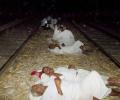
Gujjars remained adamant for calling the committee of ministers at Bayana in Bharatpur for holding talks to resolve the issue
Notorious dacoit chieftain Jagan Gujjar and Ram Vilas Gujjar on Tuesday night threatened to blow up Rajasthan Chief Minister Vasundhara Raje's palace in Dholpur if the demand of the agitating Gujjar community was not conceded within 72 hours.The dacoits have been reportedly present at Pilukapura, where the Gujjars are sitting at dharna since May 23, seeking Scheduled Tribe status for the community.Raje said that she would not deviate from her duty as Chief Minister.
Efforts by the Rajasthan government to end the 18-day-old Gujjar stir ran into rough weather on Tuesday, with the community leadership making fresh demands for the release of arrested women activists and withdrawal of murder charges against 20 protestors, as pre-condition for further talks.Gujjar leader Kirori Singh Bainsla, who had termed the first round of parleys on Monday as a good beginning, has made the two demands a pre-condition for the talks.

On Monday, the agitators blocked NH-11 and continued their blockade from previous days at other places. Since the agitation began on Friday, it has affected the movement of more than 250 trains.
One caste wants to maintain status quo in the list of Scheduled Tribes; the other wants to enter the quota.
Close aides of Bainsla, Roop Singh and Harprasad Gujjar, said the march call still stands and a final decision will be taken depending on Bainsla's health.
The fourth round of talks between the two sides are underway at the state secretariat building in Jaipur.
Bainsla is expected to try and salvage the agreement, which has come under much fire from the Gujjars.
Agitating Gujjars made fresh attempts to block more rail routes in Rajasthan as their statewide stir entered the seventh day on Sunday, though security forces managed to control the situation, official sources said.
