
The government is finalising a major GST overhaul with automated refunds, pre-filled returns, and analytics-based scrutiny to simplify compliance and boost liquidity for MSMEs.
GST Network on Saturday said beginning the July tax period, GST taxpayers will not be able to file monthly and annual GST returns after three years of the original filing due date. The July 2025 tax period means taxpayers will file
The GST Council in its meeting next week is likely to consider a proposal for making changes in the monthly tax payment form -- GSTR-3B, which would include auto-population of outward supplies from sales return and non-editable tax payment table, officials said. The move would help curb the menace of fake billing, whereby sellers would show higher sales in GSTR-1 to enable purchasers to claim input tax credit (ITC), but report suppressed sales in GSTR-3B to lower GST liability. Currently, GSTR-3B of a taxpayer includes auto drafted input tax credit (ITC) statements based on inward and outward B2B supplies and also red flags any mismatch between GSTR-1 and 3B.

Businesses that have not filed GSTR-3B returns in the preceding two months will not be able to file details of outward supplies in GSTR-1 from September 1, GSTN has said. While businesses file GSTR-1 of a particular month by the 11th day of the subsequent month, GSTR-3B, through which businesses pay taxes, is filed in a staggered manner between 20th-24th day of the succeeding month. In an advisory to taxpayers, GSTN, which manages the technology backbone for Goods and Services Tax, said that Rule-59(6) of Central GST Rules which provides for restriction in filing of GSTR-1, will come into effect from September 1, 2021.
Come January and the government is empowered to send its recovery officials to your premises to collect GST without notice, if your tax liability shown in the requisite form is less than what invoices, mentioned in the outward supply form, should draw. The relevant provision in the Finance Act, 2021, will come into effect from January 1, 2022, according to a gazette notification issued on Tuesday. Under the GST system, there are two kinds of returns that a company is required to file monthly if its turnover is over Rs 5 crore annually. These are form GSTR-1 and GSTR-3B.
Average monthly GST collection rose from Rs 90,000 crore during the first year of its implementation -- 2017-2018 -- to Rs 1.68 trillion during 2023-2024, representing an 87 per cent rise.
GST taxpayers will be required to reverse by November 30 the input tax credit (ITC) claimed in the last fiscal in case their suppliers fail to deposit the due tax by September 30, the finance ministry has said. The taxpayers, however, can reclaim the ITC later following the deposit of taxes by the supplier. The ministry has inserted Rule 37A in Central Goods and Services Tax rules to give effect to the new provision.
No longer a discretion of the tax administrator, the audit of returns filed by taxpayers is now based on a selection by algorithms, notes Tarun Bajaj.

Businesses with monthly turnover of over Rs 50 lakh will have to mandatorily pay at least 1 per cent of their GST liability in cash, the finance ministry said as it moved to curb evasion by fake invoicing. The Central Board of Indirect Taxes and Customs (CBIC) has introduced Rule 86B in Goods and Services Tax (GST) rules which restricts use of input tax credit (ITC) for discharging GST liability to 99 per cent. "... The registered person shall not use the amount available in electronic credit ledger to discharge his liability towards output tax in excess of 99 per cent of tax liability, in cases where the value of taxable supply ... in a month exceeds Rs 50 lakh," the CBIC said.

Deadline ends, after two extensions and only 70% file detailed return for July

GST collections in March grew 13 per cent to the second highest ever at Rs 1.60 lakh crore, taking the growth rate of revenue mop-up for full 2022-23 fiscal to 22 per cent. March also saw over 91 per cent of the GST registered businesses filing returns and paying taxes - reflecting greater compliance and improving economic activity. Gross GST revenue collected in March 2023 is Rs 1,60,122 crore, of which Central GST is Rs 29,546 crore, State GST is Rs 37,314 crore, Integrated GST is Rs 82,907 crore (including Rs 42,503 crore collected on import of goods) and cess is Rs 10,355 crore, the finance ministry said in a statement.
The Centre's revenue from GST registered a decline of 10 per cent in 2017-18 compared to revenue of subsumed taxes in 2016-17.
India's Goods and Services Tax (GST) collection surged to Rs 1.30 lakh crore in October, the second highest since its implementation in July 2017, indicating economic recovery from the COVID-19 pandemic and impact of festive demand, a finance ministry statement said on Monday. The highest GST collection of Rs 1.41 lakh crore was recorded in April 2021. This is the fourth time in a row when the GST collection was upwards of Rs 1 lakh crore. The collection from GST was Rs 1.17 lakh crore in September, 2021.

From filing 37 returns a year when the Goods and Sales Tax was first introduced in July last year, the process has undergone major changes as the GST Council considered and implemented various models to ease the pain for assessees. Here's a recap of how the process has changed in 10 months.
As taxpayers face technical glitch on the GST portal, the government on Tuesday said it is considering extending the April tax payment deadline and has directed Infosys for early resolution of the problem. The Central Board of Indirect Taxes and Customs (CBIC) said a technical glitch has been reported by Infosys in generation of April 2022 GSTR-2B and auto-population of GSTR-3B on portal. "Infosys has been directed by Govt for early resolution. Technical team is working to provide GSTR-2B & correct auto-populated GSTR-3B at the earliest," the CBIC tweeted.
The GST collection in April touched the highest ever level of about Rs 1.68 lakh crore, up 20 per cent from the year-ago period, on improved compliance and recovery in business activity, the Finance Ministry said on Sunday. During the month, 1.06 crore GST returns from GSTR-3B were filed, of which 97 lakh pertained to March 2022. The gross GST revenue collected in April is Rs 1,67,540 crore, of which CGST is Rs 33,159 crore, SGST Rs 41,793 crore, IGST Rs 81,939 crore (including Rs 36,705 crore collected on import of goods) and cess Rs 10,649 crore (including Rs 857 crore collected on import of goods), the ministry said.

It shows that states would require a compensation to the tune of at least Rs 1.67 trillion in 2024-25, as none of them would be able to achieve a 14 per cent growth every year.

Simplifying the processes will lead to greater efficiencies. Bad processes will not help even if implemented well, says T N C Rajagopalan

'There are unscrupulous traders who create fake invoices by showing bogus e-way bills, movement of goods.' 'Since the entities registered across different states, and kept on changing their numbers, tracing them was difficult.'

'We revolutionised the system in a manner so that the chances of leakage will be much lower than it was in the beginning.'

The aim of the exercise was to further simplify GST forms and make the filing process more user-friendly, the finance ministry said in a tweet, reports Dilasha Seth.

The GoM will meet on Saturday to finalise single-stage, simplified, return filing under the GST; report will be placed before GST Council on March 10.

The council decided not to levy any additional tax on small petrol and diesel cars of up to 1200 cc as well as on hybrid ones.

The finance ministry has asked Infosys to provide within 15 days a plan for quick resolution of glitches on the GSTN portal, as it took strong note of the "unresolved" problems and "tardy" progress made over the last two years on multiple issues faced by taxpayers in filing returns. On Saturday, the revenue secretary A B P Pandey held a meeting with top Infosys officials on the persistent glitches seen on the GST network, and decided to ask Infosys chairman Nandan Nilekani to make an urgent presentation before the GST Council on March 14.

Panel formed to simplify return-filing process, take feedback from stakeholders, experts

'Significant reductions in the compliance obligations mean businesses earlier struggling to comply will now have enough time to prepare and comply within the extended timelines.'
'We have already given Rs 1.59 trillion to states.' 'So, there is no question of giving them more.'

This meeting has led to the deferment of the Goods and Services Tax (GST) Council meeting by a day.
GSTN said those who do not want to give their Aadhaar numbers would have to undergo physical verification.
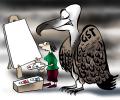
E-invoicing would be implemented on a voluntary basis by those having an annual turnover of above Rs 500 crore from January 1.

It is after the GST Network tallies invoice details with shipping bills that the refund claims can be processed. So, the refund could be delayed by over a month.
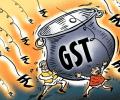
Central Board of Indirect Taxes and Customs said despite the electronic way or E-way bill mechanism there has been rampant evasion and there is a need to increase compliance.

The large drop was for export orders that were meant to be delivered until October.

Agriculture implements that are currently taxed up to 18 per cent may come under the 12 per cent or the 5 per cent bracket.
'There were lots of functionalities the Group of Ministers asked us to incorporate.'
'So far, the government has sanctioned more than Rs 300 billion as GST refunds,' Ansh Bhargava and Aditya Singhania point out.

The GST Council's agenda includes trimming the number of items in the 28 per cent slab by 75 per cent, easier compliance for assessees and small taxpayers, and a presentation on bringing real estate under GST.

The Council also discussed process to make return filing simpler with just one return to be filed every month.

After the 2019 election, one thing is sure: GST will see a number of changes, explains Indivjal Dhasmana.
 © 2026 Rediff.com - Advertise with us - Disclaimer - Privacy Policy - Sitemap - Feedback - About us - Terms of use - Grievances