
'There are unscrupulous traders who create fake invoices by showing bogus e-way bills, movement of goods.' 'Since the entities registered across different states, and kept on changing their numbers, tracing them was difficult.'

The tax department has created many circular traps -- flawed reporting formats, penalties for those who point out the flaws, and faceless assessors with no accountability. The result: Millions of taxpayers face needless harassment and procedural dead ends, highlights Harsh Roongta.

Union Minister Nitin Gadkari voiced concerns about increasing poverty and wealth concentration, advocating for wealth decentralization and job creation in rural areas. He also highlighted the need for balanced sectoral contributions to GDP and discussed infrastructure development initiatives.

To those who ask, "Is all this really worth it? Why can't domestic demand fill the gap?", it is important to remind them that only 13 economies since the Second World War have grown at 7 per cent or more for 25 years -- like India needs to. They all had one thing in common: Strong export growth underpinned by strong global engagement, explains Sajjid Z Chinoy.

The GST revenues for August 2023 have shown a growth of 11 per cent year on year due to increased compliance and less evasion, Revenue secretary Sanjay Malhotra said on Friday. The collection from Goods and Services Tax (GST) was Rs 1,43,612 crore in August 2022. "Roughly numbers are in the range of 11 per cent year on year growth as in earlier months," Malhotra told reporters.

Online sports platform Mobile Premier League has laid off around 350 people or about half of India team to cut down on expenses and bear the burden of increased GST of 28 per cent, according to an internal company email. The GST Council has decided to levy a 28 per cent GST on online gaming and casinos on the face value of bets at the entry level. The Centre will bring amendments to the Central GST law in the ongoing monsoon session of Parliament, following which states will pass the amendments in their respective assemblies to pave the way for the introduction of changes in the law by October 1.

Union Finance Minister Nirmala Sitharaman on Tuesday said the mass consumption items such as pulses, wheat, rice, flour, and curd will not attract the 5 per cent goods and services tax (GST) when sold loose, and not pre-packed or pre-labelled. The clarification came amid protests and widespread criticism by Opposition Members of Parliament over foisting GST on daily-use essentials and subsequent price rise. The all-powerful GST Council, chaired by the Union minister, had last month decided to impose GST on some mass consumption items to simplify the rate structure, which came into effect on Monday.

'Today, we have 2 million active drivers earning through our platform every month.'
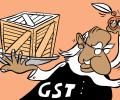
GST collection in May rose 12 per cent to Rs 1.57 lakh crore, the finance ministry said on Thursday. The gross Good & Services Tax (GST) revenue collected in the month of May, 2023 is Rs 1,57,090 crore of which Central GST is Rs 28,411 crore, State GST is Rs 35,828 crore, Integrated GST is Rs 81,363 crore (including Rs 41,772 crore collected on import of goods) and cess is Rs 11,489 crore (including Rs 1,057 crore collected on import of goods).

Bajaj Finance, IndusInd Bank, State Bank of India, Maruti, Tata Motors, ITC, Tata Steel and Reliance Industries were also among the gainers. Nestle, NTPC, Kotak Mahindra Bank, Power Grid and Titan were among the laggards.

If India caves in to US pressure as Trump hopes it will, he will further try to blackmail it into submission, points out Ramesh Menon.

School students in Rajasthan will no longer study two-part supplementary textbooks with state Education Minister Madan Dilawar arguing that these reading materials are not required because they glorify the Nehru-Gandhi family and carry no marks for students.

India's real GDP growth in FY26 will slide further to 6.2 per cent in FY26 from 6.5 per cent in FY25, a Japanese brokerage said on Monday. In a research report, Nomura said there is a "divergence" between the growth in GST collections and across other high-frequency growth indicators like auto sales and bank credit growth.

Equity markets will take cues from the US tariff related developments, global trends and trading activity of foreign investors this week, analysts said.

'The quality of justice is directly linked to the quality of judges -- if that suffers, justice delivery suffers.'

If the GST on paneer is 5% and the GST on butter is 12% and the GST on masala is 5%...
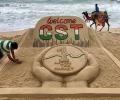
Six years after the rollout of the biggest indirect tax reform in India, Goods and Services Tax (GST) revenue of Rs 1.5 lakh crore every month has become a new normal and tax officers are focusing on dealing with fraudsters who are adopting newer modus operandi to game the system, causing loss to the exchequer. To apprehend black sheep, who operate as syndicates and create fake entities on the basis of forged documents to claim input tax credit (ITC), tax officers have started using data analytics, artifical intelligence and machine learning aiming to curb evasion, which was over Rs 3 lakh crore since inception of GST. It was over Rs 1 lakh crore in 2022-23. Thinktank Global Trade Research Initiative (GTRI) said the most critical pending GST reform is upgradation of GST Network to prevent fake supplies and fraudulent claims of Input Tax Credit (ITC).
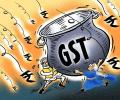
GST collections rose 12 per cent to over Rs 1.61 lakh crore in June, the finance ministry said on Saturday. The gross GST collection has crossed Rs 1.60 lakh crore mark for the fourth time since the roll-out of the indirect tax regime six years ago on July 1, 2017. The average monthly gross GST collection for the first (April-June) quarter of the 2021-22, 2022-23 and 2023-24 are Rs 1.10 lakh crore, Rs 1.51 lakh crore and Rs 1.69 lakh crore, respectively, the finance ministry said in a statement.
It is now becoming increasingly clear that rising imports have played a significant role in sustaining the buoyancy in revenues from GST, notes A K Bhattacharya.
Taiwan in 1951 came up with an ingenious plan to improve tax compliance: citizens taking receipts for purchases could use them as lottery tickets. Customers were incentivized, and businesses found it hard to evade taxes. The plan's success prompted other countries, Slovakia and Greece among them, to launch similar initiatives. India doesn't seem to find the need yet for such schemes amid surging goods and services tax (GST) collections.

Packed frozen 'paratha' is not 'roti or chapatti' as it requires further cooking before consumption and despite wheat flour being the 'common thread' there are other ingredients used in making parathas, said an order by the Gujarat Appellate Authority for Advance Ruling. Such parathas, whether named Malabar, Mixed vegetable, Onion, Methi, Alu, Laccha, Mooli or Plain, have ingredients like margarine, salt, emulsifying agent, oil, potato, peas, cauliflower, coriander powder, bread improver and water, apart from wheat flour, which make 'quite different' from plain roti or chapatti and hence are not eligible for 5 per cent Goods and Services Tax (GST) rate, the ruling said. The percentage of wheat flour used by Vadilal Industries, which had approached the AAAR, in the eight varieties of paratha manufactured and supplied by it ranges from 36-62 per cent, whereas the ingredient for plain roti or chapatti is wheat flour apart from water.

Foreign companies now pay less tax relative to their earnings than at any time in more than three decades. Foreign private companies paid 24.36 per cent of their pre-tax profit as tax in 2023-24, show numbers from the Centre for Monitoring Indian Economy (CMIE).

Provisions in the Central GST Act say reduction in GST rates or the benefit of ITC must be passed on to consumers.

The eight-month intensive programme is designed to help professionals develop comprehensive expertise across both data science and decision science, said IIT-Delhi.
Overhaul of the goods and services tax (GST) structure, including possible changes in the tax slabs, may now be taken up only after the 2024 Lok Sabha elections, given the number of states that are going to the polls in its run-up. "No major overhaul of tax rates is expected in GST until the end of next fiscal year. One major reason for this is that some members of the group of ministers (GoM) - mandated to look at rate rationalisation by the GST Council - are from poll-bound states. Later, this may lead to reconstitution of the panel," a senior government official told Business Standard. Besides, both the Centre and states are not in favour of frequent changes in the tax rates amid inflationary uncertainties; they believe any major change should be brought in after extensive deliberations, according to the official.

While demand for sub Rs 50-lakh affordable housing prevails, market players cite increased land rates, escalated construction costs and low margins as key prohibiting factors.
GST collections in March grew 13 per cent to the second highest ever at Rs 1.60 lakh crore, taking the growth rate of revenue mop-up for full 2022-23 fiscal to 22 per cent. March also saw over 91 per cent of the GST registered businesses filing returns and paying taxes - reflecting greater compliance and improving economic activity. Gross GST revenue collected in March 2023 is Rs 1,60,122 crore, of which Central GST is Rs 29,546 crore, State GST is Rs 37,314 crore, Integrated GST is Rs 82,907 crore (including Rs 42,503 crore collected on import of goods) and cess is Rs 10,355 crore, the finance ministry said in a statement.

Tax evaders, BEWARE! The Income Tax department is using AI data analytics to bust fake deductions, flag HRA fraud, and trace digital footprints.
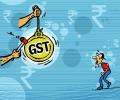
The broad trends of GST collections will make you wonder if indeed the biggest indirect tax reform in the country has led to a real improvement in revenues, notes A K Bhattacharya.

The government on Friday said GST will not be applicable on residential units if they are rented out to private persons for personal use. The government dismissed media reports which claimed that there is an 18 per cent Goods and Services Tax (GST) on house rent paid by tenants. In a tweet, the government said GST would be levied only when the residential unit is rented out to a business entity.
GST collection grew by 12 per cent in April to Rs 1.87 lakh crore, the highest monthly mop-up since the rollout of the indirect tax regime. The gross GST revenue collected in the month of April 2023 is Rs 1,87,035 crore of which CGST is Rs 38,440 crore, SGST is Rs 47,412 crore, IGST is Rs 89,158 crore (including Rs 34,972 crore collected on import of goods) and cess is Rs 12,025 crore, the finance ministry said in a statement. The previous high collection of Rs 1.68 lakh crore was in April last year.

The share of EVs in the luxury segment rose from 7 per cent in January-May 2024 to 11 per cent during the same period in 2025, marking a 66 per cent growth in the electric luxury segment.

The government has notified a host of procedural changes in the GST rules, including levy of interest for wrongful utilisation of ITC and turnover threshold for filing annual returns for the 2021-22 fiscal. The changes were vetted by the Goods and Services Tax (GST) Council at its meeting last week. With the amendments notified by the Central Board of Indirect Taxes and Customs (CBIC), businesses have also been allowed to make tax payments on the GSTN portal by using IMPS and UPI payment modes.

Yadav further accused the BJP of "using distractions" to avoid addressing real issues such as rising unemployment, inflation, lack of investment in Uttar Pradesh, and failing healthcare facilities.

GST authorities have expanded the probe into alleged tax evasion by fintech firm BharatPe to include reported issuance of fake invoices by those close to the firm's ousted co-founder Ashneer Grover, an official said. GST authorities are now scrutinising BharatPe books of the last four years to see if bogus invoices were issued for services as well. BharatPe had stripped Grover and his wife Madhuri Jain of all positions after a preliminary report of an external audit commissioned by the fintech firm's board showed that the duo indulged in alleged misdeeds and financial irregularities.
Expanding investigation into allegedly wrongful claims of input tax credit by insurance companies, the tax authorities are probing a section of automobile dealers who have supposedly generated fake invoices without providing any service, which is a punishable offence under goods and services tax (GST) law. The authorities are learnt to have questioned the car dealers to explain the services they provided general insurance companies. The investigators suspect car dealers pitched for insurance schemes that give them commissions in excess of those insurance regulations permit.

Dream11, Baazi Games, Zupee and WinZO among others are invited for the discussion with the anti-money laundering watchdog.

'You've got to understand it is not easy to die by suicide.' 'People commit suicide only when they lose everything and find no other way to live.'
GST collections rose 12 per cent to over Rs 1.49 lakh crore in February, the finance ministry said on Wednesday. February 2023 witnessed the highest cess collection of Rs 11,931 crore since implementation of GST. The collections are, however, lower than the second highest Goods and Services Tax (GST) mop-up recorded in January at over Rs 1.57 lakh crore.

They are not just underreporting income; they are reshaping what the income tax system perceives, says study.
