Discrepancies in computation of advance estimates of the country's Gross Domestic Product for 2023-24 stood at Rs 2.59 lakh crore as against (-) Rs 3.80 lakh crore in 2022-23 and (-) Rs 4.47 lakh crore in 2021-22, according to National Statistical Office (NSO). On Friday, the NSO released its first advance estimates of national accounts which showed that the Gross Domestic Product (GDP) or Indian economy will grow at 7.3 per cent in 2023-24, slightly higher than 7.2 per cent in 2022-23.

'Will this near-war, India's strongest military response so far, buy India another seven years of deterrence?' asks Shekhar Gupta.

Whether nominal or real, India's investment rate needs to increase by 3 to 4 percentage points of GDP to support 8 per cent real growth, recommends Nikhil Gupta.

Azmi said during Aurangzeb's reign, India's border reached Afghanistan and Burma (Myanmar).

The repo rate cut by 25 basis points by the monetary policy committee (MPC) of RBI announced Friday will give a long-awaited relief on interest rates and also be supportive of economic growth, according to experts. Repo rate is the interest rate at which the RBI lends money to commercial banks.
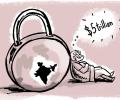
India will become the world's third largest economy by 2026 as its GDP in current dollar terms will reach $5 trillion in that year and further rise to $5.5 trillion in 2027, former Niti Aayog vice chairman Arvind Panagariya said on Friday. Delivering the 18th C D Deshmukh Memorial Lecture titled 'India at 125: Reclaiming the Lost Glory and Returning the Global Economy to the Old Normal', he said it is unlikely that GDP in current dollar terms of either Germany or Japan will cross $5 trillion-mark in the coming three years. Japan will have to sustain a growth rate of 3.5 per cent in current dollar terms to reach $5.03 trillion in 2027 from its 2022 level of $4.2 trillion, he said.

India's current account deficit declined sharply to 1 per cent of the GDP or $8.3 billion in the second quarter of this financial year, mainly due to lower merchandise trade deficit and growth in services exports, according to a RBI data released on Tuesday. The current account deficit (CAD), which represents the difference between the total amount of money sent abroad and money received from overseas across the economy, was 3.8 per cent of GDP or $30.9 billion in the July-September quarter in 2022-23. CAD was $9.2 billion or 1.1 per cent of GDP in the first quarter (April-June) of the current financial year 2023-24.

India's service sector activity accelerated slightly in April largely driven by a quicker increase in new order inflows, which also underpinned a faster expansion in employment, a monthly survey said on Tuesday. The seasonally adjusted HSBC India Services PMI Business Activity Index reached 58.7 in April, up from 58.5 in March, indicating a sharp and stronger expansion in service sector output.

The government in FY26 Budget should announce an "effective" personal income tax cut to support consumption and demand, Barclays said on Thursday. In its FY25-26 Union Budget preview, Barclays said the key ask from the Budget, to be presented on February 1, is to support growth while adhering to fiscal consolidation path.

Geopolitical tensions, trade policy uncertainties, volatility in international commodity prices and financial market uncertainties pose considerable risks to India's economic growth in the coming year, the finance ministry cautioned on Wednesday. "Global trade continues to be affected by uncertainty in the policy environment... tariff-related developments in multiple countries have heightened trade-related risks, affecting investment and trade flows globally.

The economy may grow by around 7 per cent this financial year as estimated by the Monetary Policy Committee (MPC) of the Reserve Bank of India (RBI), say economists with various organisations. The first advance estimates for 2023-24 will be released on Friday by the National Statistical Organisation (NSO), an exercise done for calculating ratios such as the fiscal deficit. The interim Budget will be presented on February 1.

For India to transform into a high-income country with a projected gross domestic product (GDP) of $23-35 trillion, will need a sustained annual growth of 8 per cent to 10 per cent. This will be powered by India's demographic dividend, technological innovation, and sectoral transformation, according to the "India@2047: Transforming India Into A Tech-Driven Economy" report by Bain & Company and Nasscom. By 2047, the services sector is expected to contribute 60 per cent of India's GDP, while manufacturing will account for 32 per cent, both playing a pivotal role in economic expansion.

The US Fed interest rate decision, trading activity of foreign investors and quarterly earnings from corporates would largely drive the momentum in the equity market this week, analysts said. Escalating tensions between India and Pakistan over the Pahalgam terror attack will also remain on investors' radar, they added.

S&P Global Ratings on Wednesday said the impact of the US reciprocal tariff will be limited on India as the economy is domestically oriented with less reliance on exports. YeeFarn Phua, Director, Sovereigns and International Public Finance Ratings, Asia-Pacific S&P Global also said India will clock a 6.7-6.8 per cent GDP growth over the next two years.

'We have to retain some fiscal headroom without compromising on the promised fiscal consolidation roadmap.'

Prime Minister Narendra Modi officially commissioned the Vizhinjam International Seaport on Friday in Thiruvananthapuram in the presence of Chief Minister Pinarayi Vijayan and senior Congress leader Shashi Tharoor, whose presence at the inauguration, Modi said, will give 'sleepless nights' to many.

Economies of Punjab, Andhra Pradesh, Madhya Pradesh, Uttarakhand and Haryana may have grown at a slower pace than the national economy during 2022-2023.

'...how do they consume and contribute to the GDP?'

'I believe that the overall demand for commercial vehicles will improve, even though there is a slowdown in the GDP.'

Retail inflation eased to a nearly six-year low of 3.16 per cent in April mainly due to subdued prices of vegetables, fruits, pulses, and other protein-rich items, creating enough room for the Reserve Bank to go for another round of rate cut in the June monetary policy review. The Consumer Price Index (CPI) based inflation was 3.34 per cent in March and 4.83 per cent in April 2024. It was 3.15 per cent in July 2019.

The prospect of protracted uncertainties in the global economic landscape not only pose a risk for India's growth outlook in 2025-26, but are also likely to dent the private sector's capital raising and investment plans, the finance ministry averred on Tuesday, cautioning the country's corporates that the era of 'easy pickings' was over.

'For the first time in this country, perhaps the first time anywhere, we are going to use backwardness index.' 'It is a fundamental shift in the discourse in the country's social justice.'

While this will incur a revenue loss amounting to 0.2 per cent of GDP, it will provide a strong boost to consumer sentiment and spending, points out Rajani Sinha.

Investors should avoid making drastic changes to their asset allocation during a market correction.

While growth in India is largely domestic and hence the overall GDP effect may not be more than 0.15-0.2%, but overall trade will be impacted due to every country going back to the drawing board, points out Madan Sabnavis.

'The finance minister missed yet another opportunity to simplify the income tax structure in the Budget.' 'This was an opportune moment to get rid of the old tax system entirely and move fully to the new system,' asserts M Govinda Rao, member of the 14th Finance Commission.

A Mumbai court has granted anticipatory bail to Samajwadi Party MLA Abu Azmi in a case filed against him for his remarks praising Mughal ruler Aurangzeb. The court, however, cautioned Azmi to exercise restraint during interviews, warning that any irresponsible statement could spark riots. The case stems from Azmi's remarks during an interview where he praised Aurangzeb's rule and claimed that India's GDP during his reign accounted for 24 percent of the world's GDP. Azmi's lawyer argued that his client's statements were made spontaneously and without any malicious intent, while the prosecution opposed the bail plea, arguing that the remarks were made in a sensitive time following the release of a film based on the life of Chhatrapati Sambhaji Maharaj, a revered Maratha king who was captured by Aurangzeb. The court noted that the investigation was at a preliminary stage and that the investigating officer did not have the video recording of the interview when the case was filed. The court also expressed concern over the potential for Azmi's remarks to incite violence.

Prime Minister Narendra Modi asserted on Tuesday that India's water will no longer flow outside the country but will be utilized in the nation's interest, a statement seemingly directed at Pakistan following his government's decision to put the Indus Waters Treaty in abeyance after the Pahalgam terror attack. Addressing the ABP Network's 'India@2047' Summit, Modi emphasized his government's focus on interlinking rivers, noting that water used to be a source of conflict among states, before alluding to India's stance against Pakistan while discussing water. He highlighted the finalization of the India-UK free trade agreement as a historic milestone and underscored the importance of prioritizing national interest for achieving objectives and realizing the country's potential. Modi highlighted the country's growth and development under his government's rule, emphasizing its focus on welfare schemes and digitalization. He reiterated his government's commitment to 'Nation First' and pointed to the recent reforms undertaken, including the new Waqf law and the ban on triple talaq, which he said were aimed at benefiting the marginalized sections of society.

"The new structure will substantially reduce taxes on the middle class and leave more money in their hands, boosting household consumption, savings and investment," Sitharaman said presenting what was dubbed as 'reformist' budget for the next fiscal in Lok Sabha.
'The government has to explain (to the army, air force and navy chiefs) whether they want a punitive strike, a deep punitive strike, or whether they want limited war or an all-out war, will it be a circumscribed war or will it be a shallow attack along the border.'

Fitch Ratings on Thursday raised its forecast for India's economic growth to 6.3 per cent for current fiscal year 2023-24 from 6 per cent it had predicted previously. This is primarily because of a stronger outturn in the first quarter and near-term momentum. The growth forecast compares with 7.2 per cent GDP expansion in FY23. In the previous fiscal year (FY22), the economy had grown 9.1 per cent.

The government may save over Rs 70,000 crore (Rs 700 billion) on capital and revenue expenditure allocated towards new schemes in the FY25 Budget that are yet to be implemented.

India's services sector activity witnessed a sharp uptick in February boosted by improving domestic and international demand, which resulted in a quicker expansion in output and a substantial increase in employment, a monthly survey said on Wednesday. The seasonally adjusted HSBC India Services PMI Business Activity Index rose from January's 26-month low of 56.5 to 59.0 in February, indicating a sharp rate of expansion.

Escalating trade tensions amid a tariff war after Donald Trump took over as President of the United States (US) could adversely impact global growth and fuel inflation, an article on the "State of the Economy" in the Reserve Bank of India (RBI) monthly bulletin said.

The Centre's fiscal deficit touched 74.5 per cent of the annual target at the end of January 2025, according to the data released by Controller General of Accounts (CGA) on Friday.

The sweeping tariffs proposed across sectors by US President Donald Trump are scheduled to be imposed starting April 2, with most analysts worried about their impact on companies, and in turn the financial markets. Recently, the US administration signaled that it will impose sectoral tariffs on energy, pharmaceuticals, semiconductors, agriculture, copper, and lumber.

Global trends, tariff-related updates and trading activity of foreign investors would be the key drivers for the equity market movement this week, analysts said. Markets witnessed a strong rebound last week, with the benchmark indices surging over 4 per cent.

India's services sector activity eased slightly in March, weighed down by a marginal slowdown in sales amid softer demand conditions and easing inflationary pressures, a monthly survey said on Friday. The seasonally adjusted HSBC India Services PMI Business Activity Index fell from February's reading of 59.0 to 58.5 in March, but remained above its long-run average of 54.2.

The risk-reward for the Indian markets, Morgan Stanley said, is turning favourable.

'War is not an answer. War is not a solution.' 'Deterrence is a solution. We should have the stick with us with which we can beat Pakistan.'
 © 2026 Rediff.com - Advertise with us - Disclaimer - Privacy Policy - Sitemap - Feedback - About us - Terms of use - Grievances