
The highest collection target has been given to Mumbai at Rs 4.39 trillion, followed by Delhi and Bengaluru.

As a percentage of the aggregate Budget expenditure, it is 12 per cent.

Using the debt-to-GDP ratio as a fiscal anchor aligns with efforts to promote fiscal transparency through proper disclosure of off-budget borrowings.

The fast-growing Indian online gaming sector is facing a significant threat from money laundering, necessitating urgent steps to ensure its sustained success and protect the country's robust digital economy, a report said on Thursday. The essential measures outlined in a report by the Digital India Foundation include forming a dedicated task force for illegal operators, creating a whitelist of legal operators, combating misleading advertisements, and incorporating principles of financial integrity and international cooperation.

Collectively, these companies spent Rs 628 crore (Rs 6.28 billion) on political contributions in the past five years, according to their annual reports.

According to Fitch rupee is expected to weaken to 72 to a dollar by the end of December 2019, and further to 73 by December 2020, from 69.82 to a dollar in end December 2018.

Infosys chairman Nandan Nilekani voluntarily chose not to receive any remuneration for his services.

The production linked incentive scheme (PLI) for automobile and auto components has so far attracted a proposed investment of Rs 67,690 crore, said Economic Survey 2023-24 tabled in Parliament on Monday. A capital of Rs 14,043 crore has been invested till end-March 2024, it stated. Applicants have proposed employment generation of 1.48 lakh, against which 28,884 of jobs have been generated till March 31, 2024, the Economic Surevy 2023-24 stated.

The number of cyberfraud cases has skyrocketed from 2,677 in 1999-2000 to 29,082 in FY24 -- more than a 10-fold increase. The RBI pegs digital payment frauds at Rs 1,457 crore in FY24, up more than five times in a year. It's not just the number of frauds. What's alarming is the growing sophistication of the fraudsters, exposing the vulnerabilities within the financial system, observes Tamal Bandyopadhyay.

Fitch reaffirmed India's rating at 'BBB-' with a Stable Outlook saying the rating balances a still strong medium-term growth outlook compared with similar category peers and relative external resilience stemming from solid foreign-reserve buffers against high public debt, a weak financial sector and some lagging structural factors, including governance indicators and GDP per capita.

Honda Cars India (HCIL) net profit dropped by 52.8 per cent year-on-year (Y-o-Y) to Rs 661.4 crore in 2023-24 (FY24), primarily due to deferred tax of Rs 359.8 crore, according to the annual results submitted to the Registrar of Companies (RoC) and reviewed by Business Standard. In FY24, the company's production increased by 16 per cent Y-o-Y to 134,807 units.

The road ahead will require navigating complex financial challenges while fostering job creation and sustainable development in the region.

'Retail investors, who had not seen such a massive correction in the SMID universe since COVID-19, are witnessing something like this for the first time. Panic profit booking may continue.'

'The race is now on for Indian IT firms to develop their AI prowess and focus on a software-first approach to services as the people element becomes more complicated with Trump's expected new regulations.'

Shares of healthcare services major Max Healthcare Institute have gained over 23 per cent since the start of this month and the stock crossed the Rs 1 trillion mark on September 24. On September 25, it closed 989.85 apiece at the NSE. The gains were cornered on the back of a strong outlook for the sector and aggressive expansion plans for the chain led by acquisitions and organic growth.

This is due to the newly formed Union Territories of Jammu and Kashmir, and Ladakh, which will get funds from the Centre's share, which means devolution will be for 28 states compared to 29 earlier.

Direct tax collection, net of refunds, moderately exceeded the revised estimates (RE) for the financial year 2023-24 (FY24) on the back of personal income tax revenues, but corporation tax receipts fell short of the RE. Net direct tax collection stood at Rs 19.58 trillion in FY24, surpassing the RE of Rs 19.45 trillion by Rs 13,000 crore, or 0.7 per cent. The government had revised up FY24 projections for personal income tax by 13.5 per cent over the Budget estimates (BE) of Rs 9 trillion, at Rs 10.22 trillion.

Ekagrah Rohan Murty, NR Narayana Murthy's five-month-old grandson who was gifted a whopping 15 lakh shares by the Infosys founder recently, is set to earn Rs 4.20 crore, thanks to the Bengaluru-IT company declaring a bumper final and special dividend totalling Rs 28 per share. Murthy had gifted 15 lakh shares to Ekagrah valued at a staggering Rs 240 crore at that time, making the five-month-old the youngest millionaire shareholder of India's second-largest IT company.

Companies in the banking, finance sector and insurance (BFSI) sector have underperformed on the bourses despite leading the earnings growth charts in the post-pandemic period. This has created a dichotomy between their earnings and share prices. BFSI companies have never been less expensive than the rest of the equity market.

Here are the key decisions announced by the Reserve Bank of India on Thursday.

'A mule operates someone else's account to transfer illegal money.'

Taxpayers who have not e-verified their ITRs for 2019-20 fiscal can complete the verification process by February 28, 2022, as the Income Tax department has given a one-time relaxation to assessees. As per law, an income tax return (ITR), filed electronically without a digital signature, has to be verified electronically through Aadhaar OTP, or net-banking, or code sent through demat account, pre-validated bank account and ATM within 120 days of filing the return. Alternatively, taxpayers can send a physical copy of the ITR filed to the Centralised Processing Centre (CPC) office in Bengaluru.

Concerns have been raised over Marico's exposure to Bangladesh in the wake of turmoil in that country. However, the management reiterated expectations of growing domestic business at double digits and maintaining international growth. Marico scaled up its food business by 4 times between FY20-24 and aims to double it again in the next three financial years.

Research and development (R&D) spending by BSE 100 companies has grown steadily, rising from 0.89 per cent of revenue in FY20 to 1.32 per cent in FY24, averaging around 1 per cent over the period in-between, according to data compiled from Bloomberg and company annual reports. Also, these companies more than doubled their R&D spending in absolute terms over these five years: From Rs 25,041 crore to Rs 63,072 crore. While this reflects a prioritisation of innovation, corporate R&D investment remains relatively conservative.

In mid-March this year, the finance ministry asked state-run banks to review their gold loan portfolio for the two-year period between January 1, 2022, and January 31, 2024. This business had grown at a fast clip. Reserve Bank of India (RBI) data has it that it grew 15 per cent to Rs 1 trillion in FY24. Now, in recent times, any kind of exuberance in financial services has seen the authorities swoop down - be it pushing the lines on governance or unsecured credit.

Once declared a dud stock, Suzlon has generated stellar returns for investors thus far this calendar year. On a year-to-date (YTD) basis, Suzlon's share price has doubled investor wealth by soaring 109.35 per cent on the bourses. By comparison, the benchmark BSE Sensex has gained just 11.2 per cent.
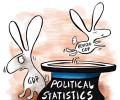
The SBI report, however, said the economic growth rate will pick up pace in 2020-21 to 6.2 per cent.

Asia's richest man Mukesh Ambani drew nil salary from his oil-to-telecom-and-retail conglomerate Reliance Industries for the fourth straight year in a row while his children earned a sitting fee and a commission for being on the board of India's most valuable company. Ambani, 67, had capped his annual remuneration at Rs 15 crore from financial year 2008-09 (April 2008 to March 2009) to 2019-20 (FY20); and since FY21, he opted to forego his salary, due to COVID-19 pandemic, until the company and all its businesses were fully back to their earnings potential.

The stock of Mahindra & Mahindra (M&M) has been touching successive all-time highs on the bourses and, over the past year, gained 81 per cent. While the S&P BSE Auto Index has not performed poorly, registering gains of 73 per cent, it still trails the company by 800 basis points (bps) during this period. There are multiple reasons why investors are beating a path to M&M's counter.

The net debt of top eight realty firms fell 43 per cent to Rs 23,000 crore last fiscal, from around Rs 40,000 crore in 2019-20, as their cash flow improved on strong housing sales, according to Anarock. Real estate consultant Anarock noted that the unfettered demand for housing across the country has enabled the country's leading large and listed developers to reduce their debt. Anarock analysed financial performances of the top eight developers engaged in the development of residential real estate.

The Indian economy needs to generate an average of nearly 78.5 lakh jobs annually until 2030 in the non-farm sector to cater to the rising workforce, according to the Economic Survey for 2023-24. The Survey tabled in Parliament on Monday also laid emphasis on the private sector's role to create employment in the country saying "In more than one respect, the action lies with the private sector. "In terms of financial performance, the corporate sector has never had it so good."

'The lack of opportunities here remains the biggest worry.' 'We have seen investment summits, but if you look around, much of it is only on paper and not on the ground.'

The stock of Voltas, the country's largest room air- conditioner (RAC) maker, is up 22 per cent in the past three months. Robust demand on the back of a sweltering summer, distribution expansion, slew of launches and backward integration are expected to forge a good operating performance for the company. In the core RAC segment, there are multiple triggers for the company.

'The nominal GDP growth assumption for FY25 may be revised upwards on higher growth expectations.'

Shares of Avenue Supermarts (DMart) have gained about 5 per cent over the past week on better than expected June quarter (Q1FY25) performance, hopes of a recovery in discretionary demand, and margin gains going ahead. The key takeaway from the results was the robust gross margin performance. Riding on improving mix, DMart posted a 34 basis point year-on-year (Y-o-Y) improvement in gross margins to 14.9 per cent.

Rishad Premji, chairman of IT services major Wipro, saw his compensation for FY23 decline by almost 50 per cent year-on-year, due to a fall in the firm's profit. According to the Form 20-F, filed with the US Securities and Exchange Commission by Wipro, Premji's compensation for FY23 was $951,353, down 50 per cent from $1,819,022 in FY22. "Rishad A Premji is entitled to a commission at the rate of 0.35 per cent on incremental consolidated net profits of Wipro Limited over the previous fiscal year. However, in light of the fact that the incremental consolidated net profits for fiscal year 2023 was negative, the Company determined that no commission was payable for fiscal year 2023 to Mr Rishad A. Premji," said the company in the filing.

More and more women are making their presence felt in jobs related to sciences, technology, and engineering across organisations.

Growth rate in per capita income is projected to fall to the lowest in 21 years this financial year - except for the financial years 2019-20 (FY20) and 2020-21 (FY21) - according to the first advance estimates. During the last 21 years, the two periods - FY20 and FY21 - saw growth rates in per capita income lower than 7.9 per cent, seen during FY24. This was despite the real gross domestic product (GDP) being projected to grow by 7.3 per cent in the current financial year by the first advance estimates.

'Investors should not go for lump-sum investments in infrastructure funds at this point.' 'The SIP route is the best to avoid any major disappointment.'

The agency attributed the sharp revision to various high-frequency indicators showing a softness and partly blamed the same to reforms like GST, real estate regulation, and the bankruptcy code which are still a "drag" on the economy.
