Benchmark Sensex pared early losses to close 242 points higher while Nifty settled above the 18,000-mark on Wednesday following gains in IT, oil and select banking stocks amid mixed global trends. Extending gains for a second day, the 30-share BSE Sensex advanced 242.83 points or 0.40 per cent to close at 61,275.09 with 20 of its constituents ending in the green. The index opened lower at 60,990.05 but later regained foot to touch a high of 61,352.55 in day trade.

Benchmark BSE Sensex rose by 319 points on Monday on gains in IT and financial stocks after positive quarterly results amid supportive global cues. The 30-share BSE barometer rose by 319.90 or 0.53 per cent to close at 60,941.67. The index opened higher and gained more than 400 points to scale the 61,000 level. It touched a high of 61,113.27 and a low of 60,761.88 in the day.

Among Sensex stocks, Tata Motors rose the most by 2.79 per cent. NTPC, Reliance Industries, Infosys, TCS, HDFC twins, Tata Motors, ITC, Power Grid and Bajaj Finserv were among the major gainers. Tata Steel fell the most by 1.22 per cent. L&T, Sun Pharmaceuticals, IndusInd Bank and Ultratech Cement were among the losers.

Ivan Manuel Menezes, the India-born CEO of the world's biggest spirits company Diageo, died on Wednesday, days after being hospitalised for treatment of stomach ulcer. Menezes, 64, who was to retire at the end of this month, died in London, the company said. "It is with great sadness that Diageo announces that Sir Ivan Menezes has passed away following a brief illness, with his family at his side," it said in a statement. Diageo had on Monday announced that CEO-designate Debra Crew will assume the top role on an interim basis immediately as Menezes undergoes medical treatment.

ITC, Sun Pharma, Maruti, M&M, Tata Motors, HCL Tech, Wipro, Infosys, HUL, Bharti Airtel and Reliance were among the major losers. Kotak Bank rose the most by 1.59 per cent, followed by IndusInd Bank, Bajaj Finance and Bajaj Finserv. L&T, SBI, TCS and HDFC Bank also closed higher.

Among Sensex shares, Bajaj Finserv fell the most by 4.08 per cent. Bajaj Finance declined by 3.01 per cent, Tata Steel by 2.2 per cent, Wipro by 2.09 per cent, Tata Motors by 1.96 per cent, IndusInd Bank by 1.9 per cent, SBI by 1.75 per cent, Tech Mahindra by 1.66 per cent and HCL Tech by 1.2 per cent. TCS, Infosys, Power Grid, Maruti, Reliance, HDFC twins, L&T, M&M, NTPC and Ultratech Cement were also among the losers.

Benchmark Sensex trimmed early gains to close marginally higher while Nifty settled flat in choppy trade on Tuesday as gains in auto shares were offset by selling pressure in banking and energy shares. The 30-share BSE barometer closed marginally up by 37.08 points or 0.06 per cent to 60,978.75 with 15 of its stocks ending in green and the rest in red. The index opened higher and gained over 300 points to a high of 61,266.06 in early trade.

Benchmark Sensex declined 224 points on Wednesday, snapping its four-session winning streak, mainly due to sell-off in IT and pharma counters amid rising concerns over possible aggressive interest rate hikes to tame high inflation. The 30-share index rebounded more than 1,200 points from the early lows before settling at 60,346.97 points, a total loss of 224.11 points or 0.37 per cent compared to Tuesday's closing level. The broader NSE Nifty closed lower 66.30 points or 0.37 per cent at 18,003.75 points.
Zomato could get added to the MSCI and FTSE indices by the end of this year, while an entry to the Nifty or the Sensex would be challenging before the second half of 2022, said Brian Freitas, an analyst at independent research provider Smartkarma, in note. "With nearly the entire pre-IPO shares locked up for one year, the free float will be very low and the stock will need to move higher to around Rs 328 per share (4.3 times over possible IPO price of Rs 76) to be included in the Nifty index (with no change in the market cap of the smallest index constituent). "We can be reasonably certain that Zomato will not be included in the Nifty index till the September 2022 rebalance at the earliest," he said.

Kotak Bank was the top gainer in the Sensex pack, rising over 5 per cent, followed by Bharti Airtel, HDFC Bank, Maruti, Axis Bank and Nestle India.
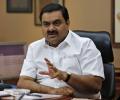
The clarification by the National Securities Depository (NSDL) - which is tasked with monitoring foreign portfolio investor (FPI) investment in domestic stocks - that the accounts of top investors in Adani group stocks remain 'active' has helped prevent a $500-million selloff of shares. Analysts said a freeze of the FPI accounts, as reported by some media outlets, could have prompted global index providers to cut weighting of four Adani group companies from their global indices. Brian Freitas, an analyst at independent research provider Smartkarma, said if the FPI accounts were indeed frozen, FTSE and MSCI would have reduced weighting of Adani group companies at the next rebalance, since it would have meant that the large part of the free float was not tradeable.

It has been a choppy calendar year 2022 (CY22) for global financial markets amid the spectre of rising inflation that led most central banks, especially the US Federal Reserve (US Fed), to tighten their monetary policy. Most equity indices across the globe have seen a sharp fall from their respective peak levels in this backdrop. FTSE India, for instance, has corrected 16 per cent from its October peak.

The index compiler will add Coal India's stock into FTSE All-World Index and FTSE All-Emerging Index on a fast entry basis.

Corporate India lags the rest of its Western and Asian peers by a wide margin when it comes to the presence of women on their boards, with just 17.3 per cent of the large companies having them on their key decision making bodies, an international report said on Tuesday. However, this is a near 6 percentage points improvement between 2015 -- when it was only 11.4 per cent -- and 2021, Swiss brokerage Credit Suisse said in the report, which covered over 33,000 executives from more than 3,000 companies across 46 countries, including over 1,440 firms across 12 Asia-Pacific markets. Female representation on boards of large Indian companies has increased by 5.9 percentage points from 11.4 per cent in 2015 to 17.3 per cent in 2021.
Life Insurance Corp of India (LIC), which is aiming to launch its initial public offering (IPO) next month, is set to alter the pecking order of top listed companies in the country. Depending upon where the government prices the IPO, the stock could end up becoming India's most valuable company on the first day and even get fast-tracked into global benchmark indices given its sheer size. According to market sources, LIC's IPO is targeting to mop up Rs 63,000 crore and Rs 75,000 crore.

The finance ministry said the sharp inflows last fiscal were due to the government's policy initiatives and economic recovery.

All Sensex components ended in the red, with Tata Steel cracking 6.39 per cent, followed by ONGC, Maruti, Titan, ICICI Bank, HDFC and Bharti Airtel.

Indian stock market indices have climbed close to their all-time highs, even as key overseas indices such as the Dow Jones, FTSE 100 and Nikkei 225 are reeling under the sub-prime meltdown in the US.

While Nifty 50 reflects changes in 40 years, it also shows what is missing: Low-cost manufacturers at one end, and deep-value players at the other. Also missing are technology players, observes T N Ninan.

So far this month, another $4.5 billion (Rs 33,000 crore) has flown into domestic stocks.

The S&P BSE Midcap and the S&P Smallcap indices rallied over 1% each

The pound lost as much as 2 per cent, a fall not seen since early 2009

The Indian markets are poised on a knife's edge testing the pivotal level of 5950, this time from the topside. Should the level hold, expect further rally to the topside, says Sonali Ranade

Price bands for the benchmark equity index derivatives will be same as that applicable for the existing stock index futures contracts.

The biggest gainers on both the bourses were Reliance Industries, Infosys, NTPC, ONGC, HUL, PowerGrid, Asian Paints, ITC and HCL Tech, rising up to 2 per cent.
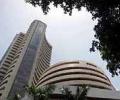
The Sensex ended below 17,500 on Wednesday amid profit taking in index heavyweights after sharp gains on Wednesday that saw the benchmark index ending at a 4-month closing high. Weakness in Europe also dampened sentiment.
BSE Power, Realty, Auto and PSU indices ended almost 1% down

Albanese, 56, will take the helm on April 1.
A weak rupee and strong global markets make a case for investing in foreign funds, but themes have to be chosen carefully.

The overall breadth was negative with 1,867 stocks declined and 1,004 advanced.

The benchmark share indices ended over 1.6 per cent down on Monday, amid weak global cues, weighed down by selling in bank shares after an RBI panel proposed strict norms for loan restructuring. The Sensex slipped 281 points or 1.6 per cent to close at 16,877 and the 50-share Nifty plunged 87 points or 1.7 per cent to close at 5,118 levels.

The fall was led by banking stocks, with IndusInd Bank, Kotak Bank, Federal Bank, Axis Bank, ICICI Bank, HDFC Bank and SBI declining up to 2.36 per cent.
The market breadth ended slightly positive with 1,448 shares advancing and 1,364 shares declining.
The Nifty ended up 113 points at 5,050.

The overall breadth was neutral as 1,362 stocks advanced while 1,331 stocks advanced.

The biggest losers of the session include Reliance, Infosys, TCS, ICICI Bank, HDFC twins, ITC, Maruti, L&T, HUL, Axis Bank, Wipro and IndusInd Bank, cracking up to 4 per cent.
Tata Motors, Maruti Suzuki and Hero MotoCorp among the top Sensex gainers

Among sectoral indices, telecom led the chart, spurting 3.08 per cent, followed by oil and gas.

Top losers in the session included Maruti, Tata Motors, RIL, Yes Bank, Adani Ports, Bharti Airtel, Asian Paints, ONGC, HUL, Kotak Bank, IndusInd Bank and Axis Bank, falling up to 5 per cent.
Weakness in the rupee against the US dollar also weighed on domestic stocks. The local unit fell 11 paise to 70.60 against the US dollar intra-day.
