
India feels that a free trade agreement with China will not work as it is not a market economy.
The proposed South Asia Free Trade Agreement, which will come into effect according to the timetable set out at the SAARC summit in Islamabad, will greatly benefit the region, diplomats from the member countries said in Washington.

India and Indonesia today agreed to fast track the ongoing negotiations for early conclusion of the proposed comprehensive market opening pact, aimed at enhancing bilateral economic engagement between the countries.
A draft report prepared by Members of the European Parliament could potentially derail negotiations between India and the European Union, the country's largest trade partner, on a Comprehensive Economic Partnership Agreement involving duty-free trade of goods, services and investment. The report has called for the inclusion of human rights and democracy issues in the CEPA talks and an international investigation into "extra judicial killings" in Jammu & Kashmir.
The implementation of the ambitious India-Asean Free Trade Agreement is likely to miss the target date of January 1, 2009. Negotiators from both the countries had closed talks this August, after six years of painstaking dialogue.
Bangladesh on Thursday agreed in principle to India's proposal for a bilateral Free Trade Agreement to boost economic cooperation and solve issues relating to tariff and non-tariff barriers.\n\n
India and the 10-member ASEAN grouping on Thursday announced concluding a deal for a free trade agreement that will break duty barriers for goods in the 1.5 billion people strong market.

His visit to India followed a few cancelled plans since he took office in July 2019 due to the coronavirus pandemic crisis, with the two leaders holding several virtual talks and eventually meeting in person on the sidelines of the COP26 climate summit in Glasgow last November.

Each member will separately sign the agreement & it will become effective only after the last member signs the pact.
India and South Korea commenced on Tuesday discussions on their initial offers in the Comprehensive Economic Partnership Agreement aimed at opening their markets to each other through reduction as well as elimination of duties.

To help US, as India will be a major economy in the future.
Taking India's Look East policy a step further, Prime Minister Manmohan Singh on Saturday announced visa-on-arrival facility for citizens of Cambodia, Vietnam, Philippines and Laos; and emphasised the need to speed up the finalisation of a free trade agreement in services and investment between India and South East Asian nations.

The minister said Australia would benefit greatly from this pact.
The US should build on the nuke deal with India by negotiating a full-fledged bilateral free trade agreement, says Senate Majority Leader Bill Frist.
Trade ministers of India and ASEAN countries are likely to meet in Singapore next month to work out a common ground so that the much-awaited India-ASEAN free trade agreement takes off next year.
The Association of Southeast Asian Nations is expected to sign a free trade agreement with India next week, Malaysian International Trade and Industry Minister Rafidah Aziz has said.
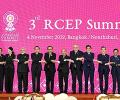
'RCEP may be in India's long-term interest, but it is certainly not in India's short-term and medium-term interest.'
"The fact that not many FTAs were sealed shows the cautious approach of the policy makers," said Ram Upendra Das, fellow, Research and Information System for Developing Countries. "But India has recognised that these duty-free agreements are the order of the day as other countries are engaging in similar deals. Indian exporters will be left out if the nation does not engage in these types of agreements with its trading partners," he added.
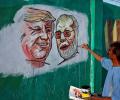
Existing trade deals, especially the 2009 pact with the Asean bloc, have been panned by the Centre for not boosting exports but flooding the domestic market with cheap imports. Subsequently, New Delhi has called for reviewing FTAs with Japan and South Korea. Going by that, a trade deal with the US is unlikely to be beneficial, say experts.

"It will be ensured that such agreements (free trade agreements) do not have a detrimental effect on domestic manufacturing in India," according to the National Manufacturing Policy (NMP), cleared by the Union Cabinet on October 25.
.jpg)
India-European Union Broad-based Trade and Investment agreement came up for discussion in a meeting between Sharma and visiting Netherlands Minister of Foreign Trade and Development Cooperation Lilianne Ploumen in New Delhi.
"We are very keen that before the year is out we should have an agreement on a comprehensive economic partnership," Dr Manmohan Singh said in an interview to a Japanese newspaper Yomiuri Shimbun. The two countries had earlier failed to finalise a trade deal by mid-2008 or to achieve visible progress in time to sign it during a three-day visit by Singh to Japan which started on Tuesday, the paper said.
The drafts or rules are prepared by Directorate General of Safeguards and it is to be issued by Finance Ministry in consultation with commerce ministry. The government may impose safeguard duties, which could be as high as more than 100 per cent, after thorough investigations confirm that import surge is leading to 'serious injury, market disruption' to domestic industry.
In a bid to further boost the growing bilateral trade, Sri Lanka is seeking to upgrade its free trade agreement with India to include services and investments, officials said in Colombo.
US said no to a free trade deal with India as India cannot fully open agricultural imports from American farmers.
The European Union has drawn up an initial negative list of 416 tradeable items on which it does not intend to provide duty cuts as part of the proposed free trade agreement with India

The agreement on services, if ratified by all member countries, could prove to be a game changer for Indian professionals in education, healthcare & IT.
A meeting to discuss what goods should be included in the negative list of items for India-European Union Free Trade Agreement, was held here recently.
With India and ASEAN making little progress on a proposed free trade pact, Prime Minister Manmohan Singh asked the 10-nation bloc on Tuesday to be "more reasonable" on sensitive farm products. "We are trying to persuade our ASEAN friends to be more reasonable and I am hopeful that this process will yield satisfactory outcome," Singh said.

The people will view it from their viewpoint, their immediate interest, historical experiences, their insecurities, he said.
India and Australia are soon likely to initiate talks for a free trade agreement.

Sharma was speaking to journalists while returning with Prime Minister Manmohan Singh from Cambodia last night on special aircraft after attending the ASEAN and East Asia Summits.

A senior European Union representative said here on Tuesday that the body would soon change its Customs laws to address the issue of seizures of Indian generic drug shipments while en route for export to other countries.
India has offered further pruning of its negative list of 560 items for Association of South East Asian Nations on which there will be no duty cuts

This presently stands at 10 per cent and is expected to jump to 70 per cent in the next 2-3-years, the official said.
