
Bajaj Auto was the top gainer in the Sensex pack, surging around 7 per cent, followed by Bajaj Finance, Bajaj Finserv, Kotak Bank, PowerGrid and Axis Bank. On the other hand, ONGC, HDFC, TCS and Reliance Industries were among the laggards.

'Short term volatility is likely due to various factors, global and domestic; investors may use this as an opportunity to increase the allocation to equities.'

Over 25 per cent of the net flows have been directed toward the large-cap category as investors preferred to put money in the top 100 stocks by market capitalisation because the segment has been the most resilient over the past year.

'Earning expectations remain strong.'

This could be attributed to the attractive valuation of the Indian equities after the sharp correction during the first quarter of calendar year 2020 and significant depreciation of the Indian rupee against USD, which provided them a rather good entry point.

Prime Minister Narendra Modi on Wednesday said that the country's economic growth is picking up pace again and the domestic industry needs to enhance its risk-taking appetite. Noting the recent reforms taken by the government, the Prime Minister said that bringing reforms is a matter of conviction for his government, which is ready to take all risks in the national interest. "We have taken bold decisions. Reforms continued even during pandemic. "The government is doing reforms not out of compulsion but out of conviction," he said while addressing the CII's annual meeting.

The country's gross domestic product (GDP) growth is likely to be 8.8 to 9 per cent in the current financial year, driven by agriculture and industry sectors, Care Ratings said in a report. The country's economy had contracted by 7.3 per cent in fiscal 2020-21. The agency said the outlook for the Indian economy on almost all counts in FY22 would look seemingly better than FY21 on account of the negative base effect.

'If the Union Budget can provide incentives for animal spirits to come as well as induce demand stimulus and consumption, the Budget would have done a wonderful job.'
Domestic mutual funds (MFs) and foreign portfolio investors (FPIs) have been net buyers of stocks in August. Domestic fund houses have continued to invest in stocks, propelled by the success of various new fund offers (NFOs) and strong flows into equity funds. MFs had purchased stocks worth more than Rs 8,300 crore until August 23, according to the data provided on the Securities and Exchange Board of India (Sebi) website. Jimmy Patel, MD and CEO at Quantum AMC, says: "The surge in equity investments by MFs is because of two key reasons. One, equity NFOs are getting a strong response from investors, and fund houses need to deploy that money in the markets.

A falling rupee and lower foreign buying in equities are signals investors should watch out for, says Devangshu Datta

Dr Reddy's was the top loser in the Sensex pack, shedding around 5 per cent, followed by M&M, Tech Mahindra, Axis Bank, IndusInd Bank and TCS. NSE Nifty sank 306.05 points to finish at 14,675.70.

While selling started in April, it has intensified this month, with FPIs pulling out $1.1 billion and $2.5 billion from equities and debt market, respectively

To get same tax treatment as FIIs; rules on search & seizure and consent settlement cleared

M&M was the top gainer in the Sensex pack, soaring around 7 per cent, followed by Bajaj Finserv, Bharti Airtel, PowerGrid, Infosys and ICICI Bank. On the other hand, HUL, Kotak Bank, Bajaj Finance and ITC were among the laggards.

They have been on an unbroken selling streak since the Union Budget, spooked by increase in income-tax surcharge, taxes on buybacks, and lack of stimulus to prop up the economy.

Highlights of Economic Survey 2020-21, tabled in Parliament by Finance Minister Nirmala Sitharaman on Friday.

Future Retail's (FRL's) independent directors have written a second letter to the Competition Commission of India (CCI), stating American e-commerce major Amazon never intended to invest in Future Coupons (FCPL) and the representations made by the US e-commerce player were completely opposite and contradictory to their own internal correspondences as submitted before courts. The directors also wrote to CCI that Amazon has obtained approval by making deliberate misrepresentations. By actively misleading the CCI and the regulator, it has to revoke the approval granted for Amazon's investment in FCPL.

Market players say following the tax cuts, the market mood had changed from bearish to positive, which should help sustain the rally.

'Our competitiveness with China is very important.' 'If the exchange rate depreciates, it is good for us because it helps in our competitiveness.'

The coming Union Budget might give relief to foreign portfolio investors from taxation on indirect transfers.

Kotak Bank was the top loser in the Sensex pack, falling around 3 per cent, followed by Axis Bank, Sun Pharma, HDFC Bank, Bajaj Finance and Asian Paints. On the other hand, ONGC, PowerGrid and IndusInd Bank were the gainers.

Besides, the quantum of FPI investments via P-notes dropped to 3.5 per cent during the period under review from 3.8 per cent in the preceding month.

While the amount collected is a tad lower than last two years, it may surpass the previous two years' collections by the end of the year.

The regulator typically meets overseas investors in the US and UK in the first half of a financial year, and had opted for a virtual meet last year too.

Swiss brokerage UBS joins European banking peer HSBC in shutting down its offshore derivative business

The quantum of FPI investments via P-notes remain unchanged at 6.6 per cent in March.

'The Indian economy is in slowdown and growth may stay slow,' notes Devangshu Datta.

The 30-share Sensex also hit its one-year low of 22,494.61 on February 29 this year.

The investors had pumped in a net sum of Rs 2,965.66 crore on February 11, the second-highest single-day inflow so far this month.

If net forex outflows turn out to be relatively high in the next few years, the rupee could depreciate beyond Rs 80 to a dollar by 2022. The causal reasons could, for example, include unmet expectations of FPI and FDI investors about the performance of the Indian economy, sharp rise in prices of imported oil and decrease in FX remittances. The RBI has to ask itself whether guaranteeing future rupee-dollar exchange rates on FX forward contracts is a reasonable way to use its risk-bearing capacity, says Jaimini Bhagwati.
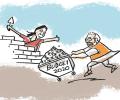
The Budget has relaxed a few safe harbour rules that aim to make it easier for fund managers overseeing offshore India-focused funds to relocate to the country.

This flight of capital began in early August due to risk-aversion created first by rising geopolitical tensions due to North Korean aggression and second by the US Fed's decision to shrink its balance sheet

Equity markets braved all odds this fiscal and rewarded investors with high returns as the benchmark Sensex surged more than 66 per cent despite COVID-led disruptions and concerns over its impact on the economy. Market analysts termed FY 2020-21 as a roller coaster ride for not only Indian markets but also for equity indices globally due to the pandemic. In an unprecedented come back, the 30-share BSE Sensex has jumped 19,540.01 points or 66.30 per cent so far this fiscal. This extraordinary rally holds significance as markets faced volatile trends this fiscal.

Experts say foreign investor sentiment was bolstered by the US Federal Reserve's decision to go slow with interest rate hikes and hopes of political stability.

'Today, there is no easy money to be made after the run-up in equities.'

Despite a temporary relief, foreign investors still see the sword of double-taxation hanging above their hard earned returns.

Companies in the small-cap universe are having a dream run - the Nifty Smallcap 100 index has shot up more than 25 per cent on a year-to-date basis, even as the benchmark Nifty is up 7 per cent. This is the best start for the index since 2017 when the Nifty Smallcap 100 index surged 32.3 per cent between January 1 and May 10. However, in terms of outperformance to the Nifty, this year's performance is the best in more than a decade. A combination of sectoral tailwinds and lack of institutional selling pressure has helped small companies escape from the correction triggered by the second wave of Covid-19.
The move will increase working capital requirement for brokers, raise the work load on the system and will leave little room for contingencies.

Foreign investors, according to them, will now wait-and-watch how the economy takes shape in the backdrop of doubts over monsoon, interest rate trajectory and other global events such as the US - China trade war.

New regime places more limits on unregulated foreign entities
