
Fifteen companies have launched their initial public offerings (IPOs) in December 2024, making it the best month for public offerings since 1996. Collectively, they have raised Rs 25,425 crore, which also made December the best month in terms of the quantum of funds raised. In December 1996, 33 companies had raised Rs 931 crore.

The new proposal comes close on the heels of six measures introduced by Sebi to curb frenzy in index derivatives.

Foreign investors have injected close to Rs 33,700 crore in domestic equities in this month so far primarily due to interest rate cut in the US and resilience of the Indian market. This also marks the second highest inflow in a month in this year so far, the last one being in March, when Foreign Portfolio Investors (FPIs) infused Rs 35,100 crore, data with the depositories showed. Going ahead, the trend of FPIs buying is likely to continue in the coming days, V K Vijayakumar, Chief Investment Strategist, Geojit Financial Services, said.

On a five-day rolling basis, FPI selling is the highest in 24 years.

Mutual funds (MFs) reinforced their record monthly inflows in October with an investment of Rs 87,000 crore (up to October 29), softening the downside pressure on domestic markets. Their prior record for monthly inflows was Rs 48,139 crore in May. This unprecedented monthly buying partially countered record monthly sales by foreign portfolio investors (FPIs) of Rs 1.1 trillion last month.

Front-running is a fraudulent practice where traders exploit advance knowledge of large client orders for personal profit.

'Stay disciplined, and remain invested.' 'Volatile times are the best to invest in structural opportunities at the right price.'

The advance/decline ratio (ADR) - a gauge of market breadth - has remained negative (below 1) for a second consecutive month. In other words, the number of stocks declining is outpacing those rising, as a brutal selloff by overseas investors and lofty valuations weigh on sentiment. According to BSE data, the ADR for October stands at 0.98 for the second month in a row.

Around Rs 1 trillion, or a fifth of the investments made by alternative investment funds (AIFs) are questionable in terms of the intent behind the investments and are under the scanner for circumvention of regulations, said Ananth Narayan, whole-time member of Securities and Exchange Board of India (Sebi). AIFs are pooled investment vehicles that invest in a variety of assets including real estate, startups, unlisted companies, and derivative strategies in the listed space.

Certain foreign portfolio investors (FPIs), which operate as pooled investment vehicles (PIVs), may not be exempt from the additional disclosure mandates by the Securities and Exchange Board of India (Sebi) following an update in the standard operating procedures (SOPs) for custodians. An updated version of the SOPs has specified several conditions to be met for PIVs to benefit from the exemptions granted. These include no segregated portfolios, independent investment manager, and investors having pari-passu (equal) rights in the entity.

Foreign investors pulled out a massive Rs 94,000 crore (around $11.2 billion) from the Indian stock market in October, making it the worst-ever month in terms of outflows, triggered by the elevated valuation of domestic equities and attractive valuations of Chinese stocks. Before this, foreign portfolio investors (FPIs) withdrew Rs 61,973 crore from equities in March 2020. The latest outflow came after a nine-month high investment of Rs 57,724 crore in September 2024.

Foreign portfolio investor (FPI) flows into India may remain tepid in 2022, said a recent note by Goldman Sachs, who now peg the foreign portfolio investment into India at $5 billion in 2022, down from their earlier forecast of $30 billion with risks skewed to the downside. "There has been $15 billion of equity outflows YTD in India already, and the IPO of the largest insurance company has been pushed out. "Additionally, with no mention of India's inclusion in global bond indices in the Union Budget, there are risks to our already conservative base case assumption of an announcement of India's likely inclusion into the GBI-EM Global Diversified Bond Index in Q4-2022," wrote Andrew Tilton, Goldman Sachs' chief Asia-Pacific economist in a co-authored report with Santanu Sengupta and Suraj Kumar.

'The problem is that the bubble may not only be in valuations, but also in investors' minds.'

The deluge of offerings in the primary market, a muted results season and increasing talks of a Fed taper may quicken the pace of overseas investors selling Indian equities in the near term. The next few weeks may see a dozen companies tap the market for initial public offerings and raise about Rs 30,000 crore. These include the likes of Zomato, Glenmark Life Sciences, Utkarsh Small Finance Bank and Seven Islands Shipping.
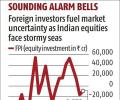
Foreign portfolio investors (FPIs) have withdrawn Rs 25,305 crore from domestic markets since September. FPIs were net sellers in the first two months of 2023, but from March to August, they purchased equities worth Rs 1.7 trillion. This selling trend has caused the National Stock Exchange Nifty Index to decline by 3.2 per cent from its September highs. FPI selling initially began in September as profit-taking but intensified due to rising US bond yields and uncertainty regarding the rate hike trajectory.

Foreign investors turned net sellers in October, offloading shares worth Rs 27,142 crore in just the first three days of October due to intensifying conflict between Israel and Iran, a sharp rise in crude oil prices, and improved performance of Chinese markets. The outflow came after FPI investment reached a nine-month high of Rs 57,724 crore in September. Since June, Foreign Portfolio Investors (FPIs) have consistently bought equities after withdrawing Rs 34,252 crore in April-May.

Revenue dept says changes in I-T Act require Parliament nod; new regime to wait till Budget in June-July 2014.

With India overtaking China in terms of weightage in the Morgan Stanley emerging markets IMI, Indian equities could see inflows of about $4.5 billion (Rs 37,000 crore), according to estimates. This week, Morgan Stanley announced that India has overtaken China in the MSCI Emerging Markets Investable Market Index (MSCI EM IMI). The weight of India in MSCI EM IMI stood at 22.27 per cent compared to 21.58 per cent of China.

The week's losses wiped out investor wealth worth Rs 18.43 trillion, with the total market capitalisation of BSE-listed firms now at Rs 441 trillion.
Foreign Portfolio Investors (FPIs) continued their buying spree and poured close to Rs 4,800 crore in the Indian equity markets in the first week of January driven by confidence in the country's robust economic fundamentals. Additionally, they injected Rs 4,000 crore in the debt market during the period under review, data with the depositories showed. With expectations of a prolonged decline in US interest rates in 2024, there is an anticipation that FPIs will likely escalate their purchase, particularly in the initial months of the New Year leading up to the general elections, V K Vijayakumar, chief investment strategist at Geojit Financial Services, said.

Domestic institutional investors (DIIs) have infused a record Rs 4.6 trillion into Indian equities over the course of Samvat 2080, marking the highest net annual investment in any Samvat to date. This robust domestic inflow has effectively counterbalanced the comparatively subdued investments from foreign portfolio investors (FPIs), who contributed a net Rs 90,956 crore within the same timeframe. Against this backdrop, the Nifty 50 and BSE Sensex indices are on track to achieve their best performance in three Samvat years, despite recent market corrections.

'The economy is clearly at a very soft spot, and earnings growth is disappointing every day.' 'After three great years, the Indian economy has hit a rough patch.'

'He will be remembered more for what he did as finance minister -- as someone who functioned well when the political fallout was taken care of.'
Markets regulator Sebi has simplified the procedural requirements for onboarding of Foreign Portfolio Investors (FPIs) in a bid to facilitate ease of doing business and to reduce the time taken for their registration. The regulator allowed designated depository participants (DDPs) to grant FPI registration on the basis of scanned copies of application forms and supporting documents, according to a circular issued on Monday. Granting of registration on the basis of scanned copies has been allowed but trading can only be activated following the verification of the physical documents, it said.

Foreign investors have pulled out a massive Rs 22,000 crore from Indian equities so far this month, due to uncertainty surrounding the outcome of the Lok Sabha elections and outperformance of Chinese markets.

By taking the mutual fund route, investors can take exposure to gilts with small amounts. Over a decade or more, returns from these funds tend to be sound.

'Investors can consider staying invested in long duration products as there is a possibility of rate cuts in the near term.' Positive macros - lower inflation, high forex reserves and favourable demand-supply dynamics for government bonds - make a strong case for rate cuts from December, says Devang Shah, head of fixed income, Axis Mutual Fund. In an interview with Abhishek Kumar in Mumbai, Shah says this view may not hold true if commodity prices go up sharply.

The country's most valuable lender HDFC Bank can perhaps no longer claim to be a favourite of foreign portfolio investors (FPIs). Two data indicators, both somewhat interconnected, point to this - the diminishing premium of HDFC Bank's American depositary receipts (ADRs) compared to local shares, and the ample investment opportunities available to FPIs in the domestic market. The ADR premium has shrunk to below 5 per cent, down from over 30 per cent in March 2021, and even lower than recent levels.

After the latest rout, the American depositary receipt (ADR) premium of HDFC Bank to its local shares has shrunk to nearly zero. Shares of HDFC Bank on Thursday fell 3.1 per cent to Rs 1,490, extending its two-day decline to 11 per cent. Meanwhile, the ADR has slumped over 15 per cent in the past two trading sessions.

India's foreign exchange reserves increased to $604 billion as on December 1, surpassing the $600 billion mark after a gap of about four months. The forex reserves were last above the $600 billion mark on August 11 this year. "India's foreign exchange reserves stood at $604 billion as on December 1, 2023.

Mutual funds (MFs) are likely to surpass foreign portfolio investors (FPIs) in terms of anchor investments in initial public offerings (IPOs) for the second consecutive year. In calendar year 2023 so far, MFs have invested Rs 5,577 crore as anchor investors, compared to the Rs 5,417 crore invested by FPIs this year. In 2022, MFs put in Rs 9,026 crore as anchor investment, 21 per cent higher than the FPI tally of Rs 7,105 crore. This marked the first time since 2014 that MFs had outpaced FPIs in anchor investments.
The Securities and Exchange Board of India (Sebi) has proposed stricter disclosure norms for certain foreign portfolio investors (FPIs) to bring in more transparency and trust against the backdrop of the Adani-Hindenburg Research saga. Under the new norms, FPIs with an exposure of more than 50 per cent to a single group or with assets of over Rs 25,000 crore will be tagged as 'high risk' and will be required to provide additional information such as full identification of their ownership, economic interests, and control rights. A failure to provide these disclosures will lead to invalidation of the FPI registration.

In a remarkable comeback, foreign portfolio investors (FPIs) have pumped Rs 1.7 lakh crore into the Indian equity markets in 2023, propelled by confidence in the country's robust economic fundamentals amid a challenging global landscape. The year 2023 has witnessed massive investment by FPIs, thanks to the sharp uptick in inflows of Rs 66,134 crore in December. Going forward, FPI flows are expected to be robust.

A delegation of high-level executives from US public pension funds (non-profit and government sectors) is visiting India next week to assess and familiarise themselves with the investment opportunities in the country. These executives belong to various American states and cumulatively represent $1.8 trillion in assets under management (AUM) invested across the US and global markets. The United States (US) mission to India, which includes its embassy and consulates and the Department of Treasury, along with India's Ministry of Finance and the National Investment and Infrastructure Fund (NIIF), is hosting the delegation.
In February, FPIs sold $421 mn in debt; in March they have sold $133 mn so far
An analysis by the Securities and Exchange Board of India (Sebi) has revealed that retail traders remain at the wrong end of the stick when it comes to equity derivatives trading. About 93 per cent of them incurred an average loss of Rs 2 lakh (per trader) during the last three financial years. The new report highlights an increase in the loss-making individual investors in futures and options (F&O) to 91.1 per cent in FY24 compared to 89 per cent in FY22.

Foreign portfolio investors (FPIs) are likely to get a reprieve from the Securities and Exchange Board of India (Sebi) in case of a passive or unintended breach of the thresholds that trigger additional disclosure norms. According to sources, FPIs whose single group exposure exceeds 50 per cent of their corpus will get 10 trading days to bring down their exposure below the prescribed level, without triggering the stricter disclosure norms. If total equity exposure of an overseas fund exceeds Rs 25,000 crore and it doesn't wish to provide additional disclosures, it will have three months to pare its exposure.

'It is advisable to stay away from the markets for now and buy only on a dip.'

Brokerages believe that the Bharatiya Janata Party's (BJP's) stronger-than-expected showing in state elections reduces political risks for the domestic markets going into 2024. However, after the short-term excitement, the focus will soon shift to earnings, global liquidity conditions, and the interest rate trajectory. "BJP's win in the three state elections is much better than what exit polls suggested and reinforces the consensus expectations of a Modi win in the 2024 national elections with a greater likelihood of 300+ seats for the BJP.

'As China's reopening euphoria fizzled out on the back of some disappointing economic data, we saw inflows coming back to India with full force in the past 3-4 months.'
