
Total foreign direct investment (FDI) inflow to India declined to $74.01 billion in the calendar year 2021, which is 15 per cent lower from $87.55 billion recorded in the previous year, the ministry of commerce & industry said on Wednesday. The FDI inflow includes equity inflow, equity capital of unincorporated bodies, re-invested earnings and other capital. "FDI is largely a matter of commercial business decisions and FDI inflow depends on a host of factors such as availability of natural resource, market size, infrastructure, political and general investment climate as well as macro-economic stability and investment decision of foreign investors.

Foreign Direct Investment (FDI) equity inflows into India contracted by 14 per cent to $26.9 billion during the April-September this fiscal, according to the data of the Department for Promotion of Industry and Internal Trade (DPIIT). The inflows had stood at $31.15 billion during the corresponding period of the previous year. The total FDI inflows (which includes equity inflows, re-invested earnings and other capital) too declined to $39 billion during the first six months of the current fiscal year as against $42.86 billion in the year-ago period.
The government is working towards further review and simplification of the foreign direct investment (FDI) policy to facilitate the proposed initial public offering (IPO) of the Life Insurance Corporation (LIC), Department for Promotion of Industry and Internal Trade (DPIIT) secretary Anurag Jain said on Thursday. The final decision will be taken by the Cabinet. The industry department is working together with the finance ministry's department of financial services (DFS) and department of investment and public asset management (DIPAM) towards a successful listing of the life insurer on the domestic bourses, which is expected to be the largest in India.

'We may see even more restrictive policies during 2.0.'

A series of steps taken by the government to promote ease of doing business and liberalisation of foreign direct investment norms have helped India receive record FDI inflows so far this year, and implementation of measures like PM Gati Shakti, single window clearance and GIS-mapped land bank are expected to further push investments in 2022. Notwithstanding the global slowdown and the COVID-19 pandemic, total foreign direct investments into India rose to a record $81.72 billion in 2020-21. During April-July this fiscal, FDI (foreign direct investment) into the country increased by 62 per cent to $27.37 billion.

The Indian insurance industry is set to focus on customer-centric technological adoption and expansion into rural areas to drive growth in 2025.

Issues related to the proposed free trade agreement (FTA) and bilateral investment treaty between India and the UK are expected to figure during the three-day visit of Finance Minister Nirmala Sitharaman to London from April 8-10, official sources said. The minister will attend a host of meetings, including the India-United Kingdom Economic and Financial Dialogue, in London.

India has set an ambitious target of textile exports worth $100 billion by 2030, but the recent data released by the Ministry of Textiles pertaining to India's textile and apparel trade puts achievement of the goal in jeopardy.
India remains an attractive destination for foreign direct investments (FDI) on account of healthy prospects of economic growth and its skilled workforce, according to a survey by Deloitte. A large proportion of international business leaders remain confident in India's short- and long-term prospects and are readying plans to make additional and first-time investments in the country, it said on Tuesday. "The survey, which questioned 1,200 business leaders of multinational corporations in the US, UK, Japan and Singapore, found that India remains an attractive destination for investments, scoring highly for its skilled workforce and prospects for economic growth," the survey - India's FDI Opportunity - said.
'Binary fission will happen -- startups will lead to more startups.'

'We face the risk of remaining a low-income country for a very long time unless something changes in the next few years.' 'Instead of constantly talking about becoming a developed economy, we need to start fixing the problems of the economy one by one.' 'There is so much potential, and we are squandering away the opportunity.'

However, that could only be for sectors where 100 per cent FDI is allowed under the automatic route and pose no risk to national security.

The Confederation of All India Traders (CAIT) representing 70 million traders has written to Union Commerce Minister Piyush Goyal, drawing his attention to the alleged violations of laws and regulations by quick commerce (qcom) companies.
Total foreign direct investment into India rose 2 per cent to the "highest ever" $83.57 billion in 2021-22 on account of various measures like policy reforms and ease of doing business taken by the government, the commerce and industry ministry said on Friday. Total FDI comprises equity inflows, reinvested earnings and other capital. In 2020-21, the inflow stood at $81.97 billion. It was $74.39 billion in 2019-20 and $62 billion in 2018-19. "India has recorded the highest ever annual FDI inflow of $83.57 billion in 2021-22," the ministry noted in a statement.

Foreign direct investment into India increased by 60 per cent to $4.44 billion in April as against $2.77 billion in the same month last year, government data showed on Wednesday. Total FDI, including equity, re-invested earnings and capital, rose 38 per cent to $6.24 billion in April this year, as against $4.53 billion in April 2020, as per the data. "During April, 2021 FDI equity inflows amounting to $4.44 billion were reported in the country which is an increase of 60 per cent over the FDI equity inflow of April, 2020 ($2.77 billion)," the commerce and industry ministry said in a statement.

Fast-moving consumer goods (FMCG) distributors' association has written to the Ministry of Commerce and Industry, expressing its apprehensions that the "unchecked expansion" of quick commerce platforms was leading to severe disruptions in the retail ecosystem. India Consumer Products Distributors Federation on Thursday shot an email to the government, saying that significant challenges were posed by the rapid growth of quick commerce platforms such as Blinkit, Zepto and Instamart to the traditional retail sector and the FMCG distribution network in the country.

India and the United States will finalize the contours, schedule of negotiations, and terms of reference for a proposed bilateral trade agreement (BTA) during a three-day meeting beginning Tuesday. The agreement is expected to be finalized in two tranches, with the first phase focusing on goods trade. The US team, led by Assistant US Trade Representative for South and Central Asia Brendan Lynch, will be in India from March 25-29 to discuss the agreement. Both countries are aiming to conclude the first phase of the agreement by fall 2025.

The Modi government's flagship initiative 'Make in India' launched 10 years ago has helped the country boost exports, push investments and promote manufacturing. Under the initiative, launched on September 25, 2014, a series of measures have been taken by the government to boost local manufacturing. These initiatives include the rollout of production linked incentive (PLI) schemes for 14 sectors, easing foreign direct investment (FDI) norms, reducing compliance burden to improve business climate, all approvals through single window, and rolling out of the national logistics policy.
India is not "rethinking" supporting investments from China, said Commerce and Industry Minister Piyush Goyal on Tuesday, referring to a proposal made in the Economic Survey 2024. The survey by India's chief economic advisor last week said India had two "choices" to benefit from the so-called China plus one strategy, either by integrating into that country's supply chain or by promoting foreign direct investment (FDI). "Chief economic advisor's report speaks about new ideas and gives out their own thinking. It is not at all binding on the government and there is no rethinking to support Chinese investments in the country," Goyal told reporters in Delhi.
The Insurance Regulatory and Development Authority of India (Irdai) has asked at least 10 general and life insurance companies to submit a detailed road map for their listing strategies by the end of this month, according to multiple sources with direct knowledge of the matter. "The regulator met four life and six general insurers last month and asked them to provide their listing strategies by the end of February," said one of the sources.

The Union Cabinet on Wednesday gave its nod for amendments in the Insurance Act, paving way for 74 per cent foreign direct investment in the sector. Currently, the permissible FDI limit in the life and general insurance stands at 49 per cent with ownership and management control with Indian. According to sources, the Cabinet in its meeting has approval for amendments in the Insurance Act, 1938.

"These latest so-called 'Liberation Day' tariffs are reckless and self-destructive, inflicting financial pain on Illinois at a time when people are already struggling to keep their small businesses afloat and put food on the table."

Union Home Minister Amit Shah on Sunday said the ruling Mahayuti in Maharashtra will retain power with full majority and a decision on who will be the chief minister will be taken by the alliance partners after the state polls.
'An explanation perhaps lies in the culture of revisions that has grown deep roots in the government data collection system,' notes A K Bhattacharya.
Foreign direct investment (FDI) in India grew 40 per cent to USD 51.47 billion during April-December 2020-21, according to government data released on Thursday.

Foreign direct investments (FDI) into the country grew 19 per cent to $59.64 billion during 2020-21 on account of measures taken by the government on the fronts of policy reforms, investment facilitation and ease of doing business, the commerce and industry ministry said on Monday. Total FDI, including equity, re-invested earnings and capital, rose 10 per cent to the "highest ever" of $81.72 billion during 2020-21 as against $74.39 billion in 2019-20. "FDI equity inflow grew by 19 per cent in 2020-21 ($59.64 billion), compared to 2019-20 ($49.98 billion)," the ministry said in a statement. In terms of top investor countries, Singapore is at the top with 29 per cent share.

The government has amended rules of the Foreign Exchange Management Act (FEMA), paving the way for up to 20 per cent foreign direct investment in the insurance behemoth LIC. The government is planning to dilute its stake in LIC through the the Initial Public Offering (IPO). LIC in February had filed the Draft Red Herring Prospectus (DRHP) before the markets regulator Sebi for the IPO.

A bill to increase foreign direct investment (FDI) in the insurance sector from 49 per cent to 74 per cent was approved by Parliament with the Lok Sabha giving green signal to the legislation by a voice vote on Monday.

Opposition MPs in India's Rajya Sabha raised concerns about US President Donald Trump's tariff threats, demanding the government clarify its response and engage in discussions with opposition parties. Leaders like P Chidambaram and Sagarika Ghose warned of potential economic repercussions, including depressed exports, lower FDI, and a significant tariff burden. The debate also touched on other issues such as the government's economic policies, demonetization, and the impact of GST on common citizens.
High frequency indicators, like vehicles sales, air traffic, steel consumption and GST E-way bills, point towards a sequential pickup in momentum of economic activity during the second half of the fiscal 2024-25 and sustain moving forward, RBI Bulletin said on Wednesday. However, a strong dollar, driven by US economic resilience and trade policy pivots, could exacerbate capital outflows from emerging economies, push risk premiums higher, and intensify external vulnerabilities, said an article on 'State of the Economy' published in RBI's February bulletin.

'Unsurprisingly, Trump shared Modi's podcast with Fridman on his Truth account.' 'The intentions of Trump, a transactional president, are never easy to tell.' 'We will know in the next fortnight if and when he unfolds reciprocal tariffs on Indian goods, whether Modi's flattering words made any significant difference to Trump's compass,' notes Ambassador M K Bhadrakumar.
The Union Cabinet on Thursday approved a proposal to allow 100 per cent foreign direct investment (FDI) in public sector refiners, expanding the scope for FDI in the privatisation of Bharat Petroleum Corporation Ltd (BPCL). The approval by the Cabinet will enable the sale of the government's 52.98 per cent stake in BPCL to a foreign buyer, and, at the same time, will open the door for FDI in other public sector companies in the oil sector put up for privatisation.

The country's forex reserves touched a record high of $675 billion on August 2, Reserve Bank Governor Shaktikanta Das said on Thursday. The previous all-time high for the kitty was $670.857 billion on July 19 this year, and the last reported reserve was $667.386 billion as on July 26. Das said overall, the country's external sector "remains resilient" as indicated by an improvement in key indicators.

Foreign Direct Investment flows to India in 2021 were 26 per cent lower, mainly because large M&A deals recorded in 2020 were not repeated, the UN trade body has said.

Foreign direct investment (FDI) in India has increased by 16 per cent year-on-year to $27.1 billion during April-August this year, the Commerce and Industry Ministry said on Tuesday. During April-August last year, India had received FDI worth $23.35 billion. The ministry said that the total FDI, which includes reinvested earnings, grew by 13 per cent to $35.73 billion.
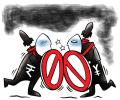
In 2020-2021, the amount of foreign direct investment into India from China and Hong Kong plummeted to just $200 million -- its lowest in the recent past. In the first half of 2021-2022, FDI investments through these two nations stood at just $36 million.

Whether it's Carrefour, Ford, or other foreign majors, they are ready to adjust their strategies and design their plans in a way that would address the Indian consumption story.

'The startup ecosystem, the government, and the owners of large pools of Indian capital need to actively support the creation of these local champions, not pull down the teams that are trying hard to get there.'

India needs another shot of difficult reform, of the kind only possible at gunpoint. Mr Trump holds that gun to our heads now. A drastic reduction in tariff protection, other elements of sarkari wet-nursing will force entrepreneurial India to become competitive again, argues Shekhar Gupta.
