
The Indian government has relaxed foreign direct investment (FDI) norms for countries sharing land borders with India, including China, a move that amends press note 3 of 2020.

'In all these years of rupee depreciation, of rising oil prices, of inflation caused by import dependence, not one leader had the courage to look the people in the eye and say: Please do this for your country.'

'At the first sign of real trouble, that money will move. There will be a run.'

'It's a changing world and the opening up doesn't mean that concerns with regards to security have gone away.'

Senior Congress leader Ramesh Chennithala has accused the Kerala government of protecting CPI(M) leaders allegedly involved in the Sabarimala temple gold loss case and failing to address other issues related to the temple.

India may adopt a "calibrated" and a "step-by-step" approach to easing norms on investments originating from China, Union Commerce and Industry Minister Piyush Goyal said on Tuesday. He was in a conversation with A K Bhattacharya on Day 1 of Business Standard's two-day annual event, Manthan 2026. The minister said foreign direct investment (FDI) from China was certainly not "banned", but it goes through an approval process. "The government's approach at the moment is to accelerate the approval process."

The deal shifts the US posture towards India from hostile to neutral, and that matters for growth, points out T T Ram Mohan.

Fintech firm One97 Communications on Thursday said its subsidiary Paytm Payments Services Limited (PPSL), has received authorisation from the Reserve Bank of India to operate as a Payment Aggregator for physical (offline) payments and cross-border transactions.

'Uncertainty level A in the morning, uncertainty level B in the afternoon. If I answer about tariff rates now, I'll be outdated by the evening.'
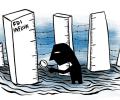
The government has not made any amendments to the foreign direct investment (FDI) policy for countries sharing land border with India, sources said on Wednesday. In 2020, the government issued Press Note 3 under which investors from these land bordering countries have to mandatorily take prior approval of the government for making investments in any sector.

In their talks, Modi and Merz are likely to deliberate on trade and investment ties as New Delhi is looking at deepening economic engagement with Europe against the backdrop of Washington's 50 percent tariff on Indian goods, people familiar with the matter said.

'This marks a turning point for Paytm, with the regulatory environment looking much clearer than it has been in the last two years.'

Elon Musk-led Tesla Inc is yet to express interest in India's flagship scheme to attract global investment in electric vehicle (EV) manufacturing, said Union Minister for Heavy Industries H D Kumaraswamy on Monday. In contrast, multiple global automobile giants -- such as Mercedes-Benz, koda Auto Volkswagen, Hyundai Motor, and Kia Motors -- are keen to participate, the minister noted.

The US Trade Representative noted that India's average applied tariff rate stood at 17% per cent, the highest of any major world economy.

The Insurance Regulatory and Development Authority of India (Irdai) has asked at least 10 general and life insurance companies to submit a detailed road map for their listing strategies by the end of this month, according to multiple sources with direct knowledge of the matter. "The regulator met four life and six general insurers last month and asked them to provide their listing strategies by the end of February," said one of the sources.

The draft favoured up to 49 per cent foreign equity in inventory model in the case of 100 per cent made in India products sold through Indian management-controlled platforms with resident Indian founders/promoters.

The Confederation of All India Traders (CAIT) representing 70 million traders has written to Union Commerce Minister Piyush Goyal, drawing his attention to the alleged violations of laws and regulations by quick commerce (qcom) companies.
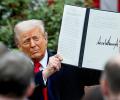
India needs another shot of difficult reform, of the kind only possible at gunpoint. Mr Trump holds that gun to our heads now. A drastic reduction in tariff protection, other elements of sarkari wet-nursing will force entrepreneurial India to become competitive again, argues Shekhar Gupta.

Anticipating US action on tariffs, India seems to have made the first move by revamping its tariff structure by reducing the slabs to eight rates, points out Mukesh Butani.

The government on Wednesday notified its decision to permit 100 per cent foreign direct investment (FDI) under automatic route in the telecom services sector. In a press note, the Department for Promotion of Industry and Internal Trade (DPIIT) said foreign investment in telecom services will be subject to the condition of Press Note 3 of 2020. Accordingly, cases requiring prior government approval under the provisions of Press Note 3 will continue to be in place.

However, that could only be for sectors where 100 per cent FDI is allowed under the automatic route and pose no risk to national security.
The Union Cabinet on Thursday approved a proposal to allow 100 per cent foreign direct investment (FDI) in public sector refiners, expanding the scope for FDI in the privatisation of Bharat Petroleum Corporation Ltd (BPCL). The approval by the Cabinet will enable the sale of the government's 52.98 per cent stake in BPCL to a foreign buyer, and, at the same time, will open the door for FDI in other public sector companies in the oil sector put up for privatisation.

The government has amended rules of the Foreign Exchange Management Act (FEMA), paving the way for up to 20 per cent foreign direct investment in the insurance behemoth LIC. The government is planning to dilute its stake in LIC through the the Initial Public Offering (IPO). LIC in February had filed the Draft Red Herring Prospectus (DRHP) before the markets regulator Sebi for the IPO.

'While my generation carries with it the memory of the Chinese perfidy of 1962, this generation will carry the memory of Chinese perfidy in Galwan.'

The government on Thursday permitted 100 per cent foreign investment under the automatic route in oil and gas PSUs which have received in-principle approval for strategic divestment. The move would facilitate privatisation of India's second biggest oil refiner Bharat Petroleum Corp Ltd (BPCL). The government is privatising BPCL and selling its entire 52.98 per cent stake in the company.

The government will press ahead with the sale of public sector companies that have been approved by the Cabinet, Finance Minister Nirmala Sitharaman said on Thursday. Highlighting that FDI flow into India is much higher compared to other emerging economies, she said India's strong macroeconomic fundamentals, ability to do reforms and a stable government help attract long-term foreign funds into Indian businesses.

Draft Press Notes on FDI regulatory framework fail to address the gap between the domestic and foreign regulatory regimes.

The government on Saturday made its prior approval mandatory for foreign investments from countries that share land border with India to curb 'opportunistic takeovers' of domestic firms following the COVID-19 pandemic, a move which will restrict Foreign Direct Investment from China.
There has been a decline in foreign direct inflow from China in the last three years, with FDI coming down to USD 163.77 million in 2019-20, Minister of State for Finance Anurag Singh Thakur informed the Lok Sabha on Monday. Giving details of the total foreign direct investment (FDI) inflow from Chinese companies in India, he said, it was USD 350.22 million in 2017-18, while it declined to USD 229 million in the following year.

No reason was cited for rescheduling of the meeting.

Union Finance Minister Nirmala Sitharaman, along with her team of bureaucrats, delved into the fine print of the 2024-25 Budget documents in a press conference, detailing the government's road map on bringing down the debt-to-GDP ratio and bold tax measures.

FinMin had, recently, notified changes in FDI rules that made prior approval of the government mandatory for foreign investments from countries that share a land border with India. Hong Kong was ranked 14th on the list of countries with FDI flows to India, contributing $4.2 billion between April 2000 and December 2019, the data from DPIIT shows. India received FDI worth $2.34 billion from China in the same period.

"We have close to about 175 press notes circulating... the Industry Ministry has taken a decision to put all of these together in a booklet so that the FDI rules become much simpler for a foreign investor."

It is alleged that the company floated 32 subsidiaries in several tax haven countries to bring foreign funds to India through sham transactions.
Towards the close of 2013, the finance ministry approved the proposal of UK-based Tesco to invest $110 million in opening up of multi-brand retail stores in the country in partnership with Tata Group firm Trent.

The government decision to permit 100 per cent foreign direct investment in medical devices will take effect from January 21, the Commerce and Industry Ministry said on Tuesday.

Opposing FDI in the retail sector, activist Anna Hazare on Wednesday said the move would lead to enslavement of the countrymen and will not benefit the farmers as claimed by the government.

China said on Monday the additional barriers set by India for investors from specific countries violate the World Trade Organisation's principle of non-discrimination, and go against the general trend of liberalisation and facilitation of trade and investment. "More importantly, they do not conform to the consensus of G20 leaders and trade ministers to realise a free, fair, non-discriminatory, transparent, predictable and stable trade and investment environment, and to keep our markets open," said a statement issued by the Chinese embassy in New Delhi.
The press notes, issued in February this year, simplified the method for calculating FDI and broadly stated that as long as Indian promoters hold a majority stake (that is, more than 51 per cent) in an operating-cum-investment company, they can bring in investments up to 49.9 per cent through FDI.
Notwithstanding its inability to open multi-brand retail for foreign investment, government on Tuesday notified 100 per cent FDI in single-brand retail, paving way for global chains like Adidas, Louis Vuitton and Gucci to have full ownership of their India operations.
 © 2026 Rediff.com - Advertise with us - Disclaimer - Privacy Policy - Sitemap - Feedback - About us - Terms of use - Grievances