
Ananya Birla shows her support for Royal Challengers Bengaluru ahead of their IPL 2026 opener, as the team enters a new era under new ownership.

Live updates on the US-Israel-Iran war: Trump escalates threats, Iran retaliates, and oil prices surge as the Strait of Hormuz crisis disrupts global markets.

Indian benchmark stock indices Sensex and Nifty rallied for the second consecutive day, closing nearly 1 per cent higher, driven by gains in metal and auto sectors and positive global market trends.

Indian equity markets experienced a significant downturn as geopolitical tensions in West Asia, rising oil prices, and foreign fund outflows dampened investor confidence. The Sensex and Nifty both fell sharply in early trade, reflecting broader global market weakness.

Recent developments - proposed changes to the goods and services tax (GST) rates and S&P Global Ratings' upgrade of India's long-term sovereign credit rating to BBB, with a stable outlook, - may not be enough to bring foreign investors back to Indian markets in a rush, feel analysts.

TMC candidate Jyotipriya Mallick, embroiled in a ration distribution scam case, declares assets worth over Rs 1.97 crore in his election affidavit, including details of his income, properties, and investments.

Indian benchmark equity indices experienced a significant downturn, with the Sensex plummeting over 800 points and the Nifty falling sharply, driven by rising crude oil prices, geopolitical tensions, and foreign capital outflows.

IT major Wipro reported a consolidated net profit of Rs 3,501.8 crore for March quarter FY26, a 1.89 per cent decrease from the previous year, amidst a challenging macroeconomic environment. The company also announced a mega Rs 15,000 crore share repurchase programme.
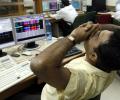
Indian equity investors experienced a significant loss of 16.32 lakh crore due to a two-day stock market decline fueled by escalating geopolitical tensions involving the US, Israel, and Iran.
Indian benchmark equity indices Sensex and Nifty experienced a significant crash in early trade, triggered by a sharp increase in crude oil prices and escalating tensions in the Middle East.

India's aviation sector is facing fresh turbulence, with rising fuel costs, the Ministry of Civil Aviation's free-seat directive, and geopolitical disruptions in West Asia clouding near-term earnings visibility.

Police in Navi Mumbai have dismantled a fraudulent call centre accused of swindling individuals out of over Rs 1 crore by falsely promising high returns on share market investments. Two individuals have been arrested, and investigations are ongoing.

What is the reason behind this drying up of talent for the top post in private banks?

Indian stock market benchmark indices Sensex and Nifty experienced a significant drop in early trade due to rising crude oil prices, bearish global market trends, and continuous foreign fund outflows.

The business value of the league, popularly called the IPL, surged to a record $18.5 billion last year, U.S.-based investment bank Houlihan Lokey says.

Ask rediffGURU Reetika Sharma your insurance, mutual fund and personal finance-related questions.

Rupee slumped 69 paise to an all-time low of 92.18 against the US dollar in early trade on Wednesday, as a sharp spike in crude oil prices amid geopolitical tensions following the escalation of the US-Iran conflict weighed on investor sentiment.
'We are profoundly energy-dependent on the Gulf. That dependency must now be redirected towards the United States, because we require American permission to procure oil.' 'We additionally require Iranian permission to acquire oil from that source. So India now has to seek two separate permissions merely to secure its energy supply.' 'Should we be compelled to source from America, or from Venezuela -- which is, in effect, American-controlled supply -- that will inevitably carry a price premium, an elevated shipping cost, and a considerably extended delivery timeline, given the distances involved.'

Indian equities on Dalal Street saw volatility. Track Sensex, Nifty50 movement and key market drivers for Feb 25, 2026.

Rediff.com India Ltd, a subsidiary of AvenuesAI Ltd, has filed draft red herring prospectus (DRHP) with SEBI through the confidential pre-filing route, marking an important step towards a potential public listing after its acquisition and strategic shift to an AI-led digital platform.

Indian stock market benchmarks Sensex and Nifty rebounded strongly after a two-day decline, driven by falling crude oil prices and positive global cues amid hopes of de-escalation in the Middle East.

India's residential real estate market experienced a 4 per cent year-on-year decline in sales during Q1CY26, while office leasing reached a quarterly high, rising 6 per cent year-on-year to 29.9 million square feet, according to Knight Frank India.

The Indian rupee weakened against the US dollar due to rising crude oil prices, geopolitical tensions in the Middle East, and foreign fund outflows.

New Zealand Cricket backs the proposed NZ20 private league to replace Super Smash, with a 2027 launch in sight and a strong push to include the women's game.

The BSE Sensex and the Nifty 50 declined around 4.5 per cent each since the start of the West Asia conflict.

There is record underperformance and under-ownership. Some of this is cyclical and will turn on its own. However, we also need to regain our growth credentials. For this, both the government and companies have a role to play, as do investors, points out Akash Prakash.

Households should moderate large discretionary expenses for the time being.
'They should prioritise essential spending. They should maintain an emergency fund covering 6 to 12 months of expenses.'
Equity benchmark indices Sensex and Nifty rebounded sharply by nearly 1 per cent on Monday, driven by strong buying in power, banking, and financial stocks.

West Asia conflict triggers sharp sell-off in Indian markets, with realty, banking and auto stocks leading losses amid energy shock fears.

With domestic markets turning choppy, investors are increasingly scouting for opportunities overseas to diversify portfolios and hedge against a weakening rupee.

Foreign investors offloaded Indian equities worth nearly Rs 21,000 crore in the first half of August, pressured by US-India trade tensions, lacklustre first-quarter corporate earnings, and a weakening rupee.
Ask rediffGURU Naveenn Kummar your insurance mutual fund and personal finance-related questions.
Equity benchmark indices Sensex and Nifty advanced for the third straight session on Tuesday driven by firm global cues and optimism over India-US trade agreement, even as investors turned to profit-booking at higher levels.
After investing a staggering amount in May, foreign investors turned net sellers with a withdrawal of Rs 8,749 crore from the Indian equity markets in the first week of this month triggered by renewed US-China trade tensions and rising US bond yields. This momentum follows a net investment of Rs 19,860 crore in May and Rs 4,223 crore in April, data with the depositories showed.

Indian equities on Dalal Street saw volatility as global market trends and fresh tariff concerns linked to Donald Trump impacted investor sentiment. Track Sensex, Nifty50 movement and key market drivers for Feb 24, 2026.

Among its 27 recommendations for the Union Budget is this: It has suggested that equity investments held for more than one year and up to three years should be taxed at 12.5 per cent on gains exceeding 2 lakh in a financial year.

Retail investors' equity portfolios have significantly underperformed benchmark indices over the past 16 to 18 months.

Indian corporate are increasingly shifting away from bank funding towards alternative sources, such as equity and bond markets, as their deleveraged balance sheets have improved their ability to raise equity at better valuations. Moreover, the 100 basis points (bps) rate cut by the Reserve Bank of India (RBI) has enabled them to access long-term funds from the debt capital market at cheaper rates.

The Supreme Court has framed key legal questions regarding the University Grants Commission's equity regulations and stayed the implementation of the framework on caste-based discrimination in higher education institutions.

The University Grants Commission's (UGC) new regulations on promoting equity in higher education institutions have sparked protests and legal challenges. This article explains the regulations, the concerns raised, and the government's response.
