
'...a mix of asset classes.' 'Include equities for growth (across market caps), debt for stability and liquidity, gold as a hedge against macro and currency risk, and global assets for geographical and economic diversification.'

Benchmark equity indices Sensex and Nifty tumbled in early trade on Wednesday, tracking a bearish trend in Asian markets, as the conflict in West Asia widened, driving oil prices higher.

We will explore some of the reasons why a stock-only portfolio may no longer be sufficient and some of the modern alternatives and strategies that can help investors build resilient and profitable portfolios.

Foreign investors offloaded Indian equities worth nearly Rs 21,000 crore in the first half of August, pressured by US-India trade tensions, lacklustre first-quarter corporate earnings, and a weakening rupee.

Foreign Portfolio Investors (FPIs) remained in a selling mode in January, withdrawing nearly Rs 36,000 crore (about $3.97 billion) as global uncertainties persisted. Meanwhile, a higher securities transaction tax (STT) proposed in the Union Budget may weigh on overseas investor participation in the near future.
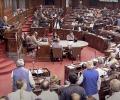
Opposition MPs in the Rajya Sabha criticised the Modi government's economic policies, citing the LPG crisis, lack of energy security, and concerns over the Economic Stabilisation Fund.

'It's a changing world and the opening up doesn't mean that concerns with regards to security have gone away.'
The Iran conflict led to a sharp correction in Reliance Industries Ltd's (RIL's) share price, which has been partially reversed by a rebound.

Benchmark equity indices Sensex and Nifty extended their gains for the second straight session on Monday, driven by optimism over the India-US trade deal and robust buying in public sector banks, consumer durables, and realty stocks.

Indian corporate are increasingly shifting away from bank funding towards alternative sources, such as equity and bond markets, as their deleveraged balance sheets have improved their ability to raise equity at better valuations. Moreover, the 100 basis points (bps) rate cut by the Reserve Bank of India (RBI) has enabled them to access long-term funds from the debt capital market at cheaper rates.
From the 30-Sensex firms, Bharat Electronics surged nearly 9 per cent post its December quarter earnings. Eternal, Bajaj Finance, Power Grid, Trent, Mahindra & Mahindra and UltraTech Cement were the other major gainers. Maruti, Sun Pharma, Infosys and Bharti Airtel were among the other laggards.

Ask rediffGURU and PF and MF expert Janak Patel your mutual fund and personal finance-related questions.

A plea has been filed in the Supreme Court challenging a University Grants Commission (UGC) regulation, alleging it has a non-inclusionary definition of caste-based discrimination and excludes certain categories from institutional protection.

'Except for extremely conservative investors, others can consider allocating 10 to 20 per cent of their portfolio to small caps.'

Capex, infrastructure development, and prudent fiscal management are the key focus areas in the Budget, says Nilesh Shah.

After withdrawing money on a net basis for the past three months, foreign portfolio investors (FPIs) have turned buyers with a Rs 6,480 crore investment in October so far, driven by strong macroeconomic factors.

Precious metal prices, particularly gold and silver, experienced a significant surge in the national capital as investors sought safe-haven assets amid escalating hostilities in the Middle East.

Stock market is gearing up for an eventful week ahead where key triggers such as quarterly earnings from corporates, the US Fed interest rate decision and the upcoming Union Budget for 2026-27 would grab the limelight, analysts said.

Largecap equity funds remain suitable for conservative and moderate risk-taking investors seeking relatively stable returns.

Most first-time investors may be better served by diversified options such as flexicap or multi-cap funds, which already hold pharma and healthcare stocks.

'Long-term investors seeking sustainable gains from resilient, fundamentally strong companies may go for these funds.'
FPIs net sold equities worth Rs 1.7 trillion in 2025 -- the highest annual net sale on record.

The rupee declined 31 paise to settle at 90.65 against the US dollar on Friday, weighed down by geopolitical uncertainties over the US-Iran talks, and a sharp rise in global crude oil prices.

Ask rediffGURU and PF expert Nitin Narkhede your mutual fund and personal finance-related questions.
After investing a staggering amount in May, foreign investors turned net sellers with a withdrawal of Rs 8,749 crore from the Indian equity markets in the first week of this month triggered by renewed US-China trade tensions and rising US bond yields. This momentum follows a net investment of Rs 19,860 crore in May and Rs 4,223 crore in April, data with the depositories showed.

The country's primary capital markets delivered a robust performance in FY26, emerging as a global leader in initial public offerings (IPOs) despite an uncertain environment, the Economic Survey said on Thursday.

From the 30-Sensex firms, Eternal declined by 4.02 per cent, followed by Bajaj Finance (3.88 per cent), Sun Pharma, InterGlobe Aviation, Trent, Asian Paints, Mahindra & Mahindra and Bajaj Finserv. HDFC Bank emerged as the only gainer from the pack.

The net inflow into equity mutual funds surged 24 per cent to Rs 23,587 crore in June, reversing the declining trend of the last five months, driven by strong equity market performance across segments, data released by the Association of Mutual Funds in India (AMFI) showed on Wednesday. Also, the latest fund infusion by investors marks the 52nd consecutive month of net inflows into the segment.

Foreign investors have remained cautious ahead of the Union Budget amid expectations of limited policy changes.

'The volatility in the stock markets since September 2024 has hurt the pace of accretion of new investors.'

Bitcoin has fallen from its peak of $1,26,251.3 on October 6, 2025, to $65,405.5, a decline of 48.2 per cent. Investors must recognise that sharp volatility is inherent to Bitcoin and avoid kneejerk reactions.

Platform-style partnerships between global investors and Indian developers are expected to gain further traction over the next few years. This comes as institutional capital increasingly shifts from one-off asset acquisitions to scalable, long-term strategies.

India is well-stocked with inventories of crude oil and key petroleum products, including petrol, diesel, and aviation turbine fuel (ATF), to deal with short-term disruptions as the war intensifies in West Asia, Union Minister of Petroleum and Natural Gas Hardeep Singh Puri said on Tuesday.

Even as the benchmark and broader indices were down sharply on Monday due to escalating tensions in West Asia, the Nifty Defence index ended the session in the green.

Benchmark indices Sensex and Nifty ended marginally higher on Wednesday as a sharp decline in IT blue-chip stocks restricted the rally in the markets.

Analysts predict a surge in gold and silver prices as investors seek safe-haven assets due to escalating tensions in the Middle East. The impact on domestic prices will depend on the conflict's duration, with geopolitical factors and macroeconomic data also playing a role.

Among the fastest-growing companies by revenue were Tata Electronics, which posted a staggering 3,173% CAGR, followed by Tata Passenger Electric Mobility at 904% and JSW One Platforms at 522%.

Stock market benchmark indices Sensex and Nifty ended 2.5 per cent higher on Tuesday after India and the US agreed to a trade deal under which Washington will bring down the reciprocal tariff on Indian goods to 18 per cent.

ICICI Bank, Eternal, Titan, Adani Ports, Tata Consultancy Services and UltraTech Cement were also among the laggards. However, InterGlobe Aviation, Tech Mahindra, Hindustan Unilever and Bajaj Finance were among the gainers.
Benchmark equity indices Sensex and Nifty rebounded on Thursday after three sessions of losses, tracking gains in global markets after US President Donald Trump struck a conciliatory tone on Greenland. In a volatile session, the 30-share BSE Sensex climbed 397.74 points, or 0.49 per cent, to close at 82,307.37.
