
Burns said, "What is paramount to any agreement is a country's obligations to its own laws, and so we have preserved -- as we must -- our obligations under US laws in this agreement."
Ashley Tellis denies saying that the US 'got more from the government of Dr Manmohan Singh.' rediff stands by the interview.
Strategic affairs specialist Ashley Tellis believes the November 26 terror attacks on Mumbai has given birth to the "misguided notion" that a resolution of the Kashmir dispute is imperative to rein in terrorism in South Asia, and that this should be the priority of the proposed special envoy to the region.
The prize, comprising Rs one lakh, a plaque and an invitation to lecture in Delhi, will be awarded at a function to be held in April.
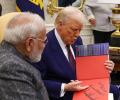
'The current strain in the relationship is serious and likely to be long lasting.' 'Even if Trump suddenly changes his attitude toward India -- which he is entirely capable of doing -- it is unlikely that New Delhi will be able to pick up the pieces and respond as if nothing has happened.'

'...it should not delude itself into thinking that India's security or its great-power ambitions will be advanced by those partnerships.'
'Instead, what India should focus on is on riding out the next three-and-a-half years of Trump's presidency with minimal damage to itself.'

Possible US envoy says India must get assurance against China.

'Fears in Washington began to intensify when it was realised that subsequent Pakistani and Indian attacks on major military facilities -- which were significant in terms of geographic scope and intensity -- could rapidly take both sides to where neither actually wanted to go.' 'The US objective was to stop the fighting as soon as possible. Everything else was secondary.'
If the prime minister can show once more that he is capable of making difficult decisions, he could restore US-Indian ties to the earlier upward trajectory, believes Ashley Tellis.
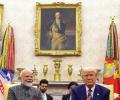
'Modi's intention was to create goodwill that will allow India to be seen by Trump as more than just a bad tariff problem.' 'He succeeded brilliantly on that count but none of these wins are unfortunately permanent.' 'Modi will have to do this again and again if Trump's grievances are to be durably assuaged.'

Foreign policy expert Dr Ashley J Tellis believes there are three fundamental objectives that Prime Minister Manmohan Singh's visit to the United States can accomplish.
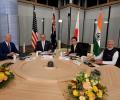
Saturday's Quad meeting in Delaware is taking place against the backdrop of China's assertive behaviour in the South China Sea, its sabre-rattling in the Taiwan Strait and increasing footprints in the Pacific and Indian Ocean, asserts Rup Narayan Das.
Prime Minister Manmohan Singh's presence at the first-ever Nuclear Security Summit hosted by United States President Barack Obama, beginning April 12, will be key for 'critical substantive reasons', believes Dr Ashley J Tellis, an expert on nonproliferation and nuclear security matters.
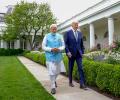
'India will want a lot of help from the US, but it's not going to want US troops.'
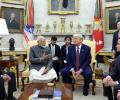
'By his words, actions, and body language during their joint press appearance wanted to convey his personal respect and, more broadly, his desire to work closely with India.'
In the wake of the movement in recent days with speculation rife that Prime Minister Singh is willing to go ahead with the deal even if the Left allies in the coalition withdraw their support, the Bush administration -- which some perceived was a totally unrealistic statement, but which sources said was consequent to indications from New Delhi that there would be movement on the deal from its current moribund status -- vowed to work to complete the deal.
India's offer of the reported proposal to put a dedicated facility under safeguards, could be a positive contribution to moving the process forward during the talks led by Narayanan, predicts Dr Ashley J Tellis.
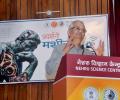
'Why should we disclose classified information to satisfy those who doubt our Hydrogen Bomb capability?'
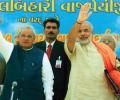
'Modi is nobody's fool. He recognises that China has a sort of quality that attracts and repels. It attracts in terms of its performance and it shows in a sense a mirror image to India of what it could be if everything went right in terms of economic performance,' says Ashley Tellis, senior associate, Carnegie Endowment for International Peace, and head of its South Asia programme.

'...to prevent this episode from disrupting ongoing cooperation.' 'The discovery of this plot had the potential to derail much of what has been achieved in the relationship during this administration's tenure -- I don't think that fact has been sufficiently appreciated in India.'

'India's specific concerns about whether Russia will be a reliable defense supplier and diplomatic partner in the event of heightened hostilities with China has undoubtedly accelerated the process of US-India defense and intelligence cooperation intended to support Indian military positions along the Line of Actual Control.'

'Instead of writing NAM's obituary, India should reinvent it,' suggests Dr Rup Narayan Das.

In the light of India's increasingly 'darkening' threat environment and the convergence of strategic interests between China and Pakistan, the IAF's declining combat capabilities are a cause for concern, says Brigadier Gurmeet Kanwal (retd).

'And if the United States, at that time, perceives India to have welched on the deal, not been our friend, when we did so much to make it a friend, that's trouble.'
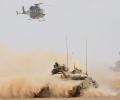
'Offensive operations to capture objectives across the LoC to eliminate terrorist launch pads and deny the use of the most dangerous routes of infiltration, are likely to be limited to brigade-level attacks.' 'These limited operations are unlikely to escalate to war across the international boundary,' says Brigadier Gurmeet Kanwal (retd).

'There will be some issues of contention, especially on H1B visa and on trade policy.'

Days before Narendra Modi arrives in the US to speak at the UN, meet Barack Obama, gupshup with the likes of Nadella, Pichai, Zuckerberg, and address desis in Silicon Valley, his ministers will help set the commercial and strategic tone for the prime minister's visit.

'Prime Minister Manmohan Singh refused to allow us to project his real personality to let the people of India know exactly what he really was. He was always shying away from greater public exposure. Since the last two years we have seen enormous criticism, ridiculing the prime minister. He has been made into an object of jokes. It certainly hurts. I think this man deserves lots of good reviews... His contribution to social policy, his contribution to the economy, his contribution to coalition management, his contribution to foreign policy.' Dr Sanjaya Baru, Dr Singh's former media advisor who is in the eye of a storm over his book on the prime minister UPA speaks to Rediff.com's Sheela Bhatt.

Aziz Haniffa, who has covered every Indian Prime Minister's visit to the US since Rajiv Gandhi in 1985, gives us a peek into what's happening in Washington, DC on the eve of the Modi-Trump summit.

'Diplomatic engagement will continue even as India keeps all its options open with respect to discretely targeting the Pakistani military and its terrorist proxies.'

'Modi's investment in the relationship with Washington is the biggest deliverable of this visit. He means business and that's fantastic!'
 © 2026 Rediff.com - Advertise with us - Disclaimer - Privacy Policy - Sitemap - Feedback - About us - Terms of use - Grievances