
Have the markets already played out their dynamics before the economy has even properly taken off? Are we now destined for a period of mediocre returns despite a strong economy? asks Akash Prakash.

The new government that presents the full Budget for 2024-2025 in July should be ready to restructure the way divestment is managed and implemented, proposes A K Bhattacharya.
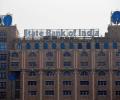
SBI Q3FY24 result review: A higher-than-factored weakness in the October-to-December quarter (Q3) results of State Bank of India (SBI), for financial year 2023-24 (FY24), has prompted brokerages to cut earnings estimates for the ongoing financial year. They, however, have maintained 'Buy' ratings on the stock, revising target price upwards in some cases, owing to the stock's recent underperformance relative to its peers.

'Somebody was using somebody to make statements that will stir the stock market and lead to a surge.' 'A sudden surge and a sudden crash is always an ideal situation for people to make illicit gains and then siphoning off the money.'

GDP growth of 7.7 per cent in the first half of this fiscal has "left sceptics gasping and woefully behind the curve", an RBI article said on Wednesday. It also stressed the buildup in the growth momentum is likely to be sustained. The article on the state of the economy published in the Reserve Bank's December Bulletin on Wednesday also said CPI-based retail inflation is expected to ease to 4.6 per cent in the first three quarters of 2024-25 from 5.6 per cent in November.

The Union government's finances witnessed significant improvement in August after a stressful first four months of the current fiscal year. India's gross tax revenue, comprising both direct and indirect taxes, for the first five months of 2023-24 surged 16.5 per cent year-on-year (Y-o-Y) to Rs 11.8 trillion. During the April-July period, gross tax revenue increased by a mere 2.8 per cent compared to the Budget Estimate of 12.1 per cent growth for FY24.

Ahead of the Budget, the government has achieved almost half the divestment target of Rs 65,000 crore. FY23 divestment receipts are unlikely to be anywhere close to the budgeted target.
The government on Monday budgeted Rs 1.75 lakh crore from stake sale in public sector companies and financial institutions, including 2 PSU banks and one general insurance company, in the next fiscal year beginning April 1. The amount is lower than the record Rs 2.10 lakh crore which was budgeted to be raised from CPSE disinvestment in the current fiscal year. However, the COVID-19 pandemic impacted the government's CPSE stake sale programme, and the target has been lowered to Rs 32,000 crore in the Revised Estimates.

Finance Minister Nirmala Sitharaman will be presenting her fifth Budget that may do a tightrope walk between staying fiscally prudent and meeting general public expectations of lower taxes and a wider social security net, while at the same time firing the engines of the economy.

For every rupee in the government coffer, 58 paise will come from direct and indirect taxes, 34 paise from borrowings and other liabilities, six paise from non-tax revenue like disinvestment and two paise from non-debt capital receipts, according to the Budget documents for 2023-24.

The finance minister's assertion that industry should not expect any spectacular announcements in the 2024 interim Budget suggest that the electoral imperatives of more tax concessions or higher expenditure on welfarist programmes could be far less pronounced than they were before the 2019 interim Budget, expects A K Bhattacharya.

The initial public offering of the country's largest insurer LIC will open on May 4 and close on May 9, sources said. The IPO, through which the government will sell 3.5 per cent stake in state-owned Life Insurance Corporation (LIC), will fetch Rs 21,000 crore to the exchequer. The IPO values LIC at Rs 6 lakh crore.
The government is likely to cut the size of the initial public offering of LIC to 3.5 per cent to raise around Rs 21,000 crore from the issue which would hit the capital markets in the first week of the next month. The government in February had planned to sell a 5 per cent stake in Life Insurance Corporation (LIC). However, the ongoing market volatility due to the Russia-Ukraine war has made it lower the IPO size. At this price, LIC, which is 100 per cent government-owned, is valued at Rs 6 lakh crore.

India on Friday made a strong pitch for a sovereign rating upgrade with Moody's and also questioned the parameters based on which the US-based agency accords ratings, sources said on Friday. Ahead of its annual review of the sovereign rating, Moody's Investors Service representatives met Indian government officials during which the officials highlighted the reforms and strong fundamentals of the Indian economy. A higher rating for India would mean the nation is less riskier, translating into lower interest rates on borrowings.

The government is planning to soon file the final papers for LIC IPO with market regulator Sebi, which will provide details about the price band, discount for policyholders and retail buyers, and the actual number of shares to be put on the block, an official said. The government is presently in the wait-and-watch mode because of the market volatility induced by the Russia-Ukraine war and will decide on the timing of the initial public offering (IPO) of Life Insurance Corporation (LIC). "We have got the approval of the DRHP and the next step would be to file the RHP, which will give details of the price band and the actual number of shares.
The rumour verification process would now be triggered by changes in price or 'material price movements', as the paper defines it. What this means is that companies would need to verify rumours only if the share price moves significantly.

Whether it was the MGNREGS or the NFSA or the Aadhaar-based DBT scheme for cash transfer, the Modi government has built on the basic architecture created by the Singh government. Policy makers in the Modi government, instead of discarding them as products of the previous political regime, worked on them, expanded their scope and reach, and used new tools to improve their performance, explains A K Bhattacharya.

Chief Economic Advisor V Anantha Nageswaran on Thursday said the economy is expected to grow at 6.5 per cent in the current fiscal notwithstanding deficient rains in August. India recorded economic growth of 7.8 per cent in the April-June quarter of 2023-24 against 13.1 per cent in the year-ago period. India's economy in Q1 grew at the fastest pace in a year, on the shoulders of a boost in capital expenditure both at central and state levels, along with stronger consumption demand, especially in rural areas, and improved performance in the services sector, he said.

'I'm pitching India for the strengths we offer, including the English language, engineers, doctors, nurses, professionals, innovative talent of startups.'

Stock market investors are expecting a balanced Budget with a focus on job creation, increased spending on infrastructure, reigning in the deficit, and bringing the economy back on track, experts said on Wednesday. Stock markets have been subdued in the run-up to the Union Budget with BSE's benchmark Sensex is almost flat so far this month. Even the corporate earning season failed to excite the markets, while some indices like IT and bankex have seen some positive movements.
The Union Cabinet has cleared disinvestment of the country's largest insurer LIC and a panel headed by the finance minister will now decide on the quantum of stake dilution, a senior official said on Monday. The Department of Investment and Public Asset Management (DIPAM) had in January appointed actuarial firm Milliman Advisors LLP India to assess the embedded value of LIC ahead of the IPO (initial public offering), which is touted to be the biggest public issue in Indian corporate history. The Budget amendments to the LIC Act has been notified and the actuarial firm is expected to finalise the embedded value of the life insurer. Under the embedded value method, the insurance company's present value of future profit is also included in its present net asset value.

The Reserve Bank (RBI) resisted a 'raid' planned by some in the government to extract Rs 2-3 lakh crore from its balance sheet in 2018 to meet populist spending in run-up to general elections, Viral Acharya, who was deputy governor at RBI at that time, has written.

'Just the amount of work which is there just to become more and more successful in banking. For this to happen you need to have leaders who understand technology.'

As many as 20 central public sector enterprises and their units are at various stages of strategic disinvestment, while six are being considered for closure or are under litigation, Minister of State for Finance Anurag Singh Thakur said on Monday.

The 2022-23 Budget has projected a disinvestment target of Rs 65,000 crore for next financial year. This is significantly lower than the estimated Rs 1.75 lakh crore budgeted for 2021-22. In the revised estimates, the target for 2021-22 has been cut to Rs 78,000 crore.

Air India sale will give a boost to India's privatisation drive, the Economic Survey said on Monday, as it suggested redefining the public sector role in business enterprises to encourage private participation in all sectors. The government earlier this month handed over ownership rights in national carrier Air India to Tata Group for Rs 18,000 crore. The amount includes the takeover of the debt burden of Rs 15,300 crore and another Rs 2,700 crore in cash.

The Appointments Committee of Cabinet has named Ravneet Kaur, a Punjab cadre IAS officer of 1988 batch, as chairperson of the Competition Commission of India (CCI). Kaur will hold the post for five years or until attaining the age of 65. She is the second woman to serve in an 'economic regulator' role after Madhabi Puri Buch, who was appointed chairperson of the Securities and Exchange Board of India last year and the first woman to head the country's chief national competition regulator.
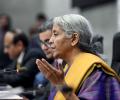
Let's wait for the monetary policy on February 8 -- to see how it complements the fiscal commitments, points out Tamal Bandyopadhyay.
The government is unlikely to come up with the IPO of Life Insurance Corporation (LIC) in the current financial year ending March 2022, as the valuation of the state-owned behemoth is taking more than anticipated time, and the preparatory work is still far from complete. There are still some issues that need to be addressed with regard to the valuation of LIC, a senior official of one of the merchant bankers said. Even after the valuation, there are several regulatory processes that have concluded, the official said.
The government and Life Insurance Corporation's (LIC's) strategic stake sale in IDBI Bank is expected to move to the second stage by the first quarter of FY24, said two people in the know. They added that considering the progress of the ongoing deal, financial bids are expected to come in by June this year. The proposed IDBI Bank stake sale is divided into two sequential stages.

The ownership by domestic investors, individual as well as institutional, in companies listed on the National Stock Exchange (NSE) has breached the 25 per cent mark for the first time. The share stood at 25.72 per cent at the end of the March 2023 quarter, up from 24.44 per cent in the previous quarter, according to data from Prime Database. The share of foreign portfolio investors (FPIs), meanwhile, rose slightly to 20.56 per cent from 20.24 per cent as on December 31, 2022.
With the Russia-Ukraine war roiling financial markets globally, the government may defer the mega IPO of LIC and wait for an opportune time to get the maximum value of its holding in the state-owned insurance behemoth, sources said. "It's a full blown war now so we will have to assess the situation for going ahead with the LIC IPO," a government source said. Finance Minister Nirmala Sitharaman, too, had indicated review of the IPO in view of the evolving geopolitical situation.

Larger firms feel that the smaller players have muddied the waters for the IBC process, leading to excessive regulation of resolution Professionals.

'While lower steel prices may impact a part of the quarter, this will be offset by softer raw material prices.'

The finance ministry has approached different ministries to increase the privatisation target

The government has received Rs 413 crore as dividend tranches from five CPSEs, including NLC and NALCO. "Government has received Rs 78 crore and Rs 165 crore respectively from Antariksh corp and NLC as dividend tranches," DIPAM secretary Tuhin Kanta Pandey tweeted.

The government on Friday appointed Suman K Bery as the vice chairman of Niti Aayog, following the sudden resignation of Rajiv Kumar.

While divestment through IPOs saw an over 90 per cent drop as compared to the previous financial year, the exchange traded fund (ETF) route proved to be a shot in the arm for the government, reports Sundar Sethuraman.

According to the bid document, as part of the strategic disinvestment Air India would also sell 100 per cent stake in low cost airline Air India Express and 50 per cent shareholding in joint venture AISATS. The management control of the airline would also be transferred to the successful bidder.

The share of listed public sector undertakings (PSUs) in the overall market capitalisation has hit a three-year high of 11.4 per cent. This comes on the back of the sharp outperformance of the PSU pack over the past two years. In 2021 and 2022, the BSE PSU index gained 41 per cent and 23 per cent, respectively. Market participants said a combination of factors like value buying and bullishness, particularly in public sector banks (PSBs), were the reason for the improved prospects.
