
The government's capital expenditure in the April-November period of financial year 2024-25 (FY25) continued to contract with a 12.3 per cent decline year-on-year (Y-o-Y), according to data released by the Controller General of Accounts on Tuesday.

Although the Budget has projected only Rs 1,120 crore (Rs 11.2 billion) receipts from disinvestment, sources said some big-ticket initial public offers, or IPOs, could hit the markets soon. Finance Minister Pranab Mukherjee will meet the Securities & Exchange Board of India board on Friday to discuss, among other things, the disinvestment roadmap and the Budget proposal to raise the threshold for non-promoter public shareholding for all listed companies in a phased manner.

Although it has not been able to sell stake in any PSU so far this fiscal, the government will be able to meet the Rs 30,000 crore disinvestment target set for 2012-13, according to Department of Economic Affairs secretary Arvind Mayaram.

Finance Minister Nirmala Sitharaman will present her 8th straight Budget and all eyes will be on the much-expected tax relief for the middle class. Sitharaman had in her first Budget in 2019 replaced the leather briefcase -- which had been in use for decades for carrying Budget documents -- with a traditional 'bahi-khata' wrapped in red cloth.
Left parties will meet in New Delhi Monday to give a final shape to their strategy on the crucial issue of disinvestment of Public Sector Units, with the government planning to divest its stake in some non-navratna companies.

A couple of options are on the table, from buyback, cross-holding, selective public offers of only big companies to residual stake in companies with minority government ownership.
The government has managed Rs 21,000 crore through stake sales and buybacks in the first six months, the highest-ever first half divestment revenue for any year by a good margin, raising expectations for the rest of FY17.
.jpg)
The ETF is expected to fetch the govt Rs 3,000 crore.

'We are not incentivising the old tax scheme. These taxpayers will also shift to the new regime after comparison.'

With Coal India deciding to pay around Rs 16,485 crore as interim dividend, the government will be able to make up for the shortfall in the disinvestment target of Rs 40,000 crore for the current fiscal.

A planned stake sale in Coal India in the last financial year had to be deferred after stiff opposition from the trade unions.

The government on Wednesday said it will raise Rs 72,500 crore through disinvestment of PSUs, including listing of three railway PSUs IRCTC, IRFC and IRCON, and proposed merger and consolidation to create globally competitive public sector units.

In the last year Budget too, the Government targetted to raise Rs. 40,000 crore through disinvestment in the current fiscal.
Disinvestment proceeds of the government could be higher than the estimate of Rs 25,000 crore for 2009-10. The government has already raised Rs 13,621 crore through disinvestment in four public sector companies.Dilution of stake in National Mineral Development Corporation, the fifth public sector undertaking to come out with a public offer this year, is likely to fetch the government more than the remaining Rs 11,388 crore, thereby exceeding even the revised target.

Kicking off its disinvestment drive, the government will sell 5 per cent of its stake in steel major SAIL on Nov 5.

Prime Minister Narendra Modi led-NDA government in its third term must tackle the problem of unemployment in the country, especially in the unorganised sector and in small and medium enterprises, former NITI Aayog Vice Chairman Rajiv Kumar said on Monday. Kumar also emphasised that the government now must finalise the four labour codes as it has been delayed beyond expectations. "We must recognise that post-COVID economic recovery has been a K-shaped recovery.
The government cut its disinvestment target by more than half for the current financial year and pegged the proceeds at Rs 36,925 crore for 2014-15.

The IEMs could be those former officers of government and PSUs who have retired from top management positions and also eminent persons and executives from the private sector.

'It has remained around 38 per cent over the past four to five quarters.'

For every rupee in the government coffer, the biggest pie of 63 paise will come from direct and indirect taxes, according to the Union Budget 2024-25 documents.
In the President's address to Parliament last week, the United Progressive Alliance government announced its intention to resume disinvestment as a way to bring the fiscal situation back under control. Of course, it would not consider surrendering its majority stake in the enterprises in which it decides to dilute its holding.

West Bengal government, through its arm West Bengal Industrial Development Corporation, had decided to offload its shares (which included the controversial 155 million shares) following which IOC emerged as the sole valid bidder.
A stalemate continued over the BHEL disinvestment issue with Left parties ruling out any dilution of their opposition to it, after their meeting with United Progressive Alliance chairperson Sonia Gandhi.

Finance Minister Nirmala Sitharaman is likely to hold pre-budget consultations with industry chambers on June 20, sources said. The budget for 2024-25 fiscal is likely to be presented in Parliament in the second half of July. Industry sources said the pre-budget consultation with Sitharaman would be preceded by a meeting with Revenue Secretary Sanjay Malhotra on June 18.

The fee pocketed by investment banks for handling equity share sales stood at $244 million during the first half of calendar year 2024. This was the highest first half figure since 2007, according to LSEG Data & Analytics, a provider of financial markets data. Capital mobilised via equity capital market (ECM) activity jumped 2.5 times to $29.5 billion - the highest-ever semi-annual total in terms of proceeds.

With the fiscal deficit target staring at the government, the FY25 Budget has limited expenditure options, points out A K Bhattacharya.

All eyes will be on whether Sitharaman will deliver a populist budget leaving more money in hands of the common man or push the reform agenda by staying on the fiscal glide path to lower the fiscal deficit to 4.5 per cent of GDP by 2025-26.

The government on Monday decided to call off the strategic divestment of Pawan Hans as the successful bidding consortium Star9 Mobility Pvt Ltd was disqualified in view of pending legal cases. Pawan Hans is a 51:49 joint venture of the government and ONGC. The government had in April last year decided to sell the helicopter service provider for Rs 211.14 crore to Star9 Mobility Pvt Ltd -- a consortium of Big Charter Private Ltd, Maharaja Aviation Private Ltd and Almas Global Opportunity Fund SPC.

Union Finance Minister Nirmala Sitharaman, along with her team of bureaucrats, delved into the fine print of the 2024-25 Budget documents in a press conference, detailing the government's road map on bringing down the debt-to-GDP ratio and bold tax measures.

...to fund the revenue gap. Of the gross market borrowing of Rs 14.13 trillion estimated for FY25, Rs 7.5 trillion, or 53 per cent, is planned to be borrowed in the first half.

The finance minister continues to be backed by the same policy team in charting out the broad strategy as in the few earlier Budgets.

Alloting more funds for MNREGA and PM-KISAN could wipe out the entire additional money that the Centre may have for FY25.
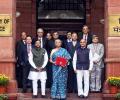
Finance Minister Nirmala Sitharaman on Thursday presented her sixth Budget in a row, equalling the record of former Prime Minister Morarji Desai.

During his visit to the Bastar district headquarters in the poll-bound state, the prime minister is scheduled to address a Bharatiya Janata Party rally.

'We have essentially tried to set out an agenda for the next five years and it, in essence, represents the political commitment to that agenda.'
Net sales of the company rose to 18,974.75 crore (Rs 189.74 billion) compared to 17,241.14 crore (Rs 172.41 billion).

The government on Thursday withdrew its offer to sell its entire 52.98 per cent stake in Bharat Petroleum Corporation Ltd, saying that majority of bidders have expressed their inability to participate in the current privatisation process due to prevailing conditions in the global energy market.
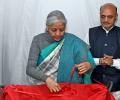
The interim Budget proposals that will be presented on February 1 in the backdrop of the general elections scheduled in April/May 2024 are likely to have a hint of populism, believe analysts, but are unlikely to derail the government from its path of fiscal prudence.

Showing the effect of the slowdown in global economic activity, the equity foreign direct investment (FDI) into India declined sharply to $13.9 billion in April-July 2023 from $22.04 billion a year ago. The net FDI, inflows minus outflows, declined from $17.28 billion in April-July 2022 to $5.70 billion in April-July 2023 on account of moderating gross FDI and a rise in repatriation. Gross FDI into India moderated to $22.0 billion during April-July 2023 from $29.6 billion a year ago, according to Reserve Bank of India data.

The court said if employees continue to hold on to flats then Air India Asset Holding Company would not be able to monetize the land to reduce the burden of Air India's debt.
