
The budgeted indirect tax collection target is Rs 9.26 trillion, and the Centre has collected around Rs 5 trillion in the first 8 months. So it needs another Rs 4.2 trn in the last four months

As much as Rs 6,696 crore has been released to the states as GST compensation for the month of March 2018, as on May 29.
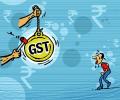
The high court's order, which says refunds paid on service inputs can be restricted, runs contrary to Gujarat HC verdict and could complicate matters.

Appearing on Rediff Chat, G Srikanth, partner in GSV Associates, Chartered Accountants, Chennai, and member of the Institute of Cost and Management Accountants, answered readers' queries on the Goods and Services Act.

The instruction is that audit of large units be completed within seven working days, of medium units in five working days and of small ones in three.

Businesses with more than Rs 10 lakh turnover may end up paying the central goods and services tax, with the Centre not agreeing to states' suggestion of keeping the threshold at Rs 1.5 crore.

'The professional or the freelancer needs to pay taxes from his pocket first and then wait for payments from his clients.'
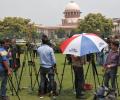
The Supreme Court Monday said the Centre was testing its "patience" and "emasculating" tribunals by not appointing officials to the quasi-judicial bodies which are facing severe crunch of presiding officers as well as judicial and technical members and sought action on the matter by September 13.
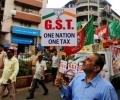
The buoyancy in the tax revenue of GST reflects the upswing in the economy and better compliance

Electricity has also been kept out of the GST ambit.

After the government sought Parliament's nod for a second batch of supplementary demand for grants that will cause a hit of Rs 2.99 trillion to the exchequer, doubts suddenly arose about the government's ability to meet the Budget projections of reining in its fiscal deficit at 6.8 per cent of gross domestic product (GDP), or Rs 15.06 trillion, for the current financial year. Till now, many were of the opinion that the government would succeed in checking the deficit at a much lower figure than what was given in the Budget Estimates (BE). The government had sought Parliament's approval to spend Rs 3.74 trillion extra, but Rs 74,517.01 crore will be matched by equal savings on other heads.

The GST Council also decided that a committee of officers will be constituted to examine the simplification of forms for annual return and reconciliation statement.

It shows that states would require a compensation to the tune of at least Rs 1.67 trillion in 2024-25, as none of them would be able to achieve a 14 per cent growth every year.

It is doubtful that our political masters are even aware of the features of the Model Law.

Compliance requirements, valuation, input tax credit transfers are likely to lead to tax litigation, says Sayan Ghosal.

The council, headed by Finance Minister Arun Jaitley, will meet again on December 11 and 12 to hammer out the differences.

Even with the possible expenditure roll-overs and off-budget financing, the fiscal deficit target will not be met. The FRBM Act, after its amendment in 2018, allows a fiscal deficit slippage of not more than 0.5 per cent for any given year, provided there are justifications. These justifications include war, national security, severe collapse in the agriculture sector, a major natural calamity, big structural economic reforms, or the decline in real output growth of a quarter by at least 3 percentage points below its average of the previous four quarters.

Nasscom president said moving from single to multiple points could be a challenge from the point of view of ease of doing business
For the sake of transparency, and to reduce undesirable bond market volatility, clarity on these would be welcome, preferably before the budgets for the next fiscal year get finalised, says Neelkanth Mishra.

Higher reliance on GST receipts for revenue reduces states' autonomy as these receipts depend on tax rates decided by the GST Council, a report by Delhi-based non-profit, PRS Legislative Research shows.
Continued lack of consensus at next meeting could cast shadow on GST rollout by April 1.

The passage of the bill will pave the way for setting up of a GST council that will decide the tax rate, cess and surcharges.

In a set of FAQs on applicability of Goods and Services Tax on banking, insurance and stock brokers sectors, the revenue department has clarified that transactions relating to securitisation, derivatives, future and forward contracts are exempt.

Facing a deepening slowdown, the auto sector is pinning hopes on the GST Council meeting on September 20 for a rate cut from 28 per cent to 18 per cent. However, states including Bihar, West Bengal, Kerala, and Punjab are of the view that the slowdown in the auto sector is not because of the GST rate but structural issues in the economy.
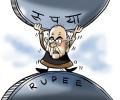
For the first eight months of the current financial year, the figure stood at Rs 7.17 trillion.
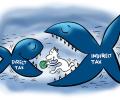
With the implementation of the goods and services tax less than 75 days away -- assuming July 1 as the roll-out date -- Sudipto Dey provides a guide to how businesses can navigate the transition.

It's an undeniable fact that after enactment of GST, buying insurance will become a little expensive impacting your term plans, health plans and motor insurance plans the most. But you should not ignore the importance of insuring your life, health, vehicle, says Harjot Singh Narula

Even if the GST rate is 18-20 per cent, there would be no average impact on inflation.

'The low tax to GDP ratio of the country will go up, helping the government to adhere to fiscal discipline and keep inflation in check.'

The government introduced the 122nd Constitution amendment Bill.
R Vignesh is a member of the Institute of Cost and Management Accountants of India in Chennai, appeared on Rediff Chat to answer readers' queries on GST.

Experts point out that National Anti-profiteering Authority does not have the power to advise companies on depositing amounts voluntarily.

Nirmala Sitharaman has designed the revenue mix in such a way that while Centre's share in taxes would grow a massive 25 per cent, states' share would grow a dismal 6 per cent.

Only after its recommendations will the central GST, integrated GST and state GST Bills be taken up

GST compensation law allows for imposition of cess on certain luxury goods like tobacco, high-end cars and aereated drinks to create a corpus for compensating states for any loss of revenue in the first five years

These have to be passed in this session to meet the September 15 deadline for switching over to the new indirect tax regime, Jaitley said.

GST reform has been hanging fire since 2006-07.
The challenge before the government now is to use the factors that are favourable to its benefit.
Simplifying the processes will lead to greater efficiencies. Bad processes will not help even if implemented well, says T N C Rajagopalan

New ITR forms indirectly force small businesses to maintain books of accounts, something that wasn't needed earlier, says Anupam Jain.
