
Elon Musk, already the world's richest person, may soon become the first trillionaire as his space and AI company, SpaceX, prepares for a public listing. The IPO is expected to be the largest ever, surpassing Aramco's 2020 listing, but recent filings reveal a challenging financial picture for SpaceX.
A fall in crude oil price and Aramco's $75 billion annual dividend commitment may have delayed Saudi company picking a stake in Reliance Industries Ltd's oil-to-chemical unit (O2C), research firm Jefferies said. Richest Indian Mukesh Ambani had in August 2019 announced talks for the sale of a 20 per cent stake in the O2C business, which comprises its twin oil refineries at Jamnagar in Gujarat and petrochemical assets, to the world's largest oil exporter. The deal was to conclude by March 2020 but has been delayed for reasons not disclosed by either company.
Given the company's expansion into internet and retail, more investments including mergers and acquisitions seem highly likely.

'We began foolishly bragging about Saudi-Emirati investment plans as indicative of the sheikhs 'distancing' from Pakistan, including on Kashmir,' notes Ambassador M K Bhadrakumar.

Among top losers, Reliance Industries (RIL) sank over 4 per cent, after the company shelved a proposed deal to sell a 20 per cent stake in its oil refinery and petrochemical business to Saudi Aramco for $15 billion. Other laggards included Bajaj Finance, Bajaj Finserv, NTPC, SBI and Titan.

Investors' wealth eroded by a massive Rs 8,21,666.77 crore on Monday as the market saw a massive sell-off not seen in many months. The BSE benchmark Sensex plunged 1,170.12 points or 1.96 per cent to close at 58,465.89. This is the worst single-day drop for the gauge in over seven months. This was also the fourth straight session of decline for the Sensex.
Reliance announced energy asset sales worth around $ 16 billion; end of the investment cycle in telecom; bringing net-debt to zero in 18 months; value-unlocking options for real estate and financial assets; listing of telecom and retail in five years; and focus on dividends.

'The surge of Saudi nationalism is the last thing Washington wants,' says Ambassador M K Bhadrakumar.
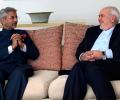
'Tehran,' Foreign Minister Zarif said, 'had expected the Modi government to be "more resilient" in the face of Washington's bullying,' notes Ambassador M K Bhadrakumar.

'Debt mutual funds are a good option now because interest rates are coming down.' 'Retail investors must put a majority portion of your money in short-term debt funds (1 to 3 years) and only a small portion in actively managed dynamic funds.'
 © 2026 Rediff.com - Advertise with us - Disclaimer - Privacy Policy - Sitemap - Feedback - About us - Terms of use - Grievances