
'The test-firing of Agni-III is overdue and we feel the need for that long-range missile as part of our policy of deterrence,' he said.
The launch of the intermediate range ballistic missile Agni-III should be seen as a stepping stone in pushing the country towards further advances in military technology, the defence minister said.
India will test fire its long-range surface-to-surface missile, Agni-III, by the year end and has started induction of the Agni-I and Agni-II versions in a newly raised strategic command, Dr M Natrajan, scientist claimed on Tuesday.
India "successfully" test-fired its nuclear-capable Agni-III ballistic missile with a range of more than 3,000 km from the Wheeler Island off the Orissa coast, on Sunday.
We will hopefully test-fire it before the end of the year, V K Aatre, Scientific Adviser to the defence minister, said.
Defence Research and Development Organisation scientists have traced the possible fault that caused the failure of the first test of Agni-III missile on July 9 and are addressing it, DRDO Director General M Natarajan said.

India on Monday test-fired its nuclear-capable Agni-III ballistic missile with a strike range of more than 3,000 km as part of a user trial by the Army from Wheeler Island off Odisha coast, defence sources said.

It was the third user trial in the Agni-III series carried out to establish the repeatability of the missile's performance.
This is the first time Agni-III has been test-fired.
"The scientists have produced results. It is excellent...up to the point," he said.
This will be the second launch of the 3,000-km range missile after an unsuccessful test on July nine last year from the integrated test range at Wheeler Island near Balasore in Orissa, defence officials said.
The first launch of the missile last year was a failure.
Any failure in the launch of the missile, which has a range of 3,000 km, 'would be a great setback to defence scientists', he added.
Two days after a perfect trial of the highly advanced Agni-IV weapon system, India on Friday successfully test-fired its nuclear-capable Agni-III missile with a strike range of over 3000 km from the Wheeler Island off the Odisha coast.
The nuclear-tipped Agni-III has all cities in both Pakistan and China, including Beijing, within its striking range and will be India's second strike deterrent.

With this second successful test-firing, India now joins a select group of nations having intermediate range ballistic missiles with range up to 3,000 km. The missile will give the nation the capability to target cities in China like Beijing and Shanghai. The success of Agni-III paves the way for India to build its truly intercontinental range missiles Agni-IV with a range of 5000 km in the near future.
The indigenously developed surface-to-surface missile, blasted off at 10.52 am from a fixed platform with the help of an auto launcher in the launch complex-4 of the ITR, located about 72 km from Balasore, defence sources said.
The Information Ministry also said Paksitan has a right to launch a pre-emptive strike if India thinks the same way.
The first test firing of the surface-to-surface missile with a range of over 3,000 km ended in failure on July 9 when, after a smooth take off, it plunged into the sea far short of its intended target.
Highly placed sources said the test firing could take place any time this month.
India succefully test-fired a 3,000-km Agni-III missile on April 12 this year.
Indonesia's foreign ministry could lodge a formal protest over the incident, Transport Minister Hatta Rajasa reportedly said.
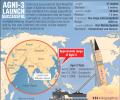
All about India's Agni-III missile
A message board on the successful launch of Agni-III
The failure of the Agni-III was a major dampner to defence scientists as it came even as Pakistan went ahead with a series of successful missile tests of its clandestinely acquired Hatf, Gauri and Shaheen range of missiles in 2006.
India is planning three more tests of the nuclear capable Agni-III missile with a range of 3000 km.

The missile has a strike range of more than 2,000 km.

The missile has a strike range of 2000 km, the sources said soon after it blasted off from a mobile launcher at the Launch Complex-4 of the Integrated Test Range, the sources said.

India on Sunday successfully test-fired its medium-range nuclear-capable Agni-II missile with a strike range of more than 2,000 km from the Wheeler Island off Odisha coast as part of a user trial by the army.

A lot of new technologies developed indigenously were successfully tested in the trial.
Buoyed by the string of successes with the intermediate range ballistic missile Agni-III, India is planning to test a missile with 5,000 km range soon. The launching of the 5,000-km range missile would entail strapping a third stage booster rocket on Agni-III missiles powered by a solid fuel propellant. The test of the next series of Agni missiles will propel the country into the select group of nations which have long range ballistic missiles.

The Agni-V can reach beyond Tibet to high-value targets in the Chinese heartland, even its northern-most provinces.
After rising to the ranks of Lt Generals in the army and Air Marshals in the IAF, a woman is now set to head the country's key missile project. 45-year-old Dr Tessy Thomas, one of the around 200 women scientists and technicians working for the DRDO, has been cleared to be appointed to the post of project director of the upgraded version of the 2000 km-long nuclear capable Agni-II missile.
The country's top rocket scientist V K Saraswat and Dipankar Banerjee, credited with developing critical materials for aircraft carriers, were among scientists decorated by Prime Minister Manmohan Singh on Technology Day on Monday. Both received the 2007 Technology Leadership Award. The top-most defence research award was bagged by the Aeronautical Defence Agency, Bangalore for carrying out test firing of close combat air-to-air missiles in LCAs.
When asked if India should be test-firing a nuclear capable missile at a time when Washington is trying to dismantle the nuclear programmes of Iran and North Korea, McCormack replied: "It's not the first time they've test-fired missiles.

Describing the trial as a "complete success", they said all mission objectives were met during the test-fire. All radars, tracking systems and range stations tracked and monitored the flight performance of the missile, which was launched with support of a mobile launcher.
Tactical systems such as main battle tank Arjun, light combat aircraft Tejas, a family of radars, electronic warfare systems, sonars, torpedoes, armaments and missiles have been successfully developed in the country and many of them are being delivered to the armed forces. The recent success of the DRDO (Defence Research and Development Organisation) in the launch of interceptor missile and Agni-III has taken our country into the elite club of a few developed nations.
As Prithvi has gone into production, one of the products from the assembly line picked up at random might be test-fired.
 © 2026 Rediff.com - Advertise with us - Disclaimer - Privacy Policy - Sitemap - Feedback - About us - Terms of use - Grievances