
Telecom operator Bharti Airtel on Monday announced 20-25 per cent tariff hikes for various prepaid offerings, including tariffed voice plans, unlimited voice bundles and data top-ups, and said the new rates will come into effect from November 26. The entry-level tariffed voice plan has been raised by about 25 per cent, while for unlimited voice bundles, the increase in most cases is about 20 per cent. Sunil Mittal led telco -- whose India mobile customer base stood at about 323 million at the last count -- has also increased the tariffs for data top-up plans by about 20-21 per cent

Till now, Jio was primarily targeting the prepaid customer base, with only a few post-paid plans. Now, it is targeting post-paid customers, who usually spend over five times their prepaid counterparts and are more company-loyal.

Vodafone Idea will gradually lose market share given its weak balance sheet and limited financial flexibility, says Fitch.
Airtel, Vodafone, BSNL increase subscriber share while Idea manages to retain

Bharti's ratings headroom is likely to improve with an equity infusion, planned asset sales and growing EBITDA from Africa.
India's second-largest telecom firm Bharti Airtel on Tuesday reported a net profit of Rs 1,134 crore for the September 2021 quarter, and said it is witnessing strong business momentum with growth in 4G customers and increase in mobile ARPU. This is against a loss (attributable to owners of the parent) of 763.2 crore during the year-ago quarter, the company said in a statement. Its consolidated revenues for the second quarter of FY21 stood at Rs 28,326.4 crore, up 18.8 per cent year-on-year (on a comparable basis) and 13 per cent y-o-y on a reported basis, it added.
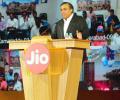
The launch of services by Jio in September 2016 had disrupted the whole telecom sector, with operators matching low rates to maintain competitive edge
India's second-largest telecom operator Bharti Airtel on Tuesday posted more than twofold year-on-year jump in its consolidated net profit for the March quarter to Rs 2,008 crore, buoyed by a lift in average revenue per user and an exceptional gain. The telco said its Q4 scorecard was backed by strong performance delivery across the portfolio and its CEO Gopal Vittal, in a statement, exuded optimism about opportunities in the coming years and Airtel being "well-poised" as a company. Airtel, which competes in the market with Reliance Jio and Vodafone Idea, as well as state-owned BSNL/MTNL, promised to maintain razor sharp focus on financial flexibility, optimising the capital structure and finance cost.

Encouraging results for PayTM (One97 Communications) for the 2022-23 financial year (Q4FY23) have led to a surge in the company's stock price, gaining nearly 5 per cent during Monday's trade. PayTM reported Q4FY23 revenues at Rs 2,330 crore, up 51 per cent on year-on-year (YoY) basis (13.2 per cent quarter-on-quarter or QoQ), led by monthly transaction user (MTU) growth of 27 per cent and average revenue per user or ARPU growth of 19 per cent YoY. MTU is defined as users with at least one transaction/month.

The government has given an option to telcos to pay back interest on dues through equity and also conveyed that it has no interest in acquiring any telecom company, a top official of debt-ridden Vodafone Idea has said. Vodafone Idea Ltd (VIL) managing director and CEO Ravinder Takkar in an interview to PTI said it is clear that the government wants the company to compete in the market and there should be at least three private service providers in the telecom sector. "I have had many many interactions across various parts of the government leading up to this announcement (telecom reforms).

These customers will be unable to meet the lowest recharge requirements for Jio, meaning they will either exit the market or migrate to BSNL/MTNL.

Six consecutive profitable quarters after an equal number of losses - for Bharti Airtel, the turnaround has been quick. But it is not a result of higher tariffs or absence of exceptional items alone. Execution and strategy are playing a part, too. Bharti Airtel's chief executive officer Gopal Vittal summed it up in a post-result conference call last month. "We track the profit in each of our 237,500 (cell) sites.

From spending a little less than three hours on making voice calls, Indians are spending well over 5 hours. So, while people make more calls, they are spending less than ever, reports Romita Majumdar.

In conversation with Deepsekhar Choudhury and Neha Alawadhi, Sharma speaks about his journey and the road ahead.
The problem is simple: None of the incumbent players, including Vodafone Idea, has a similar offer to challenge Jio and ensure that its 2G customers do not migrate.

Given the escalating cost of doing business, the revenue opportunity is decreasing and consolidation is an inevitable part of the industry.
What worked for Airtel was that its data traffic growth was 13 per cent sequentially and its average data usage was even higher than Jio's at 11.9 gigabyte per month per user.

The management plans to invest Rs 27,000 crore in 2019-20, supported by savings of around Rs 14,000 crore that it expects to come from synergising operations of merged entities.

Mukesh Ambani's Reliance Jio, however, continued to add wireless subscribers
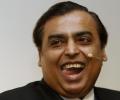
Analysts expect RIL to report consolidated revenue of Rs 1.40 trillion and 10 analysts expect RIL's net income to be Rs 9,629 crore

Billionaire Mukesh Ambani's Reliance Industries Ltd on Friday reported a 22.5 per cent rise in net profit for the quarter ended March on the back of bumper oil refining margins, steady growth in telecom and digital services and strong momentum in the retail business. The oil-to-retail-to-telecom conglomerate's consolidated net profit rose to Rs 16,203 crore in the quarter ended March 31, 2022 from Rs 13,227 crore, the firm said in a statement. Net profit, however, fell 12.6 per cent sequentially -- breaking a six-quarter chain of quarter-on-quarter improvement.

With their net debt estimated at Rs 1.15 trillion, the merged entity will not be in much of a position to dole out freebies, says Romita Majumdar.

Jio is planning to win over 350 million 2G feature phone users by launching a smartphone at a fraction of the current cost.

Consumers can expect a 5G launch in the country soon. Telecom companies (telcos) say if auctions take place on time - the target is July - they would be able to offer some services in a few cities by the end of this year and a full roll-out from 2023. But the question is: will 5G turn the tables for telcos financially? Will average revenue per user (ARPU) improve? Will mobile consumers upgrade to 5G quickly and pay more? Will the expanded functions that 5G enables drum up sufficient revenues? In simple terms, will telcos make more money?

While only 78.15 per cent of Jio's total subscriber base was active, Airtel boasts of 98.14 per cent active customers.

'Vodafone Idea has losses running over Rs 10,000 crore in the last four quarters.' 'It has long-term debt of about Rs 1.15 trillion.' 'Even post-issue, the debt service numbers won't be good,' points out Devangshu Datta.

While Mukesh Ambani-led RIL posted a 108 per cent YoY rise in profit after tax for Q4FY21 at Rs 13,227 crore, it fell short of Bloomberg estimate of Rs 13,704 crore.
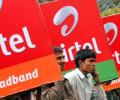
The company has a valuation of Rs 2.22 trillion, up from Rs 1.33 trillion a year ago.

Overall, the credit profiles of players will be supported by healthy balance sheets and liquidity. Prudence in capital and development expenditure, efficient working-capital management, and recent equity raising will help sustain credit metrics in FY22.

'We showcased about 20 use cases in 5G trials in Pune and Gandhinagar and some of them were interesting and innovative.' 'However, which ones will take off and which ones would not be relevant, we don't know yet.'

The average revenue per user (ARPU) of the country's four new GSM operators who got licences in 2008 - Uninor, S-Tel, Videocon and Etisalat DB - was between Rs 8.50 and Rs 39 in the January-March quarter.

The brokerage reduced its target price for the company to Rs 995 per share from Rs 1,350 apiece. Credit Suisse said RIL's liabilities increased from $19 billion to $65 billion in four years.
Ailing telecom operator Vodafone Idea has flagged the industry's "unsustainable financial duress" in its latest annual report and hoped that the government would provide the necessary support to address "all structural issues" faced by the sector. In the chairman's letter to shareholders, Himanshu Kapania cited persistent challenges in the operating environment, amid "unsustainable pricing" and "hyper-competition" during FY21. Kapania expressed hope that government will support efforts to generate reasonable returns on massive investments.

Among other segments, home broadband subscriptions have picked up and the virtual private network service, too, increased by around 15 per cent.

The merged entity would lead with a revenue market share of about 37 per cent against Airtel's 31.2 per cent and Jio's 14.5 per cent

Vodafone Idea's cash flow analysis indicates that its situation may remain challenging even after any relief measures, and the telco needs "meaningful capital infusion" with a long gestation period to become competitive, a report by Credit Suisse said on Wednesday. The report expects Airtel to be "well placed" in either of the scenarios, of two-private-operator sector, or three private operators post an industry repair. The note by Credit Suisse on the Indian telecom sector said there has been increasing interest among investors to evaluate valuations of Bharti Airtel and Indus Towers under two situations, in the wake of recent developments.

For years it has been evident that fibre and DTH would give tough competition to cable in India where regulatory overload has mutilated an already warped industry structure. OTT added fuel to the fire. From Rs 27,000 crore in 2010, cable's share of subscription revenues is now estimated at Rs 13,000 crore.

The new offer is part of its strategy to turn India to an exclusively 4G market.
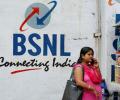
Just a few weeks ago, Communications Minister Ashwini Vaishnaw did some tough talking with the senior managers of Bharat Sanchar Nigam Ltd, the ailing state-owned telecom service provider. The message was clear: They had to perform, quit by taking the voluntary retirement package or be compulsorily retired from service. The terse message from an otherwise polite and soft-spoken minister came just days after he announced a second and bigger package of Rs 1.64 trillion as part of a four-year turnaround plan for BSNL.
