
Benchmark stock indices Sensex and Nifty declined on Monday, extending the losing run to the fourth day amid selling in IT shares and foreign fund outflows. The 30-share BSE Sensex dropped by 247.01 points or 0.30 per cent to settle at 82,253.46. During the day, it fell 490.09 points or 0.59 per cent to 82,010.38 but recovered some of the losses towards the close.

Among 30 Sensex firms, UltraTech Cement, Tech Mahindra, HCL Tech, Tata Consultancy Services, Eternal, Asian Paints, Tata Steel and Kotak Mahindra Bank were among the biggest gainers. Tata Motors, Adani Ports and Sun Pharma were the laggards.

The Indian services sector growth touched an 11 month high in July, supported by a pickup in new exports orders and sharp rise in overall sales, a monthly survey said on Tuesday. The seasonally adjusted HSBC India Services PMI Business Activity Index was at 60.5 in July, little-changed from 60.4 in June, and the rate of expansion was the best seen since August 2024.

With inflation comfortably below the Reserve Bank of India's (RBI's) 4 per cent median target and likely to undershoot its 3.7 per cent projection for 2025-26 (FY26), there is room for the monetary policy easing cycle to be sustained, the Finance Ministry said on Monday. The comments, featured in the ministry's Monthly Economic Review for June 2025, assume significance ahead of the Monetary Policy Committee (MPC) meeting of the Reserve Bank of India (RBI) scheduled to begin from August 5.

The wholesale price-based inflation declined to a 21-month low of 5.85 per cent in November on easing prices of food, fuel and manufactured items. After remaining in double digits for 19 months, the wholesale price index (WPI) based inflation declined to 8.39 per cent in October. The inflation was 14.87 per cent in November 2021. "Decline in the rate of inflation in November 2022, is primarily contributed by fall in prices of food articles, basic metals, textiles, chemicals & chemical products and paper & paper products as compared to the corresponding month of the previous year," the commerce and industry ministry said on Wednesday.

This is the highest level of wholesale price index-based (WPI) inflation since February, when it was 2.26 per cent.

The wholesale price-based inflation eased to a five-month low of 13.93 per cent in July on easing prices of food articles and manufactured products. The WPI-based inflation softened for the second consecutive month in July, raising hopes of further decline in wholesale prices in the months to come. The Wholesale Price Index-based inflation, after scaling a record high of 15.88 per cent in May, declined to 15.18 per cent in June. It was 13.43 per cent in February. It was 11.57 per cent in July last year.

Wholesale price inflation eased to 2.05 per cent in March, as against 2.38 per cent in February, government data showed on Tuesday. The wholesale price index (WPI) based inflation, however, rose year-on-year.

Wholesale prices fall 2.06% in February.

Wholesale inflation rate eased to 34-month low of (-) 0.92 per cent in April on easing prices of food, fuel and manufactured items. The wholesale price index (WPI) based inflation has been on a declining trend for 11 months in a row and entered the negative zone in April. In June 2020 WPI was at (-) 1.81 per cent.

Retail inflation declined to over six-year low of 2.1 per cent in June, nearing the RBI's comfort zone, on account of subdued prices of food items, including vegetables, driven by widespread monsoon.

The wholesale price-based inflation eased for the eighth consecutive month to 4.73 per cent in January on easing prices of manufactured items, fuel and power. The wholesale price-index (WPI) based inflation rate was 4.95 per cent in December 2022 and 13.68 per cent in January 2022. Inflation in food articles, however, rose to 2.38 per cent in January, from (-) 1.25 per cent in December, 2022.

Inflation fell by 0.18 per cent to 7.2 per cent for the week ended October 2, even as vegetable prices shot up by about 14 per cent.

From the Sensex firms, Tata Steel, Eternal, Tech Mahindra, Maruti, Mahindra & Mahindra, Infosys, IndusInd Bank, HCL Tech, Tata Consultancy Services and Bharti Airtel were the major gainers. Telecom operator Bharti Airtel climbed nearly 1 per cent after it posted about a five-fold jump in consolidated net profit to Rs 11,022 crore in the March 2025 quarter, mainly due to the tariff hike impact and one-time gain on tax benefits. However, Asian Paints, Tata Motors, Kotak Mahindra Bank, NTPC and Power Grid were among the laggards.

The domestic stock market this week would monitor the geopolitical developments after India and Pakistan reached an understanding to stop military actions, analysts said. Moreover, macroeconomic data announcements, Q4 earnings, trading activity of foreign investors and global market trends are also likely to influence sentiments, traders said.

The wholesale price-based inflation declined to a 19-month low of 8.39 per cent in October, on easing prices of fuel and manufactured items. This is the first time in 19 months that WPI inflation print has come in single digit. Last was in March 2021 at 7.89 per cent. Since April 2021, WPI inflation remained in double digits for 18 months with September print at 10.79 per cent.

Food costs jumped up year-on-year.

Commuters on national highways and expressways will need to pay more for their road journeys, as the National Highways Authority of India (NHAI) has increased toll charges by an average of 4 to 5 per cent on highway sections across the country. The revised toll charges for motorists on national highways across the country have come into effect from Tuesday, a senior highways ministry official told PTI.

Such a high level of WPI was last recorded in October 2012, when inflation was 7.4 per cent.

Retail inflation dipped marginally to a nearly six-year low of 3.34 per cent in March due to a decline in prices of vegetables and protein-rich items. The Consumer Price Index (CPI) based inflation was 3.61 per cent in February and 4.85 per cent in March last year.
All the BSE sectoral indices closed in the green. BSE Realty, Auto, Capital Goods and Industrials were lead gainers, jumping up to 5 per cent. IndusInd Bank was the lead gainer among Sensex shares, surging by 6.84 per cent. Tata Motors rallied 4.50 per cent. Larsen & Toubro, Axis Bank, Adani Ports, HDFC Bank, ICICI Bank and HCL Tech were also among the gainers. ITC and Hindustan Unilever were the only laggards.
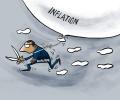
Wholesale price based inflation declined to a 3-month low of 1.89 per cent in November on cheaper food items, and experts predicted a 0.25 per cent interest rate cut by the RBI in the policy review in February. The Wholesale Price Index (WPI) based inflation was 2.36 per cent in October 2024. It was 0.39 per cent in November, last year. In August, 2024, it was 1.25 per cent.

From the Sensex pack, Bajaj Finserv, Mahindra & Mahindra, Axis Bank, Bajaj Finance, Adani Ports, ICICI Bank, Zomato and UltraTech Cement were among the biggest gainers. However, ITC, Nestle, State Bank of India, Reliance Industries, Asian Paints and Tata Consultancy Services were among the laggards.

Inflation in food articles during May stood at 1.13 per cent, as against 2.55 per cent in April.

Investors would track a host of macroeconomic data announcements scheduled this week, including inflation numbers, and also monitor global market trends, and trading activity of foreign institutional investors, analysts said. The ongoing quarterly earnings announcements and the rupee-dollar trend would also influence the markets.

India's wholesale prices declined at a faster-than-expected annual rate of 2.33 per cent in March.

Retail tomato prices declined 22.4 per cent month-on-month on improved supplies across the country, the Consumer Affairs Ministry said on Sunday. The all-India average retail price of tomatoes stood at Rs 52.35 per kg on November 14, down from Rs 67.50 per kg on October 14, according to an official statement. During the same period, modal wholesale prices at Delhi's Azadpur mandi witnessed a sharper decline of nearly 50 per cent to Rs 2,969 per quintal from Rs 5,883 per quintal, driven by increased arrivals.

From the 30-share Sensex pack, Hindustan Unilever, NTPC, Nestle, IndusInd Bank, Power Grid, Adani Ports, Tata Motors and Bajaj Finserv were the major laggards. Reliance Industries, Kotak Mahindra Bank, Tech Mahindra, Mahindra & Mahindra and HDFC Bank were among the gainers.

Soaring vegetable prices pushed the retail inflation rate to a nine-month high of 5.49 pr cent in September, according to government data released on Monday. The consumer price index (CPI)-based retail inflation rate was 3.65 per cent in August and 5.02 per in September 2023. The previous high inflation rate was witnessed in December 2023 at 5.69 per cent.

'We will be very, very proactive in providing whatever liquidity requirements are needed.'

Wholesale inflation in the country rose marginally to 0.53 per cent in March compared to 0.20 per cent in the preceding month due to increase in prices of vegetables, potato, onion and crude oil. The Wholesale Price Index (WPI)-based inflation was in the negative zone from April to October and had turned positive in November at 0.26 per cent. The inflation in March 2023 was 1.41 per cent.

'He will be remembered more for what he did as finance minister -- as someone who functioned well when the political fallout was taken care of.'

Motorists using expressways will have to shell out more from Monday as the National Highways Authority of India (NHAI) has decided to hike tolls across the country by an average of 5 per cent. The annual revision of highway user fee, which is expected to be in the range of average 5 per cent, was earlier to come into effect on April 1. But the hike was deferred due to the Lok Sabha elections.

Amid the political blame game over Bengal's potato ban, which led to shortages in Jharkhand and Odisha, Uttar Pradesh farmers are the unlikely winners.

Wholesale inflation in the country rose for the fourth consecutive month in June at 3.36 per cent on account of rise in prices of food articles, especially vegetables and manufactured items. The wholesale price index (WPI) based inflation was 2.61 per cent in May. It was (-) 4.18 per cent in June 2023.

Quarterly earnings of corporates, trading activity of foreign investors and inflation data are the key factors that are expected to drive the momentum in the equity markets this week, analysts said.

Union Finance Minister Nirmala Sitharaman on Tuesday commended Indian financial sector regulators for doing a "world-class job" and bringing greater transparency into the system. Underlining that she is not against questioning or critiquing regulators, Sitharaman said there is a need to be "extremely conscious" about contributions made by them as well. Speaking at the Financial Express Best Banks Awards, the finance minister said, "I strongly recommend that facts are taken on board before we discuss anything to do with the regulators, strictly speaking."

The wholesale inflation rose for the third consecutive month in May at 2.61 per cent on account of rise in prices of food articles, especially vegetables, and manufactured items. The wholesale price index (WPI) based inflation was 1.26 per cent in the previous month. It was (-) 3.61 per cent in May 2023. "Positive rate of inflation in May, 2024 is primarily due to increase in prices of food articles, manufacture of food products, crude petroleum & natural gas, mineral oils, other manufacturing etc," the ministry of commerce & industry said in a statement on Friday.

Wholesale inflation fell to a 4-month low of 1.31 per cent in August due to a decline in prices of vegetables and fuel, even though onion and potato prices spiked, according to official data released on Tuesday. Wholesale price index-based inflation fell for the second straight month in August after it hit a high of 3.43 per cent in May. Inflation in July was 2.04 per cent. In August last year, WPI inflation was (-) 0.46 per cent.
The wholesale price index (WPI)-based inflation eased in January to 0.27 per cent, mainly due to moderation in prices of food items. WPI inflation was at 0.73 per cent in December 2023. The WPI inflation was in the negative zone from April to October and had turned positive in November at 0.39 per cent.
 © 2026 Rediff.com - Advertise with us - Disclaimer - Privacy Policy - Sitemap - Feedback - About us - Terms of use - Grievances