
The SC has gone a step further to state that even if one were to not apply the codified GAAR provisions, the judicial GAAR would continue to apply, point out Pranav Sayta and Bhargav Selarka.

The revenue department, sources said, will pursue the tax demand along with accrued interest and penalty.

Dutch subsidiary Vodafone International Holdings BV on Tuesday severed a notice of dispute on the Indian government regarding proposals in the Finance Bill 2012 which it claimed violated the international legal protections granted Vodafone and other international investors in India.
Severe jolt to Sahara Group, strict scrutiny of mining activities and scrapping of licences for 2G spectrum dominated the corporate legal battle in 2012 in the Supreme Court which gave a decisive victory to telecom major Vodafone in a Rs 11,000 crore tax case.

On January 20, the court allowed Vodafone's appeal and had quashed the Bombay High Court verdict which had upheld the decision to levy tax on the overseas deal.

Vodafone is locked in twin tax disputes with the government.
Supreme Court Chief Justice SH Kapadia has ruled on Friday that the tax deparment has no jurisdiction over Vodafone's purchase of mobile assets in India.

Hutchison Essar is an Indian Company, the controlling interest of Hutchison Essar is held by an SPV of Cayman Island (CGP Investments Holding Ltd). CGP is owned by Hutchison Telecommunications International Ltd (HTIL), Hong Kong.

Bombay High Court had earlier dismissed a petition filed by Vodafone and ruled that the tax office had jurisdiction to tax its 2007 deal.

British telecom giant Vodafone Group plc on Friday won an arbitration against the Indian government over a demand for Rs 22,100 crore in taxes using retrospective legislation.
A landmark tax case between Vodafone of the UK and the Indian government that is set to determine the future climate for mergers and acquisitions in the country began on Monday.
India's income tax department today said it would scrutinise more than a dozen cases of offshore mergers and acquisitions in which the deal results in an ultimate change of ownership of Indian firms. The latest move by the tax department comes in the background of a favourable ruling from the Bombay High Court yesterday in a case filed by Vodafone International Holding BV.
A bench headed by Justice S B Sinha refused to hear the Vodafone plea that had challenged the Bombay high court judgment, which on December 3 last year had dismissed a petition by Vodafone International Holdings BV, contesting a showcause notice by the I-T department. Vodafone, Netherlands-based company, had bought a 67 per cent stake in Hutchison Essar from Hutchison Telecom International in February 2007 for $11.2 billion.

The Department of Telecommunications (DoT) has initiated discussions with banks to address financial stress in the telecom sector, particularly Vodafone Idea Ltd (VIL) that urgently requires fund infusion to stay afloat. There was a meeting of DOT officials and senior bankers on Friday on the issue of Vodafone, sources said, adding that banks have been asked to look for a solution within the prudential guidelines. According to sources, senior officials from the country's biggest lenders State Bank of India and Bank of Baroda were also present among others in the meeting. More such meetings are expected to take place in the coming days, they said.

India has challenged in a Singapore court a verdict of an international arbitration tribunal that overturned its demand for Rs 22,100 crore in back taxes from Vodafone Group Plc, sources said on Thursday. An international arbitration court had on September 25 rejected tax authorities' demand for Rs 22,100 crore in back taxes and penalties relating to the British telecom giant's 2007 acquisition of an Indian operator. Two sources privy to the development said India had 90 days to file an appeal against the tribunal award, and the same was done in a Singapore court earlier this week.
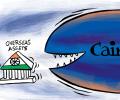
Faced with prospect of its assets across the globe being seized just like Pakistan and Venezuela, the government decided to scrap retrospective taxation but the international embarrassment could have been avoided had 'attached' shares of Britain's Cairn Energy Plc not been sold, according to tax and legal experts. On Thursday, the government introduced a Bill in Parliament to scrap the tax rule that gave the tax department power to go 50 years back and slap capital gains levies wherever ownership had changed hands overseas but business assets were in India. The 2012 legislation was used to levy a cumulative of Rs 1.10 lakh crore of tax on 17 entities, including UK telecom giant Vodafone, but substantial punitive action was taken only in the case of Cairn.

The government, however, amended the tax laws with retrospective effect to undo the Supreme Court judgement and claim taxes.

Recently, the government had appointed former Chief Justice of India R C Lahoti as arbitrator in the tax dispute case.

The government may be waiting for the outcome of an arbitration initiated against its levy of Rs 10,247 crore retrospective tax on UK's Cairn Energy Plc before deciding on appealing against losing a tax case against Vodafone Group, sources said. An international arbitral tribunal is expected to give a decree within next few days on Cairn Energy Plc's challenge to the Indian government seeking Rs 10,247 crore in retrospective taxes. If the arbitration award in the Cairn cases goes against India, the government has to pay the British firm over Rs 7,600 crore to reverse the dividend and tax refund it had ceased and shares it sold to recover part of the tax demand.

The manner in which India has allowed the rule of law to be subverted for over eight years is tragic, notes former additional solicitor general of India Bishwajit Bhattacharyya.

The IT department had issued a tax assessment order in December 2011 asking Vodafone to add Rs 8,500 crore (Rs 85 billion) to its taxable income, thus raising the tax liability of the company.
.jpg)
Faced with over Rs 11,200 crore (Rs 112 billion) tax liability, Vodafone India chief Analjit Singh on Thursday met Finance Minister P Chidambaram for the second time this week and expressed the hope that there will be clarity soon on the proposal to settle the dispute through conciliation.

Finance Minister P Chidambaram has asked UK-based Vodafone Group, which is facing a tax liability of over Rs 11,200 crore in India, to give its view on the long-pending matter in writing, a senior official said.

The British telecom major has disputed the tax demand over its acquisition of 67 per cent stake in Hutchison, now called Vodafone India, arguing that no tax was due as the transaction was conducted offshore.

The Department of Telecom, Department of Industrial Policy and Promotion, Ministry of Home Affairs, Ministry of External Affairs and the Department of Economic Affairs had to give their comments on the proposal, sources said.

The onus of the tax dues of Rs 22,100 crore on Vodafone India's British parent could also fall on the merged entity.

The Finance Ministry has already circulated a draft Cabinet note withdrawing the conciliation offer to Vodafone to resolve the Rs 20,000-crore (Rs 200-billion) tax dispute case.

The Foreign Investment Promotion Board (FIPB) on Monday deferred a decision on Vodafone's Rs 10,141 crore (Rs 101.41 billion) proposal to buy out minority shareholders in its Indian arm as the Ministry of Home Affairs is yet to give its comments.

A bench headed by Justice H L Dattu, however, allowed the petitioner, former Additional Solicitor General Bishwajit Bhattacharyya, to file fresh petition with all the relevant documents stating what action Centre has so far been taken on the issue.

Senior advocate Harish Salve, appearing for the telecom major, informed Justice Manmohan that the company in its response to the high court's August 22 notice has said it is not acceding to jurisdiction of the Indian courts in the matter.

While it was technically not possible to block the deal, the tax department could resort to arm-twisting.
The 1995 judgment in the Union of India vs Cricket Association of Bengal case emphasised that free speech is essential for a successful democracy and citizens must have a plurality of views and a range of opinions on all public issues, says M J Antony.

The retrospective tax decision reversing the January 2012 Supreme Court verdict in the Vodafone case has often been cited as the reason for foreign investors losing confidence in India as an investment destination.
 © 2026 Rediff.com - Advertise with us - Disclaimer - Privacy Policy - Sitemap - Feedback - About us - Terms of use - Grievances