
Investors are set to monitor quarterly earnings, crude oil prices, the Jio Platforms initial public offering, and foreign investor activity in the upcoming holiday-shortened week, according to market analysts.
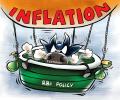
The Reserve Bank of India (RBI) has marginally raised its retail inflation forecast for the current fiscal year (FY27) to 5.2 per cent from 5 per cent, citing increasing price pressures across various commodities. Concurrently, the Monetary Policy Committee (MPC) unanimously decided to hike the key interest rate (repo) by 25 basis points to 5.5 per cent, shifting its stance to 'calibrated tightening'.

The Goods and Services Tax (GST) Council has announced that Input Tax Credit (ITC) will now be available on health and life insurance policies provided by employers to their employees, a move expected to significantly reduce costs for businesses, especially MSMEs.

Reserve Bank of India (RBI) Governor Sanjay Malhotra stated that surplus liquidity in the banking system is expected to drain within the current financial year, utilising tools like currency leakage, sell-buy swaps, open market operations (OMOs), and variable rate operations.

PFRDA Chairperson S Ramann announced an ambitious target to add 2-3 crore new subscribers to the National Pension System (NPS) within the next two years. This growth will be significantly driven by the new 'NPS Tatkal' scheme, which enables direct enrolment and contributions via UPI applications, making the pension system more accessible, especially in tier 2 and tier 3 cities and for the informal sector.

Researchers have outlined five crucial actions to help the world prepare for a potentially strongest-on-record El Nino, aiming to reduce its severe health consequences like infectious diseases, malnutrition, and heat-related conditions. These recommendations, published in The Lancet, emphasise a comprehensive risk overview and early preparatory measures.

The GST Council is set to discuss the application of GST on merchant fees for UPI transactions exceeding Rs 2,000. This comes as a new Merchant Discount Rate (MDR) of 0.4% (capped at Rs 300) is effective from October 15 for such transactions, which, as a service, would typically attract an 18% GST levy. The Council's decision is anticipated to consider consumer interests, with merchants potentially able to claim Input Tax Credit.

Indian states' capital expenditure (capex) utilisation for April-August FY27 fell to 21.21 per cent, slightly below the 21.73 per cent recorded in the same period of FY26, according to a CAG analysis. Despite the dip, this figure remains the third highest in the past six years, with significant variations observed across states.

Non-resident Indian (NRI) deposit schemes witnessed a staggering 678.2 per cent increase, reaching $36.24 billion in the April-July period of FY27, primarily driven by strong FCNR(B) deposit flows and a concessional swap facility introduced by the RBI.

A new EY India report highlights how young professionals, women wealth creators, entrepreneurs, ESOP beneficiaries, and digitally active consumers from Tier-2 and Tier-3 cities are fundamentally changing India's wealth ecosystem. This shift is evidenced by increased participation of young and women investors, a rise in disciplined investing via SIPs, and the crucial role of Digital Public Infrastructure in democratizing access to long-term wealth creation. The report predicts over 100 million new investors by 2035.

India's private sector capital expenditure is projected to reach approximately 3.2 trillion in the financial year 2026-27, up from 2.6 trillion in FY26, according to a Reserve Bank of India bulletin report, indicating sustained confidence despite global uncertainties.

The Indian corporate sector demonstrated strong credit quality in the first half of FY27, driven by robust balance sheets and healthy liquidity, despite facing risks from elevated crude prices, inflation, and global interest rates.

India's Consul General in Shanghai, Pratik Mathur, extended greetings to Song Hou, Director General of China's Commercial Aircraft Corporation (COMAC), ahead of his visit to New Delhi for the BRICS Business Forum 2026. Discussions focused on B2B, technology, and connectivity ties, aligning with India's BRICS Presidency vision. The forum precedes the 18th BRICS Summit.

'Tax recovery will continue through attachment and sale of assets and other recovery mechanisms, but personal arrest will no longer form part of the prescribed recovery process.'
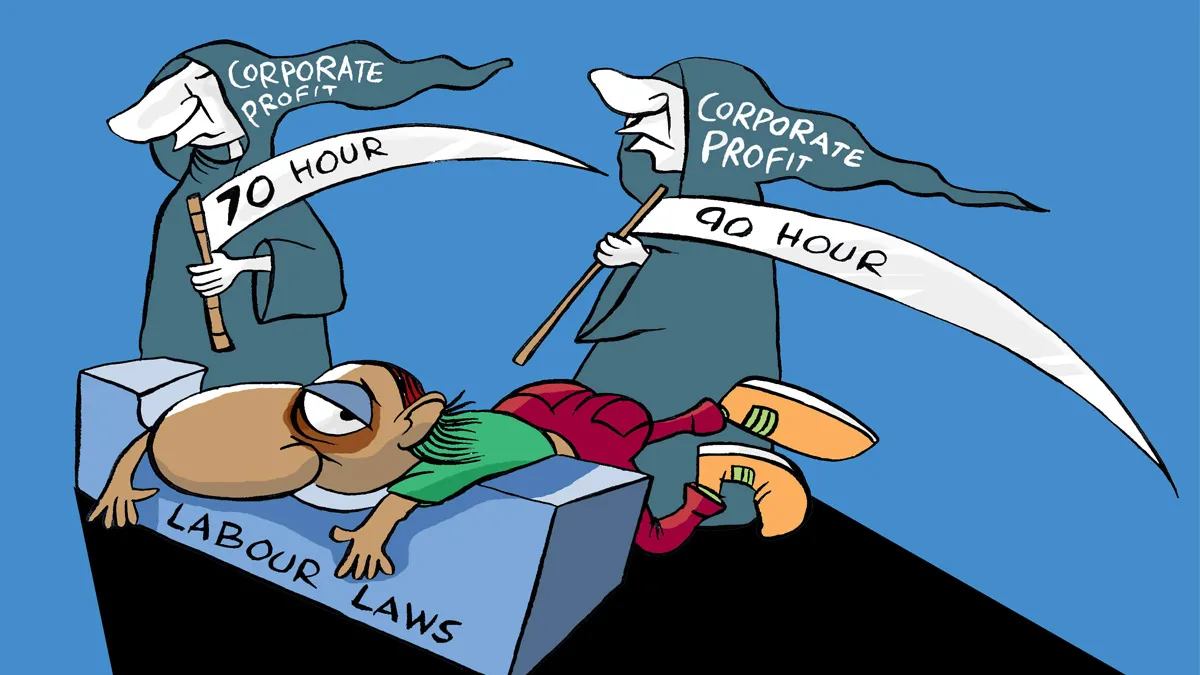
The Indian government is pressing all states and Union Territories (UTs) to publish their rules under the four new labour Codes by October 31, aiming to fully operationalise the new labour law framework. This move is crucial as labour falls under the concurrent list, requiring state-level rule-making for effective implementation.

Foreign portfolio investors (FPIs) have withdrawn nearly Rs 5,109.21 crore from Indian government securities under the fully accessible route (FAR) in just three days, driven by global uncertainty, elevated crude prices, rising US Treasury yields, and a depreciating rupee.

Property insurance premium rates are increasing by 25-30 per cent, primarily due to a reduction in discounts, following substantial claims from natural calamities like the Gujarat floods, which caused an estimated 5,000 crore in losses.

FATF Vice-President Vivek Aggarwal has urged the fintech industry to increase investments to combat emerging threats from AI, scam compounds, virtual digital assets, and quantum computing. He warned that these technological challenges pose a significant risk to India's rapid growth in the fintech sector, highlighting a current lack of adequate investment and risk realisation within the industry.
Foreign Portfolio Investors (FPIs) withdrew Rs 13,138 crore from Indian equities in the first half of September, driven by heightened global uncertainty, rising crude oil prices, firm US bond yields, and a strong dollar, impacting risk appetite.

India's 10 largest pharmaceutical companies have consistently maintained positive average volume growth throughout 2026, while smaller rivals have experienced more erratic performance, driven by a market shift towards chronic and sub-chronic therapies.
Private corporations in India invested approximately 30.3 trillion in fixed assets during FY25, marking a 7 per cent increase from the previous year, according to the statistics ministry. This growth in private capital expenditure contrasts with a slowdown in government capital spending.

India's Consumer Affairs Secretary Nidhi Khare announced that cab aggregators have been ordered to cease advance tipping options, deeming the practice misleading and unfair. This follows the Central Consumer Protection Authority (CCPA) imposing a Rs 10 lakh penalty on Rapido for unfair business practices, including advance tipping and "dark patterns" that pressure users to pay more. Investigations into Uber and Ola are ongoing, with the government emphasizing that tipping should be voluntary and post-ride.

India's venture capital deal value grew by a modest 5 per cent in the first seven months of the year, significantly lagging the global average surge of 161 per cent, reflecting continued investor caution and valuation discipline.

Merchants will be subject to an 18 per cent Goods and Services Tax (GST) on the Merchant Discount Rate (MDR) for UPI payments exceeding Rs 2,000, but can mitigate this burden by claiming input tax credit (ITC), according to tax experts.
Non-banking financial companies (NBFCs) experienced a significant 68.5 per cent year-on-year growth in gold-backed credit in July 2026, while banks saw their gold loan growth moderate to 88.1 per cent from 136.4 per cent a year prior, according to RBI data.
Tax experts clarify that merchants will pay 18% GST on Merchant Discount Rate (MDR) for UPI payments exceeding Rs 2,000, effective October 15. However, registered merchants can claim Input Tax Credit (ITC), mitigating the tax burden. This move is expected to generate significant GST revenue for the exchequer while funding payment infrastructure.

India is actively integrating payment system harmonisation into its Free Trade Agreement (FTA) negotiations, especially with countries hosting a large Indian diaspora. This strategy aims to leverage India's growing fintech ecosystem, facilitate cross-border financial services, and position India as a global hub for financial services exports, particularly through platforms like GIFT City.

Smallcap funds have emerged as the primary beneficiaries of the systematic investment plan (SIP) wave in Indian mutual funds over the past five years, with their SIP assets surging to approximately 1.83 trillion by March 2026, a fivefold increase.

'I don't really expect the August increase in food prices, which was close to 6 per cent, to persist as we go close to the end of this year.'

InsuranceDekho and RenewBuy have merged to establish India's largest artificial intelligence (AI)-enabled insurance distribution platform, targeting a significant premium book and extensive reach across the country.

Indian information technology (IT) stocks, led by Infosys, experienced a significant selloff, dragging the Nifty to a two-month low, primarily due to escalating West Asian tensions pushing crude oil prices higher, and concerns over upcoming large IPOs diverting funds from secondary markets. The sector is also grappling with the long-term implications of AI disruption.

Flexi-cap mutual fund schemes have attracted nearly Rs 50,000 crore in net inflows during January-July 2026, a 27 per cent increase year-on-year, as investors increasingly favour dynamic equity strategies.

Credit card spending in India has consistently topped Rs 2 trillion for three consecutive months, with July 2026 recording Rs 2.08 trillion, indicating a new normal for consumer expenditure, according to the latest RBI data.
Indian banks anticipate a reduction of up to 50 basis points in their funding costs due to a surge in liquidity from robust Foreign Currency Non-Resident (Bank), or FCNR (B), flows, lessening their reliance on more expensive certificates of deposit (CDs).
Fintech company Cashfree Payments India Private Limited has significantly reduced its consolidated net losses to Rs 118.5 crore in FY26 from Rs 154 crore in FY25. The firm also saw a substantial revenue growth of over 51 per cent, reaching Rs 967.4 crore. Co-founder & CEO Akash Sinha highlighted achieving EBITDA profitability in March 2026 and outlined plans for full-year profitability in FY27, driven by growth in SMB and cross-border payments.

The Bombay High Court has ruled that mere annoyance and normal disagreements do not amount to mental cruelty sufficient for divorce. The court stated that cruelty must be severe enough to make cohabitation unreasonable, and cannot be determined by isolated incidents. This ruling came as the court dismissed a man's divorce petition, upholding a family court's decision and ordering him to pay maintenance to his wife.

Analysts predict that geopolitical developments, particularly surrounding the Strait of Hormuz and the US-Iran standoff, along with crude oil prices, will be the primary factors influencing stock market movement in the coming week. Investors will also monitor foreign institutional flows and the Federal Open Market Committee (FOMC) minutes for signals on the Federal Reserve's policy outlook.

India has attracted foreign direct investment (FDI) worth approximately 4,896 crore across 29 projects since May, following the government's relaxation of norms under Press Note 2 of 2026. The revised rules permit investment without government approval from entities with up to 10 per cent non-controlling ownership by land-bordering countries.

The absolute amount of money raised is more than three times the 2 trillion seen before the pandemic (June 2019).

The combined market valuation of five of India's top-10 most valued firms eroded by Rs 1 lakh crore last week, with IT giant Tata Consultancy Services (TCS) experiencing the largest decline amidst a bearish trend in domestic equities.
