
The US Federal Reserve, on Wednesday, announced a 0.25 per cent cut in benchmark interest rate, which is expected to increase capital flow from foreign institutional investors in the Indian stock market.

'In the short term you keep your return expectations very, very low; in the medium term be prepared to invest and in the long term growth will come and your returns from stocks will be high.'

After heavy selling in the past two months, foreign investors have staged a strong comeback to Indian equities with a net investment of Rs 24,454 crore in the first week of December amid stabilising global conditions and expectations of potential US Federal Reserve rate cuts. This revival follows significant outflows in the preceding months, with foreign portfolio investors (FPIs) pulling out a net Rs 21,612 crore in November and a massive Rs 94,017 crore in October - the worst monthly outflow on record.

'India is not so distant from years of high and entrenched inflationary expectations that it should start trying to play games with the economy the way the West's central bankers think they are entitled to,' argues Mihir S Sharma.

The November 5 US presidential elections, Federal Reserve interest rate decision, trading activity of foreign investors, and the upcoming quarterly earnings from domestic firms are the major triggers that would influence sentiments in the equity market this week, analysts said. In an eventful week ahead, a host of macroeconomic data announcements and global trends would also drive the markets, experts said. "The upcoming week is poised to be eventful on the global front.

Quarterly earnings from corporates, the US Fed interest rate decision and other global trends will be the major driving factors for determining movement in the domestic equity market in a holiday-shortened week ahead, analysts said. Besides, factors like trading activity of foreign investors, global oil benchmark Brent crude and rupee-dollar trend would also influence trading.

'A 10 to 15 per cent allocation to gold in portfolios reduces risk without compromising on potential returns.'

The breadth, indicating the overall health of the market, turned negative from positive

The index could be vulnerable to a bigger fall given the present market dynamics.

Stock markets would take cues from the biggest event of the week -- the US Fed interest rate decision, besides tracking the trends in global markets and trading activity of foreign investors, analysts said. Last week, a heavy decline in smallcap, midcap firms, foreign fund outflows and elevated crude oil prices in the international market dented investors' sentiments. Experts said equity markets may remain volatile in the near-term amid a host of global central bank's monetary policy decisions lined up during the week.

On Monday, the rupee gained 16 paise.
Foreign investors have continued selling in the Indian market, pulling out a massive Rs 85,790 crore (around $10.2 billion) from equities this month due to Chinese stimulus measures, attractive stock valuations, and the elevated pricing of domestic equities. October is turning into the worst-ever month in terms of foreign fund outflows. In March 2020, FPIs withdrew Rs 61,973 crore from equities.

The US Federal Reserve on Wednesday surprised the markets by saying it will continue with its monthly $85-billion bond buying programme and wait for more evidence of growth recovery.

The broader NSE Nifty shuttled between 10,784.65 and 10,689.80, before ending 21.30 points, or 0.20 per cent, lower at 10,718.05.

The Reserve Bank of India (RBI) abstained from selling any US dollars throughout February, for the first time in nine months. The decision comes amid increasing pressure on the rupee, as expectations of rate cuts by the US Federal Reserve keep pushing back. The last time the RBI did not sell dollar over a month was in May 2023.

Among the Sensex firms, Titan, Asian Paints, ITC, Hindustan Unilever, Nestle India, Bajaj Finserv and Bharti Airtel were among the gainers. In contrast, UltraTech Cement, Tech Mahindra, Tata Steel, Power Grid, HDFC Bank, HCL Technology, State Bank of India and ICICI Bank were the laggards.

After depreciating 0.32 per cent against the dollar in October so far, the rupee is expected to hold ground against the greenback in the current quarter on the back of robust inflows. According to the median of a Business Standard poll of 10 respondents, the rupee is seen trading around 84 per dollar till the end of December. "In India's case, at least the bond and cash related inflows will continue.

From the Sensex basket, Tata Consultancy Services, Nestle, Bajaj Finserv, Wipro, Maruti Suzuki India, Reliance Industries, Larsen & Toubro and NTPC were the major laggards. Tata Steel, Bajaj Finance, JSW Steel and Bharti Airtel were among the gainers.

'Market corrections are a natural part of investing, so it's essential to remain focused on long-term financial goals.'

From the Sensex pack, Tata Motors, NTPC, Bajaj Finserv, Power Grid Corp, Titan, Asian Paints, IndusInd Bank, Maruti Suzuki India and Tata Steel were among the biggest gainers. Sun Pharmaceuticals, ITC, Hindustan Unilever, Bharti Airtel, UltraTech Cement and Reliance Industries were among the laggards.

After a robust 2023, foreign investors significantly scaled back their investments in Indian equities in 2024, with net inflows amounting to over Rs 5,000 crore, as elevated domestic valuations, coupled with geopolitical uncertainties prompted investors to adopt a more cautious stance. Looking ahead to 2025, FPI flows into Indian equities could see a recovery, supported by a cyclical upswing in corporate earnings, particularly in domestic-oriented sectors like capital goods, manufacturing, and infrastructure, Vinit Bolinjkar, head of research, Ventura Securities, said.

Tata Sons will likely choose Singapore as a "key partner" for its semiconductor plans, a senior minister from the city-state said on Friday. Speaking to reporters after a meeting with Tata Sons chairman N Chandrasekaran earlier in the day, Singapore's minister for home affairs and law K Shanmugam said semiconductors was a "big discussion" point during the meeting. "If they (Tatas) want to, they can do business with anybody in the world.

India is better prepared to deal with any further US Fed tapering, but the country needs to remain vigilant to face eventualities, Reserve Bank Governor Raghuram Rajan said.

The government will unveil the Consumer Price Index data and the Wholesale Price Index data for August on Monday.

Among Sensex shares, Hindustan Unilever, Bharti Airtel, Tech Mahindra, Infosys, Mahindra & Mahindra, ICICI Bank, ITC and Asian Paints were the biggest winners. On the other hand, Kotak Mahindra Bank, Reliance Industries, NTPC, UltraTech Cement and Power Grid were among the laggards.

'Consider 40% to 50% in equities, 10% in gold as a hedge, and the remaining 30% to 40% split between multi-asset funds and hybrid funds.'
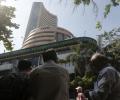
From the Sensex pack, Larsen & Toubro, Bajaj Finserv, Mahindra & Mahindra, UltraTech Cement, State Bank of India, IndusInd Bank, Reliance Industries and Sun Pharma were among the biggest gainers. Bharti Airtel, Titan, ITC, Kotak Mahindra Bank, Tech Mahindra and HDFC Bank were among the laggards.

Benchmark Sensex rose by 443 points to close at a new record high while Nifty settled above the 24,100 mark on Monday on buying in banking and IT shares in line with gains in Asian and European markets. The 30-share BSE Sensex settled higher by 443.46 points or 0.56 per cent at an all-time high of 79,476.19.
It could be a tough week In the run-up to such an event, the market is always nervous.

Sensex,Nifty to remain under pressure through the week.

The US Federal Reserve on Wednesday (local time) raised interest rates by 75 basis points (bps) or three-quarters of a percentage point in the boldest move since 1994.

India's largest IT services firm TCS on Thursday reported a 4.99 per cent increase in its September quarter net profit at Rs 11,909 crore. The Tata Group company had reported a net profit of Rs 11,342 crore in the year-ago period, while in the preceding quarter, it had a post tax net of Rs 12,040 crore, a company filing said.

Among the Sensex firms, Hindustan Unilever, Reliance Industries, Infosys, Asian Paints, ITC and UltraTech Cement were the major gainers. State Bank of India, JSW Steel, Axis Bank, ICICI Bank, Tata Steel and Tata Motors were among the laggards.

Foreign investors have injected close to Rs 33,700 crore in domestic equities in this month so far primarily due to interest rate cut in the US and resilience of the Indian market. This also marks the second highest inflow in a month in this year so far, the last one being in March, when Foreign Portfolio Investors (FPIs) infused Rs 35,100 crore, data with the depositories showed. Going ahead, the trend of FPIs buying is likely to continue in the coming days, V K Vijayakumar, Chief Investment Strategist, Geojit Financial Services, said.

M&M was the biggest gainer on the Sensex chart, rising 5.97 per cent, followed by JSW Steel, Ultra Cement, Kotak Bank, ITC and NTPC. Reliance Industries gained 0.73 per cent to close at Rs 2,871 apiece. In contrast, TCS, HCL Tech, HUL, Nestle Industries, Bajaj Finserv, Wipro and Infosys were among the losers.

Invest with a 5 to 7 year horizon so that you are able to ride out price volatility and benefit from the long-term trends of demand and macroeconomic shifts.

The RBI under former governor Shaktikanta Das resisted pressures to cut interest rates through 2024 as it kept its 'Arjuna's eye' trained on inflation, but the central bank under a new detail-oriented head will soon have to take a call if it can continue sacrificing growth. Das, a career bureaucrat who in 2016 oversaw Prime Minister Narendra Modi's highly disruptive demonetisation move, left a lasting legacy as he demitted office towards the end of 2024 after expertly navigating monetary policy for six years, the highlight of which was steering India's recovery through the pandemic.

Corporate bond issuances fell by around 22 per cent in August, despite easing yields as issuers delayed raising funds awaiting the US Federal Reserve to start cutting interest rates from this month. Corporates and financial institutions expect yields to fall further and borrowing costs to become cheaper, said market participants. The US Fed is widely expected to cut interest rates by 25 bps in the 17-18 September meeting, marking the start of a downward interest rate cycle.

Movement in the stock market this week will largely be driven by global trends, macroeconomic data announcements and trading activity of foreign investors, analysts said. Equity benchmark indices, which are on a dream run for the past several days, will also track trading in global oil benchmark Brent crude and movement of rupee against the US dollar. "The next FOMC (Federal Open Market Committee) meeting is scheduled for mid-September, but before that, the market will be closely watching upcoming US economic data.

Equity indices faced a heavy drubbing on Thursday after an initial rally, with Sensex tanking 1,045.60 points amid a largely bearish trend overseas after the US Federal Reserve hiked rates by 75 basis points.
