
Such cold-shoulder by banks also indicates a credit freeze that is hard to overcome, unless the government comes out with credit guarantee schemes for loans given by banks. Since that is not happening, and there is no indication of that too, banks are not willing to listen to RBI prodding.

The Reserve Bank of India (RBI) on Friday said it will maintain comfortable liquidity conditions and conduct market operations in the form of outright and special open market operations. It will conduct on tap targeted long-term repo operations (TLTRO) with tenors of up to three years for a total amount of up to Rs 1 lakh crore at a floating rate linked to the policy repo rate.

The disruptions caused by COVID-19 have more severely impacted small and mid-sized corporates, including NBFCs and MFIs, in terms of access to liquidity.
Asset quality of banks, which saw some improvement in the second half of 2020, is likely to worsen during the first six months of 2021, according to a survey. The findings are part of the 12th round of bankers' survey carried out by FICCI-IBA between July and December 2020. The survey was conducted on 20 banks, including public sector, private sector and foreign banks, representing about 59 per cent of the banking industry, as classified by asset size.

While the economy seems to be on a firm growth path, the fight against inflation is not over yet. Shaktikanta Das seems to be in no hurry. After playing well through a five-year Test match, he doesn't want to get out hit wicket, observes Tamal Bandyopadhyay.

Here are the highlights of the monetary policy announced by RBI governor Shaktikanta Das on Friday.

The Reserve Bank of India (RBI) on Friday kept key repo rate unchanged at 4 per cent in view of rising inflation and faint signs of economic growth amid gradual lifting of coronavirus (COVID-19) lockdown. The central bank's newly-constituted monetary policy committee (MPC) began its three-day meeting on October 7 and maintained the stance as accommodative. It also kept the reverse repo rate unchanged at 3.35 per cent.

Axis Bank was the top gainer in the Sensex pack, surging over 13 per cent, followed by ICICI Bank, IndusInd Bank, Maruti, TCS, Kotak Bank and Reliance Industries. On the other hand, Nestle India, HUL, Tech Mahindra and Sun Pharma ended in the red. NSE Nifty zoomed 273.95 points, or 3.03 per cent, to finish at 9,266.75.

SBI was the top gainer in the Sensex pack, rallying over 10 per cent, followed by Kotak Bank, Dr Reddy's, UltraTech Cement, ITC and HDFC Bank. On the other hand, Axis Bank, Bharti Airtel, ICICI Bank, Maruti and HCL Tech were among the laggards.

While banks are not as exposed as the corporate sector during the initial stage of the pandemic, the strain on lenders could ultimately be profound. Banks face a second-order hit compared with the corporate and household sectors.
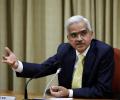
The Reserve Bank of India (RBI) on Friday decided to leave the benchmark interest rate unchanged at 4 per cent but maintained an accommodative stance, implying rate cuts in the future if need arises to support the economy hit by the Covid-19 pandemic.
'A strong foreign exchange reserve is the best safety net against global spillovers.'

'We believe there will be a full shutdown for four weeks and a partial shutdown for eight weeks.' 'Hence, economic activity is unlikely to normalise before the end of May.'

'Common sense says if one can afford, servicing the loans during this period is a better bet than postponing it by three months,' says Tamal Bandyopadhyay.
