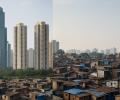
A larger part of India's population was in the middle 40 per cent of the national income share in 1980. Today almost all are in the bottom 50 per cent.

'Previously, contributing only 25 per cent of material costs, states now face burdens of 40 per cent to 100 per cent of total costs, ensuring poorer states will curb project approvals, directly stifling work demand.'
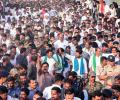
'For the first time in this country, perhaps the first time anywhere, we are going to use backwardness index.' 'It is a fundamental shift in the discourse in the country's social justice.'

Taxing capital less may not lead to more investments but taxing more will drive capital away, Chief Economic Advisor V Anantha Nageswaran on Friday said during a discussion on Inequality, Economic Growth and Inclusion. While it is easy to drive capital out, bringing it back is a lot harder, said Nageswaran.

The paper said that the taxation proposal needs to be accompanied by explicit redistributive policies to support the poor, lower castes, and middle classes.

While other backward classes had a share of 9 per cent, there were no scheduled tribe billionaires.
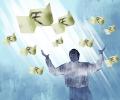
Inequality in India has skyrocketed since early 2000s, with the income and wealth share of top 1 per cent population rising to 22.6 per cent and 40.1 per cent, respectively, in 2022-23, according to a working paper. The paper titled 'Income and Wealth Inequality in India, 1922-2023: The Rise of the Billionaire Raj' said between 2014-15 and 2022-23, the rise of top-end inequality has been particularly pronounced in terms of wealth concentration.

Wealth, which can broadly be a measure of assets held as opposed to income earned, is unequally distributed.

'If we want real democracy, the economy itself will need to be democratised.'

While movie stars like Akshay Kumar, Amitabh Bachchan and Salman Khan are among the top I-T payers, very few of the wealthiest Indians figure on the list.

India stands out as a poor and very unequal country, with the top 1 per cent of the population holding more than one-fifth of the total national income in 2021 and the bottom half just 13 per cent, according to a report. The report, titled ' World Inequality Report 2022', has been authored by Lucas Chancel, co-director of the World Inequality Lab, and coordinated by several experts, including French economist Thomas Piketty. It further said India is now among the most unequal countries in the world.

Reserve Bank of India Governor Raghuram Rajan took charge of India's central bank when the rupee seemed to be in a tailspin while the country was facing runaway inflation.

From 1980 to 2014, the top 1 per cent captured 29 per cent of total growth, as much as the bottom 84 per cent put together.

Why are the poor turning Right instead of turning toward far-Left parties, ponders Pranab Bardhan.
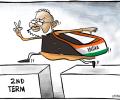
The government's decision to release the reports comes two days after over 200 scholars from across the globe issued a statement demanding release of all withheld reports produced by the NSO, including the household consumer expenditure survey that was junked.
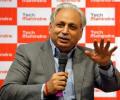
The top companies with a striking gap in pay between the senior-most executives and median employees in 2017-2018 belonged mostly to sectors such as information technology, auto and engineering.
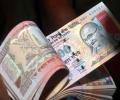
The government earned Rs 7.42 lakh crore as direct taxes in 2015-16, a 66 per cent increase from Rs 4.45 lakh crore in 2010-11
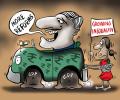
A new study shows that the bottom half of the population enjoyed only 15 per cent of national income in 2013-14, down sharply from 24 per cent in the early 1980s.
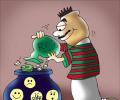
Middle class constituted about 49 per cent of the total tax payees in financial year 2011-12

New data show tax reform, better tracking needed

Soulful strains of classical music wafted through the chilly air as the ninth edition of the Zee Jaipur Literature Festival kicked off in Jaipur on Thursday at its usual venue, the sun-kissed Diggi Palace grounds, amid elaborate security arrangements.
Though Narendra Modi doesn't know it, he is a victim of this deep-rooted infection.

Income-tax data released by FinMin after 15 years


Finance Minister Arun Jaitley is unlikely to heed economists' suggestion that an inheritance tax be introduced in Budget 201415 as an additional revenue stream.
Finance Minister Arun Jaitley is unlikely to heed economists' suggestion that an inheritance tax be introduced in Budget 201415 as an additional revenue stream.

India has some ability to influence what the world order will look like, but it needs to make structural changes to the ministries of external affairs and commerce, and evolve formal coordination mechanisms with the ministries of finance and home, says Nitin Pai

From Aurangzeb to Sangh Parivar, the year 2016 offers plenty of hope in historical and modern literature.

If the impact of the Greece crisis spreads across Europe and parts of the world which are more interconnected than ever before, India cannot hope to be insulated, says Paranjoy Guha Thakurta.

'Growth is predicated on the misery of large sections of people.' 'Maybe Hindutva will be used to suppress any such unrest.'
 © 2026 Rediff.com - Advertise with us - Disclaimer - Privacy Policy - Sitemap - Feedback - About us - Terms of use - Grievances