
Unveiling far reaching fiscal reforms to improve tax mop up and wipe out revenue deficit by 2009, the Kelkar panel on Friday proposed a single countrywide goods and services tax, removal of tax exemptions and raising income tax slab to Rs 100,000.

High-value insurance policies experienced muted growth in the first six months of the current financial year after the Centre decided to tax such products in this year's Budget. Simultaneously, there has been a marked improvement in the growth of policies with premiums of 'less than Rs 5 lakh', mainly originating from smaller cities. During this year's Budget, Finance Minister Nirmala Sitharaman proposed that insurance policies (excluding unit linked insurance plans or ULIPs) with an aggregate premium exceeding Rs 5 lakh, and the maturity amount, would not be exempt from tax.
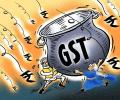
Economic Advisory Council to the Prime Minister (EAC-PM) chairman Bibek Debroy on Tuesday said the government was losing revenue due to the GST, which should be revenue neutral with a single rate. Speaking at an event organised by the Calcutta Chamber of Commerce in Kolkata, he however said that GST has led to a lot of simplification. "The ideal GST is one that has a single rate, and it was meant to be revenue neutral.

Markets closed in the red on domestic worries.

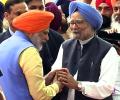
Whether it was the MGNREGS or the NFSA or the Aadhaar-based DBT scheme for cash transfer, the Modi government has built on the basic architecture created by the Singh government. Policy makers in the Modi government, instead of discarding them as products of the previous political regime, worked on them, expanded their scope and reach, and used new tools to improve their performance, explains A K Bhattacharya.

Finance Minister Nirmala Sitharaman will keep on the path of fiscal consolidation and opt for narrowing the FY24 fiscal deficit to as low as 5.8 per cent in the upcoming Budget, analysts said on Tuesday. The government may go for a fiscal deficit number which will be far lower than the 6.4 per cent of GDP budgeted for FY23, they said, pegging the Budget figure for the next fiscal in the range of 5.8 - 6 per cent. Given the fact that this will be the last full Budget of the present government, there may be a temptation to make it into an expansionist one.
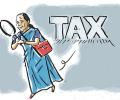
The gross tax revenues have touched 65 per cent of the Budget estimates at Rs 17.81 lakh crore during the first eight months of the current fiscal till November, propelled by corporate and personal income tax mop-up, according to the Economic Survey 2022-23 presented in Parliament on Tuesday. The survey, authored by Chief Economic Advisor V Anantha Nageswaran, said the 'substantial reforms' in India's taxation ecosystem post-2014 and policy reforms have removed the distortionary incentives from the economy. Reforms like GST, reduction in corporate taxes, exemption of sovereign wealth funds and pension funds from taxes, and removing Dividend Distribution tax have reduced the tax burden on individuals and businesses.

'In the long run, I don't foresee major ramifications [about Trudeau's allegations].' 'There's just enough hypocrisy among Western nations for India to douse the outrage.'
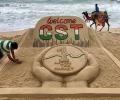
Six years after the rollout of the biggest indirect tax reform in India, Goods and Services Tax (GST) revenue of Rs 1.5 lakh crore every month has become a new normal and tax officers are focusing on dealing with fraudsters who are adopting newer modus operandi to game the system, causing loss to the exchequer. To apprehend black sheep, who operate as syndicates and create fake entities on the basis of forged documents to claim input tax credit (ITC), tax officers have started using data analytics, artifical intelligence and machine learning aiming to curb evasion, which was over Rs 3 lakh crore since inception of GST. It was over Rs 1 lakh crore in 2022-23. Thinktank Global Trade Research Initiative (GTRI) said the most critical pending GST reform is upgradation of GST Network to prevent fake supplies and fraudulent claims of Input Tax Credit (ITC).
Only by slashing its current spending can the government hope to generate the rise in domestic savings of about 6% of GDP required to boost investment to the levels needed to achieve its growth goal of 8% a year.

"Of the structural reforms, the GST has been the most historic in our country. Its chief architect is not with us today. I pay homage to the visionary leader late Arun Jaitely. GST has been gradually maturing into a tax that has integrated the country economically," she said during her budget speech.

Eminent economist Arvind Panagariya has said India is on the cusp of returning to a high growth trajectory and voiced confidence that the country will become the world's third-largest economy by 2027-28. Currently, India is the fifth largest economy "so it's another five years.We are already in (the year) 2023. "So 2027-28, India should be the third-largest economy," Panagariya, Columbia University Professor and former Vice Chairman of NITI Aayog, told PTI in an interview in New York.

Foreign portfolio investor (FPI) flows into India may remain tepid in 2022, said a recent note by Goldman Sachs, who now peg the foreign portfolio investment into India at $5 billion in 2022, down from their earlier forecast of $30 billion with risks skewed to the downside. "There has been $15 billion of equity outflows YTD in India already, and the IPO of the largest insurance company has been pushed out. "Additionally, with no mention of India's inclusion in global bond indices in the Union Budget, there are risks to our already conservative base case assumption of an announcement of India's likely inclusion into the GBI-EM Global Diversified Bond Index in Q4-2022," wrote Andrew Tilton, Goldman Sachs' chief Asia-Pacific economist in a co-authored report with Santanu Sengupta and Suraj Kumar.

Here are some goods that will be expensive after GST's implementation.
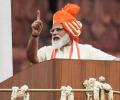
Prime Minister Narendra Modi on Wednesday underscored tax reforms of the past six years to say India has moved from tax terrorism to tax transparency. Speaking at the inauguration of an office-cum-residential complex of the Income Tax Appellate Tribunal at Cuttack, Modi highlighted the reduction in the corporate tax rate, simplified rate structure for individual taxpayers, faceless appeals and quick refunds.

Modi's reform agenda suffered a major setback earlier this month when lawmakers in the Rajya Sabha refused to support the the Goods and Service Tax bill.
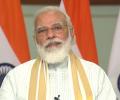
"The emphasis is on making every rule, law, policy people-centric, and public-friendly. This is the use of the new governance model and the country is getting its results," Prime Minister Modi said while speaking at the launch of a platform for 'Transparent Taxation -- Honoring the Honest'.
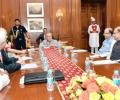
Government will lay greater emphasis on social sectors, finance minister said.
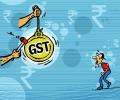
The broad trends of GST collections will make you wonder if indeed the biggest indirect tax reform in the country has led to a real improvement in revenues, notes A K Bhattacharya.

One of the the biggest tax reforms since Independence, GST will create a national market for goods and services

There are two ways: Deliver a rapidly growing economic pie or reform GST and close corporate tax loopholes, suggests T N Ninan.

According to reports, eight hours have been allocated by the speaker for discussion on the tax reform bill.

His likable boy-next-door face and casual approach to public speaking have a unique appeal for the younger generation, but it stops there, observes N Sathiya Moorthy.
The monsoon session of Parliament is likely to begin in the third week of July and end by mid August.

'Modi had not discussed demonetization with me prior to his announcement on 8 November 2016. 'I learnt of it along with the rest of the country. 'I was not surprised when he did not discuss the issue with me prior to making the public announcement. 'It fitted in with his style of making dramatic announcements.' A fascinating excerpt from Pranab Mukherjee's The Presidential Years: 2012-2017.

United States President Donald Trump boasted about his administration's progress.

The tax department will remain a source of endless nightmares for citizens and 'transparent taxation' will remain an empty slogan and a cruel joke, observes Debashis Basu.

Catch all the latest action from the Lok Sabha and Rajya Sabha here.

A record GST tax collection, an overhaul of the income tax return filing portal and the landmark move to scrap retrospective taxation have set the stage for the next level of reforms in tax administration that include bringing a framework for cryptocurrencies and rationalising the GST rate structure. With tax reforms such as faceless assessment taking roots, 2021 will go down as the year that pivoted the tax administration in a country aspiring to become the world's favourite investment destination. The task ahead is going to be a tough one as the tax department would grapple with taxing cryptocurrencies, rationalising Goods and Services Tax (GST) rates to shore up revenues and post June 2022, the scenario of how the GST revenue plays out for states without the Centre's support of compensation.
Finance Minister Nirmala Sitharaman on Thursday said taxpayer base has almost doubled to 1.28 crore in four years of rollout of the historic tax reform and the enhanced GST mop up in the recent months should now be the "new normal". In a written message to tax officers on the fourth anniversary of GST rollout, she said implementing any reform of this scale in a large and diverse country like India can be highly challenging, but GST has brought about ease in taxpayer compliance and reduced common man's tax burden.


India has emerged as one of the top three choices for investments in the next 2-3 years, with more than two-thirds of respondents in a survey of multinational companies (MNCs) citing the country as their number one choice for future investments. According to the FDI survey released on Tuesday by CII in association with EY, about half of the respondents see India amongst the top three economies or leading manufacturing destinations of the world by 2025.

The UP minister embarrasses the government ahead of the GST rollout.

President Donald Trump has warned of "consequences" to American companies planning to shift base abroad, telling them that he would make it "harder" for them to just say "bye-bye and fire everybody."

Following passage of the Constitution Bill, 2014, Dass and Finance Minister Himanta Biswa Sarma, who introduced it in the House, exchanged sweets.

Jaitley said the government has created transparent environment.
Singling out the Congress as the only opponent to the GST, the government hopes to pass the bill after the altered numbers in the Upper House, reports Archis Mohan.
The original DTC draft was put in the public domain in 2009 but revised the next year before being presented in Parliament.
