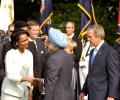
The night before Dr Singh was to meet President Bush, he said he could not sign the agreement.

President Xi Jinping's visit may put relations between India and China on a new trajectory

When people say the two-day visit was been successful in taking back the bilateral relationship to the political plane, essentially the reference (mostly left unsaid) is to the wresting of initiative from the intelligence 'agencies', whose meddling had hurt bilateral ties, says the distinguished editor Kanak Mani Dixit.

To persist with talks in the face of continuing terrorism that puts hundreds of Indian lives at stake is not only naive but morally repugnant and ethically unacceptable. It is time to see through this charade and abandon a path of high risk and no returns, says Vivek Gumaste.

'Foreign policy-making cannot be shifted out of Delhi and the regional satraps, who do not have a national perspective, should not be allowed to dominate foreign policy. But regional inputs should be integral to foreign policy-making at every step of the way,' says Ambassador T P Sreenivasan.

Narendra Modi's promise to allow states a bigger say in strategising and building foreign policy is unexceptionable, says TP Sreenivasan.

'The US wants Modi to succeed because we want India to succeed. For our part, when India thinks of its partners in the world, we want it to think of the US first. That means positioning our country as the preferred provider of the key inputs that can help to propel India's rise.' 'The meeting between Modi and Obama is, and must be, an opportunity for true strategic dialogue -- not a scripted exchange of talking points, but an open discussion of the big questions. What kind of world do we want to live in? What are our true priorities? And most importantly, why does this partnership still matter?'
 © 2026 Rediff.com - Advertise with us - Disclaimer - Privacy Policy - Sitemap - Feedback - About us - Terms of use - Grievances