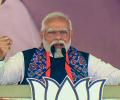
Narendra D Modi and his party campaigned in these elections uncharacteristically without any big ideas. Of course, winning each election at all costs could be a big idea as well, observes Shekhar Gupta.

If the Congress reached 90, it would have a pretty good chance of holding the BJP below the 272 mark. A hundred seats will rock national politics, argues Shekhar Gupta.
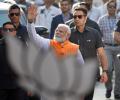
The big surprise is that Narendra Modi, the greatest conjurer in our national politics, has not yet presented a theme to this election, observes Shekhar Gupta.
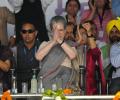
The Congress now knows that it is the only force -- however weakened it might be -- that stands between the BJP and India's evolution into a single-party Republic. Because, once it is out of the way, the BJP could sort out the other regional powers: Co-opting some, demolishing others, asserts Shekhar Gupta.

If Indira Gandhi hadn't targeted the RSS, Narendra Modi wouldn't be sitting pretty with his second majority and looking at a third, asserts Shekhar Gupta.
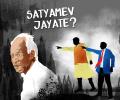
Will the Supreme Court take note of the case and ensure a respected civil servant is not punished for being in office at the wrong time?

If the party's members aren't sure what it stands for, see no path to wealth or power, and endure control by a dynasty, which, almighty as it is within the party, cannot get them the votes, they are likely to explore options, notes Shekhar Gupta.

If Modi wants to leave a real legacy, breaking India's strategic triangulation would be the real gift, notes Shekhar Gupta.

Will January 22 mark a point of no return for our Constitutional secularism? asks Shekhar Gupta.

Wouldn't it be better to join the celebrations with the vast Hindu majority while at the same time criticising Mr Modi/BJP/RSS for politicising it? notes Shekhar Gupta.

The most important lesson is that you have to build your political proposition, and sell it yourself. You can't leave it to the courts, media, NGOs and civil society and expect them to play the role of the Opposition. That's precisely what Mr Modi's challengers have been doing and we know the results, notes Shekhar Gupta.
Even if the BJP gets 60, 70, or even 100 per cent of the votes in the seats where it scored more than 50 per cent in the 2019 Lok Sabha election, these will still add up to only 224 seats, argues Shekhar Gupta.

'It is no longer about going on stage, taking your award and mumbling your thank you speech.' 'Now it's a whole big tamasha on stage.'

It is a tribute to a system so robustly meritocratic that this team represents India's diversity better than any other institution: The Union Cabinet, our chief ministers, the civil services, the leadership of our armed forces and security agencies, the judiciary and more than all of these, our typical newsroom. That is the biggest message from this breathless rise of Indian cricket, asserts Shekhar Gupta.

If military power is all it would take to finish the menace of an awful terrorist organisation like Hamas, how come five Israeli wars in Gaza since 2003 have failed to do so? asks Shekhar Gupta.

Will a caste census make tens of millions desert Mr Modi?, asks Shekhar Gupta.

We got the same Diwali bonuses. We ate together. We carried equipment together on shoots. And when the odd reporter tried to throw her weight around and leave the camera person to carry bags of equipment, cables, the camera and tripod down the stairs and to the shoot location, Prannoy would step in, take the tripod off the shoulders of the colleague silently, lightening the load, recalls Revati Laul.

There is only one perpetrator, Hamas. It is a terrorist organisation. It is obscene to argue that until the Palestinian question is solved, anybody has the right to use terrorism as an instrument of policy, argues Shekhar Gupta.
With the general election campaign less than six months away, the BJP has more to think about than it had on the eve of 2019. It's the states that will be robbing BJP strategists of their sleep at this point, not the Lok Sabha, asserts Shekhar Gupta.

Restoration of peace and the normal routine of daily life, compared to the past, stands out as its most significant achievement, observes Mohammad Sayeed Malik, the veteran commentator on Kashmir affairs, four years after the abrogation of Article 370.

Almost all will say no. Then ask them why they don't push back at those who rise the slogan of Khalistan. Somebody would confront you with a counter-question: If people can talk of a Hindu Rashtra, why get so upset if others talk of a Sikh Nation, points out Shekhar Gupta.

There's an entire gurdwara dedicated to immigration. People present tiny airliner models here in the hope that Waheguru will soon give them a ticket, passport and visa to leave, reveals Shekhar Gupta.

The competition for the worst or most perilous 10 years has always been between the 1960s and the 1980s, points out Shekhar Gupta.

Today, with China centrally seated and located, the Global South has an intriguing road ahead. Odds of it becoming a Chinese bloc in the emerging new bipolar world are higher than we'd wish them to be, observes Shekhar Gupta.

The Democrats, especially the Biden administration, wanted to deliver a sharper message to Mr Modi than would be possible in a formal summit setting. So, why not get the most prominent Democrat in decades to deliver it?, explains Shekhar Gupta.

The best, wisest, and fairest next step in strengthening our own cause is to restore statehood to Jammu & Kashmir and allow the resumption of robust political activity. That's a box that remains unchecked on the Modi government's report card as we approach the fourth anniversary of Kashmir's Constitutional shift, notes Shekhar Gupta.

If only the Congress could rebuild on its strengths and develop a modern enough ideology, we could again be moving towards a clearer two-party political landscape, asserts Shekhar Gupta.

India would not be seen to be anything but rude with the Pakistanis. In the big picture, who is the bigger adversary right now? Who is the bigger pain in the neck? And who is it that is keeping more than 3,000 km of our borders active, throwing our military posture and deployments into imbalance? asks Shekhar Gupta.

For the most battle-hardened, specialised and successful counter-insurgency army in the world, this is an unfamiliar, first-time experience of dealing with the north east's deepest complexities, observes Shekhar Gupta.

'Indian families' needs and expectations have gone through a revolution across economic demographics.' 'As this latest Modi-Sitharaman Budget demonstrated, politicians have understood this change. They are responding to it,' points out Shekhar Gupta.
In one state, the BJP sweeps in Modi's name -- and only because of Modi's name. In the other state, Modi's name did not work. Himachal underlines the limitations of Modi's magic, observes Shekhar Gupta.

There are three things you never do in a small North East state: Undermine local leaders, divide and rule, push homogenisation, asserts Shekhar Gupta.

Mr Modi might have questions to ask himself on the most formidable strategic challenge before India that he inherited from the United Progressive Alliance: The triangulation between China and Pakistan. The failure to break out of it, or even loosen it a bit, is something to reflect on, notes Shekhar Gupta.

Pakistan still has to acquire the patience you need in a democracy. The patience to accept that even if I do not like the government I have, I must wait till the next election to change it, explains Shekhar Gupta.
A family man, a confident investor, someone who was sure two decades ago that India and its stock market were going to boom. T N Ninan recalls his chats with Rakesh Jhunjhunwala.

Reversing the burden of evidence means that the principle of innocent until proven guilty does not apply. It is exactly the opposite: Guilty as charged, until you can convince the judges of the contrary, points out Shekhar Gupta.

This State-corporate 'cooperation' didn't begin with the arrival of the Modi government.
Many of the big licences, contracts, and even environmental clearances for the Adani group had come in the UPA's time, points out Shekhar Gupta.

Our political history tells us this has never worked. A united Opposition does work in some specific, limited situations, especially in the states. But never as some brilliant pan-national collection of diverse interests with no ideological or political core, asserts Shekhar Gupta.

The BJP at 43 is a work in progress, with total ideological continuity and much substantive change in political method and style, observes Shekhar Gupta.

The rising pitch of road shows and long rallies with hectoring pitches seem to have exhausted and numbed the audiences, rather than motivating them to vote for the party, observes Shreekant Sambrani.
