
Electric two-wheeler (e2W) companies are upset with some of their suppliers of heavy rare-earth magnet-powered electric motors, who have objected to their proposal - under consideration by the government - that would allow e2W original equipment manufacturers (OEMs) an exemption from localisation norms on electric motors, thereby enabling them to continue receiving the 5,000-per-vehicle subsidy.V
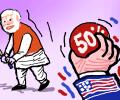
'Things may get much worse before they get better,' predicts Ajay Chhibber.

China does not have to give up what it took in 2020, it will never give up its claim to Arunachal Pradesh, Ladakh and other areas, and it has all the time now to plan its next surprise, points out Lieutenant General Prakash Katoch (retd).

New Delhi has reached out to Moscow while waiting for a new president in Washington. New Delhi knows well that in international relations, there are no permanent friends or foes, only permanent national interests, points out Dr Rup Narayan Das.
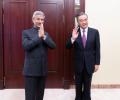
'We stress that the boundary issue shall not be linked with the overall bilateral relations. That is an important experience we have gathered through many years' effort to keep the ties moving forward

The incident had taken place at a time when the Indian Foreign Minister, S Jaishankar, was in Moscow for the Shanghai Cooperation Organisation meeting, where he met his Chinese counterpart to address the border issues.
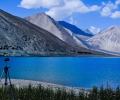
According to sources, the post at which the Chinese army has put up loudspeakers is under 24x7 constant watch by Indian soldiers and it is possible that the Chinese might be indulging in such drama to distract our troops or perhaps just relieve the pressure.

In the midst of a war of words between the two countries, Chinese Premier Wen Jiabao on Wednesday expressed his desire to meet his Indian counterpart Manmohan Singh.The Chinese leader's remarks come a day after Beijing raked up its claim over Arunachal Pradesh, questioning Prime Minister Singh's visit there on October 3. India hit back on Wednesday, reacting strongly to Chinese plans to get involved in projects in Pakistan-occupied-Kashmir.
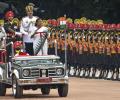
The coming year will be one that will test sabka vishwas to the utmost, predicts Aditi Phadnis.

External Affairs Minister S Jaishankar and his Chinese counterpart Wang Yi met in Moscow on Thursday amid hopes of a possible breakthrough in reducing tensions along the Line of Actual Control (LAC) in eastern Ladakh.

On being asked about the Swaraj-Qureshi meeting, the MEA sources said the two leaders only exchanged pleasantries.

According to the photos published by the Pakistani media, Swaraj and Qureshi were seen seated next to each other.

The Ministry of External Affairs said the two ministers discussed the outstanding issues related to disengagement from all friction points along the Line of Actual Control in eastern Ladakh.

The armies are working to schedule their seventh round of talks to take steps towards "early and complete" disengagement of troops along the LAC in eastern Ladakh.

After two decades, the SCO appears to be at a cross-roads with the US withdrawal from Afghanistan, asserts Srikanth Kondapalli, the leading China expert.

'Both sides should, therefore, focus on easing tensions in the friction areas by refraining from any actions that may lead to an escalation in the situation'
According to Jaishankar, much has changed, mostly to India's disadvantage, since November 1950, when Sardar Patel and Jawaharlal Nehru had a famous exchange of views on how to approach China.

India has realised that one can only deal with China from a position of strength and that is not palatable to Beijing, observes Dr Rup Narayan Das.

The sources also said both the Indian and Chinese troops are firmly holding on to their respective positions at the Line of Actual Control.
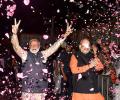
Will it be home or defence for Amit Shah?
External affairs minister S Jaishankar has told his Chinese counterpart Wang Yi that the two sides should work for an early resolution of the remaining issues along the LAC in eastern Ladakh to restore peace and tranquility in the border areas as this has been an essential basis for progress in Sino-India ties.
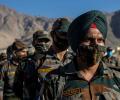
The Indian side also told the Chinese delegation that the talks on disengagement should include Depsang as well as all face-off sites, insisting that it should be a simultaneous process and not a selective one.
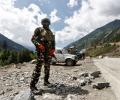
At a virtual media briefing, Ministry of External Affairs (MEA) Spokesperson Anurag Srivastava said disengagement of troops is a complex process which would require mutually agreed 'reciprocal actions'.
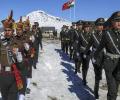
Sources said India will not lower its guard and will maintain the current state of very high-level of combat readiness in eastern Ladakh till there are visible changes in the ground situation.

The use of firearms along the LAC marks a serious escalation in border tensions as the previous instance of shots being fired at the de-facto border was in 1975.

'India has to prepare for future warfare where kinetic use of force at the border will be limited. War will take place in the realms beyond the border.'

The Wednesday talks took place amid a war of words between the two sides on perception of the LAC, the de-facto Sino-India border spanning a length of nearly 3,500 km.
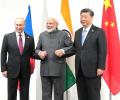
'Russia is the only country that can act as facilitator for any eventual Chinese-Indian rapprochement,' points out Ambassador M K Bhadrakumar.
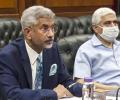
'Terrorism continues to be the overwhelming threat to security and stability in the SCO region and therefore Dr Jaishankar strongly pitched for 'collective action',' observes Dr Rajaram Panda.
The decisions were mentioned in a joint statement issued by the two armies late Tuesday, a day after the sixth round of Sino-India Corps commander-level talks that lasted for 14-hours.

Xi's presence in Mahabalipuram is more of a political message by Modi to the world -- as well as to regional parties in South India that they should be beware of the BJP's rise, says R Rajagopalan.
The effort made to define the larger picture by focussing on history and the wish not turn differences into disputes and conflicts is welcome. In the obtaining circumstances today, nothing more could have been possible, observes Ambassador T P Sreenivasan.
'It is advisable for Indian interlocutors to follow the Chinese tactic of repeating the Indian position, both for the record and to test the Chinese negotiator's resolve and intentions.' A riveting excerpt from former foreign secretary Vijay Gokhale's The Long Game: How the Chinese Negotiate With India.
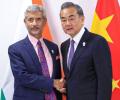
The joint statement said Jaishankar and Wang agreed that both sides should take guidance from the series of consensus reached between leaders of the two countries on developing India-China relations, including not allowing differences to become disputes.

Parrying a direct reply on whether there will be a meeting between Khurshid and Aziz on the sidelines of Shanghai Cooperation Organisation meet, Spokesperson in External Affairs Ministry said the External Affairs Minister will take the opportunity to interact "informally" with several other leaders present there.
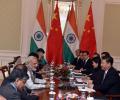
External affairs ministry spokesperson Vikas Swarup also asserted that India's participation in the NSG would have further strengthened nuclear non-proliferation regime and made global nuclear commerce more secure.
It is apparent that an easing of tensions at the border and a disengagement of troops is on the cards, observes Ambassador M K Bhadrakumar.
'Given the sharp increase in oil prices, a mounting problem for the 2nd and 4th largest importers like China and India -- the Qingdao meeting is likely to push for the large energy producers (Russia and the Central Asian Republics) and energy consumers (China and India) to arrive at some understanding for mutually beneficial outcomes,' notes Srikanth Kondapalli.

'India needs to be cautious that its differences with Pakistan do not obstruct SCO's functioning,' says Sana Hashmi.

If China's behaviour in the past on ticklish issues is any indication then China could eventually support India's NSG application, says Rup Narayan Das.
 © 2026 Rediff.com - Advertise with us - Disclaimer - Privacy Policy - Sitemap - Feedback - About us - Terms of use - Grievances