
Reserve Bank of India Governor Shaktikanta Das on Monday stressed on achieving 100 per cent self-sufficiency in banknote manufacturing in the near future. He was speaking after dedicating Varnika, the ink manufacturing unit of Bharatiya Reserve Bank Note Mudran Private Limited (BRBNMPL), to the nation in Mysuru. BRBNMPL, a wholly-owned subsidiary of the RBI, has set up Varnika with an annual ink manufacturing capacity of 1,500 MT to enhance the security of banknotes.

Two days after Nepal scrapped a deal with India to print new smart passports, India regretted the politicisation of the contract, saying it was just a "goodwill gesture" toward its neighbour on Tuesday.

The CBI, in its FIR, alleged that Mayaram, the UK-based company De La Rue International Ltd and unidentified officials of the finance ministry and RBI hatched a criminal conspiracy to extend undue favour to the firm.

If RBI has to replace the entire stock of Rs 1,000 and Rs 500 notes with Rs 100 ones, the cost would be more than Rs 10,000 crore.

The printing of one-rupee notes was discontinued in 1994.

The department of investment and public asset management (Dipam) can also seek in-principle approval from the Cabinet Committee on Economic Affairs (CCEA) for strategic divestment of PSUs on a case-to-case basis considering investor appetite and sectoral trends.

Though this is part of the divestment drive, government's stake in these companies remains 100 per cent even after the buybacks
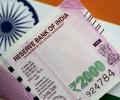
The number of Rs 2,000 currency notes in circulation has come down from 33,632 lakh pieces at end-March 2018 to 32,910 lakh pieces at end-March 2019 and further to 27,398 lakh pieces at end-March 2020.

Use cheques, cards to check black money, says Jaitley.

The RBI has shelved its plan for polymer notes more than a decade after it invited interest from global manufacturers for one billion pieces of Rs 10 denomination polymer banknotes, reveals Tamal Bandyopadhyay.

In the third of a four-part series, Business Standard reporter travels to Nashik to assess how the currency press there is responding to demonetisation.

In the second of a four-part series, Business Standard checks out the currency press in Dewas to find target-based allowances have increased the monthly salary of employees from Rs 10,000 to Rs 30,000, at a time when notes are being printed 24x7.

What's the real reason behind ATMs running dry even in states that are not election-bound, wonders Nivedita Mookerji.

In a first, a special National Investigation Agency court in Mumbai sentenced six accused in a 2009 fake currency case to life imprisonment, terming the possession and circulation of Indian counterfeit notes as an "act of terrorism".

Congress chief spokesperson Randeep Surjewala released a list of 55 persons who lost their lives while standing in queues at banks and ATMs in the wake of demonetisation and demanded compensation to their families besides probe into their death.
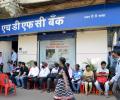
Cash withdrawal limits likely to continue

In the first of a four-part series, Business Standard takes a look at how a mint in Salboni, West Bengal, is working overtime to print currency notes.

Little attention is paid to the management of currencies and coins in India.
In the first of a four-part series, Business Standard takes a look at how a mint in Salboni, West Bengal, is working overtime to print currency notes.

James Wilson tracks down discrepancies in the much-hailed demonetisation policy and the subsequent statements of the government and the Reserve Bank of India.
James Wilson explains why Indians are destined to silently suffer the cash shortage for half a dozen more months.
 © 2026 Rediff.com - Advertise with us - Disclaimer - Privacy Policy - Sitemap - Feedback - About us - Terms of use - Grievances