
'Suppose, a time when Musharraf was on the verge of collapsing, and India unveiled a proposal to create a South Asian federation, inviting Pakistan to join as founder member. The clincher? Set a date to discuss Kashmir,' says Ramananda Sengupta.
'As long as India and Pakistan remain at loggerheads, SAARC\n\nis dead in the water. So why go through with this charade?' asks Ramananda Sengupta.

'The resolve has to be there, the will has to be there. Above all, our top leadership has to adopt a statesman-like approach' says Pakistan's Interior Minister Faisal Hayat.
'There is no doubt that the US would like all their friends to agree with them. We are not in the habit of doing that,' says former diplomat Arundhati Ghose.


'The slaughter and handling of infected poultry poses the greatest risks,' says FAO official Dr Samuel Jutzi.
'The worry is that being neighbouring countries, you cannot but help a spillover,' says India's High Commissioner to Bangladesh Veena Sikri.


Admiral S M Nanda on India stood up to America during the 1971 war.
'It is because of Chinese policy that Pakistan is nuclear. So we have to look at it as one unit. If the fissile material of Pakistan is to be controlled, you have to control China,' says former diplomat Arundhati Ghose.
Politicians on either side of the secular fence should tell people that Pakistan has now attacked the heartland and peninsular India after targeting the northeast, Punjab and Kashmir, says former IB official Maloy Krishna Dhar.
'It is our duty to fight those forces trying to destabilise the Muslim psyche of India,' says former IB official MK Dhar.
'If any Pravasi attends the event he will not be disappointed,' says Minister for Overseas Indian Affairs Vayalar Ravi.
'Our response to the current crisis in Lebanon is indicative of our not being in a position today to act like a global power. Coalition politics is not going to help.'

'Much of the recent overtures by the US reflect Washington's awe at India's recent economic successes and reforms,' says economist Dr William T Wilson.

'This surrender is unique, the only public surrender in history where a ceasefire was converted into surrender and signed in four hours,' says Lieutenant General J F R Jacob (retd.

General J F R Jacob looks back at the 1971 war.
'We cannot forget what happened in the past, and there is no room for complacency,' says Defence Minister Pranab Mukherjee.

'Even though as Xi will seemingly continue to stay in power beyond his third term, competitions for the post-Xi leadership would be inevitably unfolded beneath the surface of water, and that will be a big headache for Xi the dictator.'

'China might soon have to seriously consider whether it prefers an Indo-US hyphenation to a Sino-Indian one.'
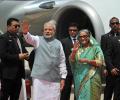
'When we have a terrorist outfit in a neighbouring nation, we need to do whatever we can to neutralise that threat,' says Ramananda Sengupta.
'Crafting a coherent, transparent and consistent policy vis-a-vis our neighbours, leave alone the rest of the world, is unlikely to be high on the priority list of the new Indian government, which will be sworn in before June,' says Ramananda Sengupta.

'Crap cannons' can be an effective mob-control weapon.

'Much of the Socialism that we attribute to him actually came during Indira Gandhi's time,' says M J Akbar who believes that Nehru's convictions helped shape modern India.

Lieutenant General J F R Jacob, Chief of Staff, Eastern Army Command during the 1971 war, revealed how, armed with only a draft surrender document and an aide, he made the Pakistani army led by Lieutenant General A A K Niazi surrender.
Lieutenant General J F R Jacob, Chief of Staff, Eastern Army Command during the 1971 war, revealed how, armed with only a draft surrender document and an aide, he made the Pakistani army led by Lieutenant General A A K Niazi surrender.
 © 2026 Rediff.com - Investor Information - Advertise with us - Disclaimer - Privacy Policy - Sitemap - Feedback - About us - Terms of use - Grievances