
All the 27 public sector banks together have market share of about 70 per cent.

Human memory about policy issues is short. That alone can explain why many are deliriously happy with his latest slogans and ignore seven years of poor 'doing business' climate, taxtortion, extortionate oil prices, and high dependence on babus and the big State that has kept the enterprise system stifled, observes Debashis Basu.

Every patriot should learn from our history and recognise that celebrating size will neither negate nor obscure the huge economic challenges that India faces, asserts Rathin Roy.

A roadmap for the consolidation of public sector banks will be outlined during the year.

The All India Bank Officers' Confederation has condemned the purported "unsavoury attack" on SBI chairman Rajnish Kumar by Finance Minister Nirmala Sitharaman during a banking event last month in Guwahati. The association claimed that an audio clip has gone viral on social media that revealed the finance minister coming down heavily on the SBI chief, accusing him of poor credit uptick, during an outreach programme in late February.

Banks are in need of government support to manage the stressed assets

The proposed amalgamation will make Bank of Baroda, which will merge the other two lenders with itself, the second largest public sector bank after State Bank of India in place of Punjab National Bank.
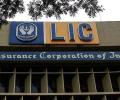
The government is mulling allowing foreign direct investment (FDI) in the country's largest insurer LIC, a move which would help overseas investors take part in the company's proposed mega IPO, sources said. The proposal is under discussion between the Department of Financial Services and Department of Investment and Public Asset Management (DIPAM). "Discussions have been going on for the proposal for the last few weeks. "It would also go for inter-ministerial discussions and would also require Cabinet nod," a source said.

Finance Minister Arun Jaitley on Saturday proposed to infuse Rs 7,940 crore funds next fiscal in the public sector banks.

This issue was discussed at the Gyan Sangam addressed by Prime Minister.

The Centre should privatise all public sector banks (PSBs), except the State Bank of India (SBI). This is because private banks have emerged as a credible alternative to PSBs with substantial market share. Also, government ownership hinders the ability of the Reserve Bank of India (RBI) to regulate the sector, according to a report by the National Council of Applied Economic Research (NCAER).
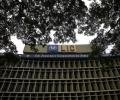
Initial public offering (IPO)-bound Life Insurance Corporation (LIC) of India's assets under management (AUM) increased to Rs 38 trillion as of September 2021, compared with Rs 37 trillion as of March 2021, said sources in the know. Its AUM is almost 3x the AUM of all the private life insurers in the country and over 15x more than the AUM of the second largest life insurer, SBI Life, as of September 2021. SBI Life's AUM was approximately Rs 2.4 trillion as of September 2021, said sources.
Concerned over inflationary pressures in the economy, the Reserve Bank of India (RBI) is bringing down surplus liquidity in the system rapidly. It has fallen to pre-Covid levels and almost 2 per cent of banks' net demand and time liabilities (NDTL). NDTL shows the difference between the sum of demand and time liabilities (deposits) of a bank (with the public or the other bank) and the deposits in the form of assets held by the other bank.

Banks' gross non-performing assets (NPAs) and net NPAs are expected to rise to 10.1-10.6 per cent and 3.1-3.2 per cent, respectively by March 2021, Icra said on Monday. The agency also expects net NPA to decline to 2.4-2.6 per cent by March 2022. "As moratorium on loan repayments is over and though we await the Honourable Supreme Court directive on asset classification, the GNPAs and NNPAs for banks are likely to rise in near term to 10.1-10.6 per cent and 3.1-3.2 per cent, respectively by March 2021 from 7.9 per cent and 2.2 per cent, respectively as of September 2020," the rating agency said in a report.

As per the structure proposed, 99 per cent of government holding in the bank will be shifted to the Holding Company and the government will retain 1 per cent with itself so that it remains a state-owned bank.

Recently, CVC suggested that banks have a monitoring mechanism for bad loan sales to ARCs, with the cash flow statement from stressed assets shared with banks.

Banks' bad loans might cross Rs 10 lakh crore by the end of this fiscal, mainly on account of slippages in retail and MSME sectors, a study said on Tuesday. "NPAs are expected to rise to 8.5-9 per cent by March 2022, driven by slippages in retail, Micro, Small and Medium Enterprise (MSME) accounts, besides some restructured assets," the study by industry body Assocham and ratings firm Crisil said. The study titled 'Reinforcing the Code' said the Gross Non-Performing Assets (GNPAs) of banks are expected to cross Rs 10 lakh crore by March 2022.

Mihir Tanna, Associate Director, S K Patodia & Associates, answers your tax queries.

The Union Cabinet has approved amendments to the General Insurance Business (Nationalisation) Act, paving the way for privatisation of government-owned insurers. The amendments, approved by Cabinet, will remove the clause for the Centre to hold at least 51 per cent in public sector insurance companies at any given time. It will also have an enabling provision for the transfer of management control from the government to the potential buyer of the public sector insurance company. The finance ministry will move amendments to the insurance Act in the ongoing Parliament session.

That's the only way to convince those who have money to return to the bank fold, ditching other asset classes, says Tamal Bandyopadhyay.

Of the three major Budget announcements related to the banking sector, privatisation of PSBs is the most audacious, says Tamal Bandyopadhyay.

While a DFI will help banks derisk their loan portfolios, creation of a bad bank will clean up their balance sheets.

The loss to policyholders due to massive mis-selling of insurance policies by trusted private sector and public sector banks will be well in excess of Rs 2 trillion, warns Harsh Roongta.

'The government has realised that the finances of the government are in a precarious state.' 'We are borrowing to fund the ever-burgeoning revenue deficit.' 'Then you are paying interest on the fresh borrowing.' 'For the first time, the government has realised that this cannot go on.'

The government is set to initiate consultations with the Reserve Bank of India (RBI) to devise a new security clearance framework for screening potential bidders of public sector banks (PSBs) as it kick-starts the privatisation process, beginning with the strategic divestment of IDBI Bank. As the government is moving ahead with strategic divestment of IDBI Bank and is looking to privatise two PSBs, the Department of Investment and Public Asset Management (DIPAM) is looking to put in place an appropriate framework as the potential buyers will have to meet the RBI's fit and proper criteria, said an official. The process of bank privatisation would be different from the sale of any other public sector undertaking (PSU), and more restrictions and measures will have to be put in place, the official said.

Analysts were expecting the government to propose higher capital infusion for banks.

Finance secretary Rajiv Kumar was positive in formation of a committee consisting all concerned to address the issues arising out of the proposed merger of 10 banks including preserving the identity of all the banks.

Union Finance Minister Arun Jaitley is set to present the Budget next month.

The unexpected interest rate hike by the RBI on Wednesday will have the banking system on average making a 10-15 bps gains on the yields, with private banks making larger gains as 57 per cent of their loans are linked to external benchmark rate and 40 per cent to the marginal cost of lending rates, as per a report. Stating that lenders and borrowers will face volatile times with the Reserve Bank raising the repo rate by 40 bps to 4.40 per cent and the cash reserve ratio (CRR) by 50 bps on May 4 in an off-cycle policy move, India Ratings said the market rates had already been moving higher before the move. The 364-day T-bills have moved up 120 bps and 10-year G-sec by 140 bps since May 2020, when the repo rate was cut to a record 4 per cent, which led to an expectation of a faster and sharper rise in interest rates in the system but the central bank stayed the course to support the fragile economy battered by the pandemic.

Providing comfort to the government on the revenue front amid fiscal stress, direct tax collection is moving closer to the revised Budget target for 2021-21 and may get a further thrust from the last instalment of the advance tax payment, the deadline for which ended on Monday. The contraction in net direct tax collection narrowed to 5 per cent year-on-year as on March 15 compared to a 9 per cent decline seen in January. In absolute terms, net collection stood at Rs 8.2 trillion against Rs 8.67 trillion in the same period last year, according to the provisional numbers shared by a government official.

The decision to do away with Rs 500 and Rs 1,000 notes accelerated the slowdown in economic activity with growth averaging 6.8 per cent in the seven quarters after it, as against an average of 8 per cent in the six quarters preceding it, says former chief economic advisor Arvind Subramanian.

Government asks banks to furnish capital, ratings and NPA details.

Dutch brewing major Heineken on Wednesday said it has acquired an additional 14.98 per cent stake in United Breweries Ltd, taking its total shareholding to 61.50 per cent. "Heineken N.V. today (on Wednesday) announces that it has acquired an additional 39,644,346 ordinary shares in United Breweries Ltd (UBL) taking its shareholding in UBL from 46.5 per cent to 61.5 per cent," Heineken said in a statement. UBL, with its flagship brand 'Kingfisher', is the leading player in the beer market in India.

Unions, which are protesting against FDI in the banking sector, are pressing for various demands.
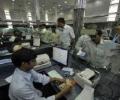
The wage revision of public sector bank employees is due from November 2012.

'...Rs 137 lakh crores of people's money?' 'It is not the government's money, it is people's money.'

Chief Economic Adviser K V Subramanian on Wednesday said India is expected to hit a growth rate of 6.5-7 per cent in 2022-23 and accelerate further to 8 per cent in the subsequent years on the back of reforms undertaken by the government. He also said the government is expected to meet the fiscal deficit target of 6.8 per cent in the current fiscal despite pressure on revenue collections.

The strike call is over privatisation, mergers, and also due to write-off of corporate NPAs, criminalisation of willful default

Stating that growth impulses and the fast-moving indicators are strong, Reserve Bank Governor Shaktikanta Das on Wednesday exuded confidence of the economy clipping at the projected 9.5 per cent this fiscal. Giving all the credit for the faster-than-expected recovery of the economy to the government, Das said the central bank has only been supporting the government in reviving the economy ravaged by the pandemic. Citing a slew of measures the government has taken since the pandemic struck in March 2020, the governor specifically mentioned tax cuts on fuels, tax resolution for the telecom sector, annulling of the retro tax legislation, sale of Air India, plans to sell some of the public sector banks and PLI scheme as the major reforms and growth-drivers bearing fruits now.

Rating agency ICRA on Wednesday revised down its credit growth outlook for banks to 2-3 per cent for the current fiscal, and said the coronavirus pandemic-driven stress may leave 3.1-3.7 per cent of assets into bad loan list by March.
 © 2026 Rediff.com - Investor Information - Advertise with us - Disclaimer - Privacy Policy - Sitemap - Feedback - About us - Terms of use - Grievances