
'Corporates now have multiple funding sources beyond banks, and many are sitting on large cash reserves.'

Among Sensex firms, Trent, Tech Mahindra, Hindustan Unilever, UltraTech Cement, Asian Paints, Eternal and ITC were the major laggards. Selling in HDFC Bank and ICICI Bank also dragged the key indices. However, Axis Bank, Bajaj Finance, Maruti and State Bank of India were among the gainers.

By enabling real-time data sharing, the platform will help prevent scams and ensure secure transactions.

'This is an area where good lending can happen, and that is one of the priorities for the next quarter.'

'The frenzy for gold is primarily due to the uncertainty surrounding the tariff war.'

Public-sector banks (PSBs) are attracting the attention of investors and the PSU Bank Index has gained nearly 10 per cent in the past month. PSBs have seen return on assets (RoA) climbing to 1 per cent in 2024-2025 (FY25) and margins are believed to have moved up further in the first half of this financial year (H1FY26) with asset quality remaining stable.

'Some buyers get carried away by festival offers and purchase higher variants or larger vehicles than they truly need, which impacts running cost and long-term affordability.'

An Enforcement Case Information Report (ECIR), the ED's equivalent for a police FIR, has recently been filed by the federal probe agency, taking cognisance of a CBI complaint registered on August 21, the sources said.

CPGRAMS -- an online platform available to citizens 24x7 to lodge their grievances to public authorities on service delivery -- has existed for close to two decades. But it has never been this active, points out Tamal Bandyopadhyay.

Banks are receiving requests for cancellation of approved car loans, in view of the implementation of GST rate cut, which will lower the price of passenger vehicles and also lead to subsequent reduction in the amount needed to purchase them. It is to be noted that the 56th GST Council meeting earlier this month, approved substantial reduction in the GST rate for cars for up to 1,200 cc to 18 per cent from the existing 28 per cent.

'Indian markets may underperform global peers for the next two quarters.' 'But beyond that, India should catch up and resume its long-term growth path.'
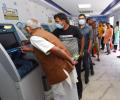
Unlike any other national asset, which is typically sold to the highest bidder, the profile of the bidder is the most important criterion for a licence to bank, and even for acquiring more than 5 per cent stake, explains Tamal Bandyopadhyay.

Public sector banks (PSBs) have seen a sharp drop in household deposits from 70.6 per cent to 63 per cent in contrast with private banks, which witnessed a surge from 27.1 per cent to 34.1 per cent.

State-owned banks are prioritising local language skills in their hiring to improve customer service and reduce language barriers.

Some public sector banks, including State Bank of India (SBI), Union Bank of India, Canara Bank, and Bank of India, are increasing the spread on home loans for new customers to protect margins.

To shield against US President Donald Trump's tariff shock, analysts have been advising investors to focus on stocks of domestic-oriented companies, rather than export-centric ones, to minimise potential losses.

Public sector banks (PSBs) have written off bad loans of about Rs 5.82 lakh crore in the last five financial years, Parliament was informed on Tuesday. During 2024-25, the loan write-off of PSBs was at Rs 91,260 crore, compared to Rs 1.15 lakh crore in the previous fiscal, Minister of State for Finance Pankaj Chaudhary said in a written reply to the Rajya Sabha.

Public-sector banks, which are the largest employers in the banking space, have seen a drop in clerical staff over the years.

Public sector banks (PSBs) have delivered significant outperformance over the past three years and the sector has been re-rated. Given the growth and profitability expectations of an 18 per cent return on equity (RoE) over FY24-26, there is still a case for buying at the current levels. While the net interest margins or NIMs may remain range-bound or have a downward bias, there's optimism about possibly better opex ratios and lower non-performing assets (NPAs), plus scope for further credit cost reduction, and healthy treasury performances as interest rates trend down.

Finance Minister Nirmala Sitharaman on Wednesday said she has requested banks to work with all state governments to push the 'one district, one product' agenda. Banks have also been requested to have interaction with export promotion agencies, chambers of commerce and industry to understand and address the requirement of exporters on a timely manner, Sitharaman said while addressing the media in Mumbai on Wednesday.

Given that a sizeable part of this money is part of the coveted current accounts and savings accounts, it is surprising that banks are not in a hurry to revive these accounts, notes Tamal Bandyopdhyay.

Commercial banks in India reported 26 per cent year-on-year (Y-o-Y) growth in slippages at Rs 63,000 crore during the first quarter ended June 2025 (Q1FY26). This was predominantly due to stress in microfinance and unsecured retail portfolios of select lenders.
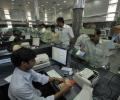
The IBPS clerk application form for 2025 will be released on July 31. The IBPS Clerk preliminary exam 2025 is scheduled to be held on October 4, 5 and 11.

At times, this stress reaches a tipping point, resulting in tragedy. 'Organisations need to empower their people managers to foster psychological safety, where employees feel seen, heard, and supported -- not just as professionals, but as people navigating the pressures of work and life.'

'Are there other ways to reduce the energy airconditioners consume?' asks Ambi Parameswaran.
It may sound bizarre, but incidents of public sector bankers dying by suicide could probably equal the number of such bankers quitting their jobs, reveals Tamal Bandyopadhyay.

Bad loans in the agriculture sector remain elevated, with several public-sector banks (PSBs) reporting higher slippages in the April-June quarter of FY26. For many banks, non-performing assets (NPAs) in farm lending were 5 per cent or more, with some nearing double digits.'

This article examines the call for the government to reduce its majority ownership in public sector banks ostensibly with the objective of improving the functioning of these banks.

Infrastructure bonds, which were relied upon the most in 2024-25 (FY25) by commercial banks to raise funds through the domestic debt capital market amid lagging deposit growth, seem to have lost their sheen in FY26. So far in FY26, no bank has tapped the domestic debt capital market to raise funds via infra bonds, and the expectation is that the amount raised through this route will be significantly lower than that last year, unless credit demand picks up.

'From tariff tensions and border skirmishes to unrest in West Asia.' 'The worst may be behind us. But any further upmove will now have to come from earnings.'

Public sector banks' cumulative profit crossed the Rs 1 lakh crore-mark in the financial year ended March 2023, with market leader State Bank of India (SBI) accounting for nearly half of the total earnings. From posting a total net loss of Rs 85,390 crore in 2017-18, the Public Sector Banks (PSBs) have come a long way as their profit touched Rs 1,04,649 crore in 2022-23, according to an analysis of their financial results. These 12 PSBs witnessed 57 per cent increase in total profit compared to Rs 66,539.98 crore earned in 2021-22.

Operations of public sector banks (PSBs) may be impacted as bank union AIBEA has given a strike call for Saturday to oppose incessant outsourcing of jobs. Although the officers are not part of the strike, there may be some impact on cash deposit and withdrawal, clearing of cheques etc. Several banks, including Bank of Baroda and Punjab & Sind Bank, have already informed their customers about the potential impact on services if November 19 strike materalises.

'The approach today is, instead of giving loans to 100 MSMEs, let us give one loan to a big-ticket corporate.' 'And so many of these big fish deceived the banks and the banks are in the doldrums now with high NPAs.'

A nationwide strike called by trade unions to protest against the central government's labor policies had a mixed impact across India. While normal life remained largely unaffected in most parts of the country, some sectors like banking, transport, and insurance experienced disruptions. Sporadic incidents of violence were reported in West Bengal.

In the past 10 years, over 500 PSB officers have died by suicide. When targets are overwhelming, senior management and customers are both impatient, and there is constant fear, not every banker has the resilience to survive and thrive, warns Tamal Bandyopadhyay.

Banks have been borrowing heavily from the Tri-Party Repo (TREPS) market and deploying those funds into the Standing Deposit Facility (SDF) of the Reserve Bank of India (RBI), which is offering higher interest rate than the former, leading to increased volumes in the SDF window. The weighted average TREPS rate was trading at 5.66 per cent on Monday, 9 basis points lower than the SDF rate which currently stands at 5.75 per cent.

'This will be our first large-size bank partner, and hence, the partnership will be a game-changer for us.'
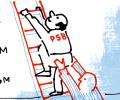
The bank made a Rs 67 crore net profit, up 21% from the previous year. Its deposits grew 8%, the loan book 10%. Net bad loans dropped from 7.53% to 6.07%. So why was the banker, who headed the bank, not promoted?
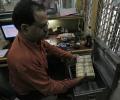
The government is open to providing more capital than that announced in the Budget.

'Vigilance' is a dreaded term for PSB employees and there are instances where this fear is misused by the higher authorities to tame their subordinate officials. This fear always deters PSB executives from making decisions -- the fewer the decisions, the less the chance of falling into trouble, points out Tamal Bandyopadhyay.
 © 2026 Rediff.com - Investor Information - Advertise with us - Disclaimer - Privacy Policy - Sitemap - Feedback - About us - Terms of use - Grievances