
With the dissolution of former chief statistician Pronab Sen-led Standing Committee on Statistics (SCoS) by the Ministry of Statistics and Programme Implementation (MoSPI), the National Statistical Commission (NSC) has regained prominence as the primary statistical body to address issues regarding results, methodology and questionnaire, among others. A MoSPI official in an email informed the 16-member SCoS about the decision to dissolve it, citing that its work was "overlapping" with that of the Steering Committee for National Sample Surveys (NSS), which was set up in June this year.

'My concern is that, although everything is expressed in monetary terms, you are effectively combining values that have been adjusted using different price measures.'

Real GDP growth surprised on the upside in 2025, but weaker nominal growth, trade uncertainty, and soft demand signal a bumpier road ahead.

The NSO previously tried to collect household income data in its ninth (1955), 15th (1959), 19th (1964), and 24th (1969) rounds (July 1969-June 1970), but these efforts were not completed, partly due to non-responsiveness by respondents.

Key Planning Commission official says push from small-scale industries will help reach the figure, but others disagree.

A recent World Bank report placing India among the most equal countries globally may present a limited view of inequality, with economists suggesting that broader data sets could tell a different story. According to the report, India's Gini index (or coefficient/ratio), a key measure of inequality, stood at 25.5 in 2022-23, placing the country fourth globally in terms of equality, behind only the Slovak Republic, Slovenia, and Belarus.

The next Census' findings will help identify the extent of India's ageing population and vulnerability levels.

'Everyone confuses GDP to be a measure of output, when it is actually a measure of income.'

Using the debt-to-GDP ratio as a fiscal anchor aligns with efforts to promote fiscal transparency through proper disclosure of off-budget borrowings.
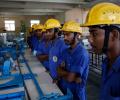
Unincorporated enterprises in the manufacturing sector lost nearly 1.8 million establishments and shed 5.4 million jobs between July 2015-June 2016 and October 2022-September 2023, an analysis of the fact sheet on 'Annual Survey of Unincorporated Sector Enterprises (ASUSE)' and the comparable 73rd round survey in 2015-16 by the National Statistical Office (NSO) showed. An estimated 17.82 million unincorporated enterprises operated in the manufacturing sector in October 2022-September 2023, nearly 9.3 per cent down from 19.7 million unincorporated enterprises in July 2015- June 2016.

After adding 11.7 million workers in the October 2022-September 2023 period from the pandemic lows in April 2021-March 2022, total workers employed in the vast informal sector in India - at 109.6 million - still remains below the pre-pandemic period.
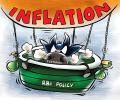
Amid a debate on the basis of a monetary policy stance, one may be curious enough to know how non-food retail inflation has behaved over the years in India. Let the eager souls catch a glimpse of facts. In the past 10 years, non-food inflation came down below 4 per cent on two occasions - pre-Covid period of 2019-20 and now in the first four months of the current financial year (FY25).

Despite high headline numbers, the output of one-third of the segments in the manufacturing sector in August stood below even that in the same month in 2011-12, when the new index of industrial production (IIP) series started. This is despite the fact that manufacturing grew 9.3 per cent in the month, driving up IIP growth to a 14-month high of 10.3 per cent. Part of it is due to the devastation of these product categories by lockdowns induced by Covid waves and subdued export conditions, while part of it needs to be assessed further.

Economist Abhijit Sen, a former Planning Commission member and one of the country's foremost experts on rural economy, died on Monday night. He was 72.

How is it that tomatoes recorded a price fall in official statistics when it remained unaffordable for the common person in June?

'Revision of the base year for both CPI and GDP are long overdue.' 'The basic data that went into the 2011-2012 series were mainly from surveys done in 2011 or earlier.' 'We have since seen the emergence of new sectors like platform-based work and online marketing.' 'The employment surveys and the consumption surveys need to reflect these adequately.'

'The linking of Aadhaar to births and deaths will revive the debate around citizenship.'

NITI Aayog has not said what the reasons were for having achieved or not having achieved what was sought to be achieved, or what lessons can be learned for the future, points out Aakar Patel.

A depreciating rupee, which briefly hit 80 to the dollar on Tuesday, may boost India's exports but price-inelastic imports of crude oil and gold would mean limited relief on the trade deficit, which clocked a record $26.2 billion in June. Due to global risk aversion on the back of geo-political tensions and aggressive policy tightening by the Fed, the dollar has appreciated against most currencies, including the rupee. And, with other currencies depreciating, India's comparative advantage in this respect may be limited.
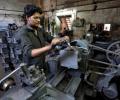
The fall in investment rate is not surprising. But putting it together with rising share of wages in GVA, it shows that the focus is more on productivity, rather than adding new capacity, says Pronab Sen, former chief statistician of India.

Poverty figures for 2011-2012 have shown a steep decline since 2004-2005.

'Government's focus should be on the expenditure side in this Budget, not so much on the taxation side.'
Pronab Sen, the government's former chief statistician, says contrary to perception, GDP growth won't be drastically hit in the present quarter.
Others may be gung-ho about food inflation falling into the negative territory, but not former chief statistician Pronab Sen.
India's industrial growth has been crawling below five per cent for months now and overall economic growth has moderated to a two-year low of 6.9 per cent in the second quarter of this financial year, say the statistics.
If you earn Rs 12-15 lakh a year, you could attract additional taxes. Should you worry?

While there is pressure on the Reserve Bank of India to cut policy rates to spur stagnating industrial growth rates, Pronab Sen, principal advisor to the Planning Commission, says the central bank should exercise caution till it is sure inflationary expectations are under control.

The rising core inflation might result in an inter-policy decision by RBI to raise policy rates. Core inflation is a measure of inflation which excludes certain items, particularly food and energy, which face volatile price movements.

Pronab Sen, principal advisor in the Planning Commission, says that it is difficult to pinpoint the exact GDP number for the current fiscal, as IIP data is questionable and contradicts with exports growth story.

RBI in its mid-year review of the monetary policy is expected to raise its key interest rate by 25 basis point to contain inflation which is hovering near the double-digit mark.

Wholesale price-based inflation, which dipped to sub-zero levels following the impact of the global crisis, has started firming up and rose to 7.3 per cent in December, 2009.
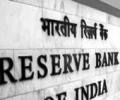
The Planning Commission said on Friday that the Reserve Bank of India has some headroom for rate hike of around 50 basis points.

In a surprise move late Friday, RBI raised its short-term lending and borrowing rates -- the repo rate (the rate at which it lends to banks) and the reverse repo rate (the rate at which banks park their surplus funds with it) -- by 0.25 per cent each to 5 per cent and 3.75 per cent, respectively, to cool off runaway inflation, which has already crossed the central bank's forecast for March at 8.5 per cent, signalling interest rake increase.
The services sector contributes the highest of around 54 per cent to the country's gross domestic product. At present, the WPI, which is released every week, contains prices of primary articles, fuel and manufactured products. Data from banking and transport services would be the first sectors to be covered on an experimental basis. The plan is to initially build a separate services index, which would be integrated into the WPI later.
In an interview with Business Standard's Devika Banerji, he says the monitoring of rural spending should be on top of the new government's priorities.

Industry growth has started picking up in recent months fueling suggestion from RBI and other analysts for partial roll back of stimulus measures taken to ward off the impact of global economic slowdown last year.

'Political parties bring out money they have stashed away and start spending it. How large that spending will be depends on how much money has been stashed. So, you are going to have a strong upside coming from the election effect,' says Pronab Sen.

Mobile phone manufacture in India started only in 2006.

An analysis of WHO data shows that most of the countries with an older cohort of population and higher in the development index had a lower excess mortality rate than India.
India's wholesale price index, the inflation measure most widely followed by policy-makers and investors, does not need another revision after the release of the final number eight weeks after the provisional numbers, as more than three-fourths data are collected by then, Pronab Sen, chief statistician, Ministry of Statistics has said.
 © 2026 Rediff.com - Advertise with us - Disclaimer - Privacy Policy - Sitemap - Feedback - About us - Terms of use - Grievances